

Ask around about prompting for designers and the advice sounds like locksmithing. Magic phrases, a role to assume, a temperature somebody swears by, a screenshot of a prompt that once produced something good. It is folklore, and it expires the week the model version changes. The tools underneath it date just as fast, which is why they are worth comparing by what they hand back rather than by what they generate. What does not expire is much older and much less exciting than the tools it is aimed at.
The prompt that works is not longer than the one that failed. It is shaped differently. It has the shape of a brief: what the business sells, the number this work is meant to move, who it is for, what cannot move, and how you will know it worked. Most of what gets filed under design prompt engineering is a rediscovery of that shape, badly, by people who never had to write one.
Which is the good news buried in this, and it is not the consoling kind. Designers who can already write a brief have half of this skill finished and mostly do not know it. The other half is the place where the analogy breaks, and it breaks somewhere specific enough to be worth naming before you lean on it.
Why more words stop helping
The instinct when the output disappoints is to add. More adjectives, more references, more description of the tone you were after. You end up with three paragraphs of texture and the same generic result, because none of what you added told the model what the work is for. A model has read more descriptions of good interfaces than you ever will. What it has never seen is your quarter.
Direction is the set of things that make one plausible answer better than another plausible answer here. There are always many correct-looking options, and the frame is what collapses them to one. Adjectives collapse nothing: they describe the surface of an answer you are hoping for, which is a way of asking for something you have not decided on yet.
That is also why a vague prompt costs more now than a vague brief used to. A vague brief cost a junior's week and came back as one wrong thing you could fix in conversation. A vague prompt costs ninety seconds and comes back as forty wrong things, all finished-looking, and conversation does not scale to forty. The split between what you delegate and what you keep only holds if the handover between the two halves is specific.
The five fields, and what each one is doing
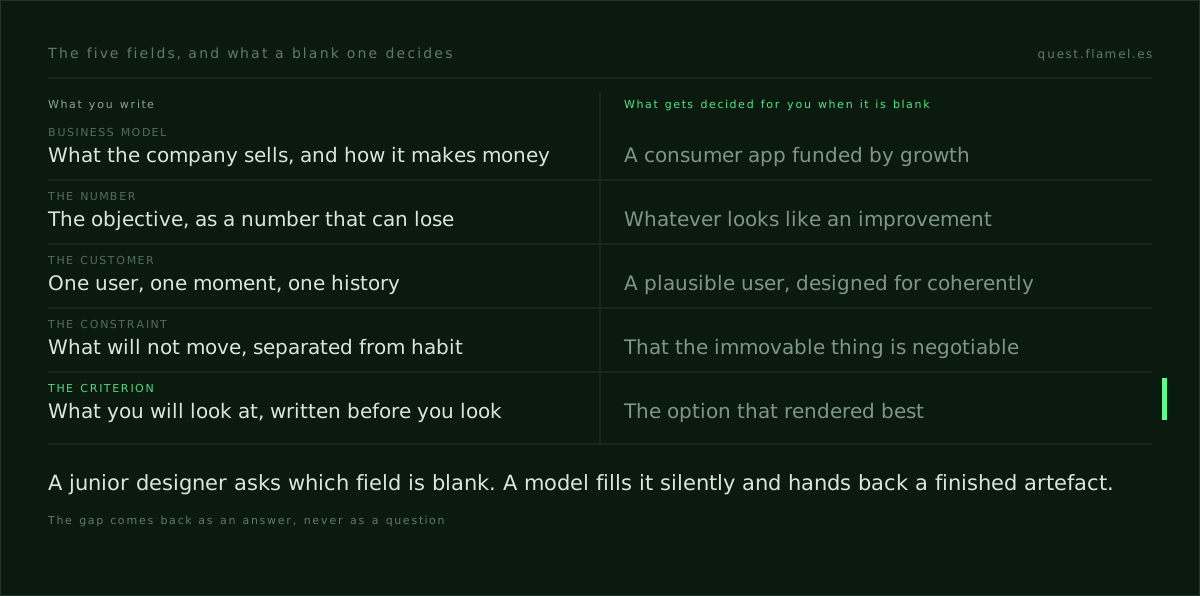
A brief is not a form. Each field is there because it closes a decision the executor would otherwise make on your behalf, and a model makes every one of those decisions silently and confidently. Read the five as questions somebody is going to answer whether or not you answer them first. The design brief template extends them to eight fields, with what breaks when each is missing.
The first is the business model, because the same screen is a different design in freemium and in enterprise. A checkout that removes a step is a win when you sell impulse purchases and a liability when the purchase needs a procurement trail. Leave it out and the model reaches for the most common shape in its training data, which is a consumer app funded by growth.
The second is the objective, stated as a number rather than as a mood. Not "improve onboarding" but "get more of the people who sign up to their first saved project in the same week." A number is the only instruction that can lose an argument. A prompt without one cannot be evaluated, which means whatever comes back gets judged on how finished it looks.
The third is the customer, at a specific moment rather than as a persona. A logistics coordinator opening this at seven in the morning, on a phone, in a van, having been burned by a system like this before: that changes the work. "Busy professionals" does not change anything, because it excludes nobody and therefore decides nothing.
The fourth is the constraint, and it has to separate the real from the decorative. The API cannot return more than fifty rows: real. Legal will not sign off on a one-click delete: real. We usually do cards: not a constraint, a habit. Models are obedient about stated constraints and oblivious to unstated ones, so the immovable thing you did not write down is precisely the thing that gets designed straight through.
The fifth is the criterion, which is not the same as the objective. The objective is what the business wants to move; the criterion is what you will look at to decide whether this artefact plausibly moves it. It has to exist in writing before the first output arrives, because it is the only defence you have against the best-rendered option winning the argument on polish alone.

What it costs when a field is missing
The costs are not symmetric, which is worth knowing when you are writing at speed. A missing business model produces work that is competent and aimed at somebody else's company. A missing number produces work you cannot argue about, so it gets settled by whoever holds the strongest opinion in the room. A missing constraint produces work that has to be thrown away rather than edited.
The missing customer is the sneakiest of the five, because the output looks specific. The model invents a plausible user and designs coherently for them, and coherence reads as insight. You do not notice the substitution until somebody who actually uses the product sees it and says the obvious thing you would have said yourself, if you had written the moment down.
A missing criterion produces the failure that does not look like a failure at all: six good options and no way to choose between them, which is where people quietly hand the decision to whichever one rendered best. Keeping the number of things in play small enough that you can actually judge them is a skill with a name and a shape, and the criterion is what it is protecting.
Where the junior analogy breaks
The comparison earns its keep everywhere except one place, and that place matters. A junior designer who gets a bad brief asks. They come back on Tuesday and say they do not understand who this is for, and that question is the most valuable thing in the whole exchange, because it tells you exactly which field you left blank.
A model never asks. It fills the gap, silently, with the statistical average of every similar thing it has read, and hands you the result with the same confidence it would have had if you had briefed it perfectly. There is no Tuesday. The hole in your brief comes back as a finished artefact instead of as a question, and finished artefacts do not announce what they assumed.
So the discipline moves to your side of the exchange. You have to find the missing field before you send, because nobody is coming to find it for you. The cheapest method is to read your own prompt and ask what a stranger would have to guess, since every guess you leave available is a decision you handed over without meaning to. That is all saying the thing you actually want in terms that cannot be misread amounts to.
The half of the skill you already have
None of the five fields is new. That is the whole point of this piece, and it is better news than most of what gets written about how to prompt ai design. If you have ever written a brief that a contractor could execute without calling you back, the muscle is already built. What changed is how many people now need it, and how fast its absence shows.
It also means the practice is cheap and already available. Not tutorials on ai prompts for ux design, which teach the folklore layer and expire with it, but the older exercise of taking a badly written request and turning it into something executable. Vague where clients are vague, immovable where they are immovable: briefs written the way clients actually write them are the raw material for it.
The test to run this week
It is not whether your prompts are long enough. Take the next piece of work you are about to hand to a model and check it against the five: the business model, the number, the customer at a moment, the constraint that will not move, and the criterion you wrote down before you looked at anything. If one of them is blank, the model will fill it, and it will not tell you which one.
Read a brief with all five filled in, then write your own version of the same request and compare which decisions each one actually closes. The distance between them is not a prompting technique you are missing. It is the amount of thinking you had been leaving to a machine that has never once asked you a question.