
Key takeaways
- In a subscription, onboarding is the first part of the product: the first choice decides whether the second delivery feels like a surprise or a repeat.
- The fix is rarely fewer questions. It is asks the person can answer without expertise and will see again.
- Investment has to follow reward, so build a small reward into every step and ask for the heavier investment after the reveal.
- End the flow with a decision left open for the next delivery, so the person comes back to something they built.
- Measure earlier signals than cancellations: defaults changed, sets saved, the remix choice opened, with flow completion as a guard.
An onboarding flow is usually designed as a toll: the questions a person has to answer before the product starts. In a subscription it is the first part of the product, and the first choice decides whether the second delivery feels like a surprise or a repeat. The fix is rarely fewer questions. It is asking for answers the person gets back, and leaving one of them open for next month.
That is the investment phase of the Hook Model, placed where most teams least expect it: before the first box ships. Here it is on a real brief, a coffee subscription that loses more than a third of its subscribers after the first box: the order of the asks, what to leave open and what to measure.
Why a shorter quiz does not fix it
Most onboarding advice is about length: cut a step, merge two screens, add a progress bar. Length matters, but it is not what makes people leave after the first delivery. A preference quiz collects data for the system. The person answers, the system decides, and a box arrives that they do not recognise as theirs. A shorter quiz gives them even less to recognise.
The investment skill names the trap. Investment must follow reward, not precede it, and a setup wizard placed ahead of the first reward is the most common way products lose people in the first session. Onboarding looks like the exception, because the product cannot ship anything until it knows something. It is not an exception. It is the case where you have to build the reward into the asks themselves.
Two findings explain why that works. Effort justification, from Aronson and Mills in 1959, says people value what they worked for. The IKEA effect, documented by Norton, Mochon and Ariely, says they value what they partly made. Both only apply when the effort visibly produced something. An answer that disappears into a database produced nothing the person can see.
The brief: a coffee subscription that loses a third after box one
Origin Drift is one of the practice briefs on Quest: a specialty coffee subscription based in Oslo, three years old, working with 12 micro-roasters across Europe and around 3,500 active subscribers. Its onboarding reads like a typical preference quiz. 35% of new subscribers cancel after the first box, and they say they don't know what they ordered. The brief asks for that number to fall under 20%.
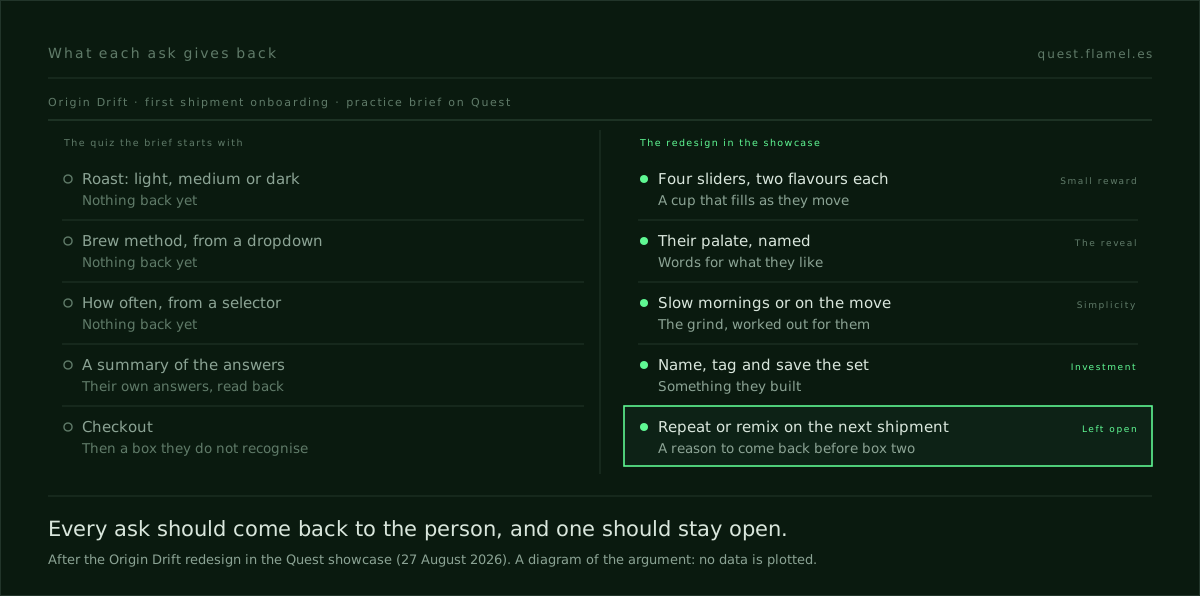
The starting draft is the one any generator produces: roast preference (light, medium or dark), a brew method dropdown, a frequency selector, a summary and checkout. It collects everything needed to ship a box and nothing the subscriber can recognise when the box arrives. The person the brief describes owns an AeroPress or a V60 and knows washed from natural, but cannot describe it. Asking them to pick a roast asks them to already know what the product promises to teach.
Ask for what makes the reward theirs
The decision is not fewer questions. It is different ones: each ask should be answerable without expertise, and should visibly change what arrives. In the Origin Drift redesign in the Quest showcase, made in 65 minutes, five abstract taste options such as "Deep and rich" became four screens with one slider each, between two ingredients anyone recognises: caramel and vanilla, chocolate and mint. A cup fills as each slider moves.
That cup is the small reward inside every step. The person is not answering questions, they are building something, and each step makes leaving cost a little more. The large reward comes next: a screen that names their palate, warm and sweet with a touch of brightness, in words they could not have produced on screen one.
Only after that reveal does the redesign ask for the heavier investment, and that order is the whole point of the investment skill. Contribution feels like building once the person has seen what they are building toward. Before that, it reads as an entry fee. If you want to try ordering asks this way before reading on, the sample brief gives you a different product and the same sixty minutes.

Leave something open for the second box
The first box answers a question. The second has to surprise, or it bores, and the brief knows it: the lineup rotates across roasters so no shipment repeats, and the taste profile is refined after every box instead of frozen at signup. An onboarding that ends with a finished profile contradicts the product. It tells the subscriber the learning is over on the day it starts.
The redesign ends with the choice made retrievable. The subscriber names the set, tags it, saves it, and reads one line: repeat or remix this set on your next shipment. That line is the open question. It gives the person a reason to come back before box two, to decide what changes, and the decision is about something they built.
This is how investment loads the next trigger, the step most Hooked loops skip. The stored value is not a profile for the system to use. It is a draft the person owns and is invited to revise, which is why the second box can feel like progress instead of a repeat.
Order the asks by what the person knows
The same redesign moves logistics out of the way. Grind is a technical term many subscribers do not command, so the brewing step became two scenes from a life, slow mornings or on the move, with a "surprise me" default for anyone who sees themselves in neither, and the system infers the grind. Taste comes before logistics and payment comes last: the rule of ordering a multi-step form by commitment, not by fields, applied to a flow whose first job is to make a choice feel like theirs.
A quick test for each screen: can the person answer it with what they already know, and will they see the answer again in this session or in the next box? An ask that fails both belongs later, or nowhere. An ask that fails only the first needs translating into something they can recognise, the way ingredients replaced roast levels.
What to measure, and what would prove you wrong
The verdict in the brief is cancellations after the first box, from 35% to under 20%. It arrives a month after the redesign ships, so pick earlier signals that should move first, each a ratio with its population:
- The share of new subscribers who move at least one slider away from where it started.
- The share who name or save their set at the end of the flow.
- The share who open the remix choice before the second box ships.
- Completion from the first screen to checkout, as a guard: a longer flow that loses people before payment has to show it.
The investment skill adds the check that ties them together: count the investment actions per person in the first session, compare them with retention at 30 days, then design the first session to reach the level where retention changes. Keep the ethical line from the same page in view too. Stored value should make the product better, never hold the person hostage, which is why cancel-anytime and the pause default stay as visible as the remix line.
If the early signals move and cancellations do not, investment is not what is missing. The map of persuasion principles gives the next place to look: people who try once and vanish point to the trigger that should bring them back, and people who never start point to Fogg's motivation, ability and prompt.
Practise it on one flow this week
Take one onboarding flow you own, or one you use every day, and list every question in it. Next to each, write what the person gets back and when: on this screen, at the end of the flow, in the next delivery, or never. Cut or postpone the "never" questions. Rewrite one abstract ask as a choice between two things anyone recognises, and add one line at the end that leaves a decision open for the next visit.
Then defend it in one sentence: the flow asks for what the person will see again, in the order they can answer it, and leaves the next choice open. To practise on a brief you have not seen before, the sample brief shows the format: a real client problem, a starting design to beat and sixty minutes on the clock.
You are a senior growth designer reviewing my onboarding before it ships. The product: [describe the product and what the first delivery or first session gives the person]. The current flow: [list every screen and the question it asks]. The person: [who signs up and what they already know]. For each question, tell me: 1) what the person gets back and when (on this screen, at the end of the flow, in the next delivery, or never); 2) whether they can answer it without expertise, and if not, a rewrite as a choice between two things they already recognise; 3) whether it should stay, move later or go. Then propose the order of the asks, mark where the first visible reward lands, and place any heavier investment (naming, saving, customising) after it. Finish with one line that leaves a decision open for the next visit, and three early signals to measure, each a ratio with its population, plus one guard metric. Reject any ask whose answer the person never sees again.
Frequently asked questions
How many questions should an onboarding flow have?
There is no right number. Count instead how many answers the person gets back: an answer that changes the next screen, the end of the flow or the first delivery earns its place. An answer that only feeds your database belongs later, after the first reward, or nowhere. A longer flow where every step pays back can keep more people than a short quiz that returns nothing.
How do I ask for preferences from users who do not know what they like yet?
Translate the expert question into a choice they can make with what they already know. A coffee subscriber who cannot name a roast can still choose between caramel and vanilla, and a brewing method becomes a scene from their morning. Let the system infer the technical answer, then show the person what their choices add up to, in words they could not have produced at the start.
Should onboarding ask for investment before users see any value?
As little as possible. Investment works when it follows reward, because effort feels like building only once the person sees what they are building toward. Give each early ask an immediate small payback, such as a preview that changes as they answer, and save the heavier asks, naming, saving or customising, for after the first real reveal. The investment skill also covers when not to use it at all.
How do I know if an onboarding redesign improved retention?
Set the final verdict first, such as cancellations after the first delivery, then pick earlier signals that should move before it: the share of new users who change at least one default, the share who save what they built, and the share who return to the open choice before the next delivery. Track flow completion as a guard, so a longer flow that loses people before payment shows up straight away.
What should the last screen of an onboarding flow do?
Make the result retrievable and leave one decision open. Let the person name or save what they built, show them where to find it again, and give them a reason to come back before the next delivery or session, such as choosing whether to repeat or change it. A last screen that only says the setup is complete tells them the interesting part is over.