
Key takeaways
- Agentic UX here means designing for a visitor who is an agent sent by the buyer, not designing the interface of an agent.
- The agent reads the page as a source and summarises it; the person reviews the summary, not your layout.
- Anything that exists only as an image, a badge or an implication falls out of the summary, so write down the claims that make you different.
- The agent can close some decisions; others only the person can make, so the page should say which is which and supply the material.
- Write the hand-back as an explicit prompt: a specific verb and a specific object, placed where the person reviews what the agent found.
Agentic UX is design for a user who sends an agent instead of coming. The term also names the opposite job, designing the interface of an agent; this post is about the agent as your visitor. When it arrives, the page stops being where persuasion happens and becomes a source: the agent reads it, and the person reviews what it brings back.
That changes two things for a designer, and neither is a new set of screens. The first is what has to be written down, because an agent repeats what a page states and drops what it only implies. The second is which decision the page hands back to the person, because some choices an agent can close and some it cannot. A perfume is the cleanest test of both: an agent cannot smell it.
A visitor that reads instead of looking
A person on a product page arrives with a mood and a few seconds of attention, and the page is built to move them: what they see first, the order in which doubts get answered, the image that does the work a sentence cannot. An agent arrives with a task its person wrote, something like "find a niche perfume under my budget that nobody I know wears", and goes through the page looking for what it can repeat.
It compresses the page into a few lines and a recommendation, and the person reads that, not your hierarchy. Your page is still a pitch to whoever is in front of it, but it is now also a source quoted to someone who is not, by a reader with no reason to keep what it cannot state.
The page becomes a source
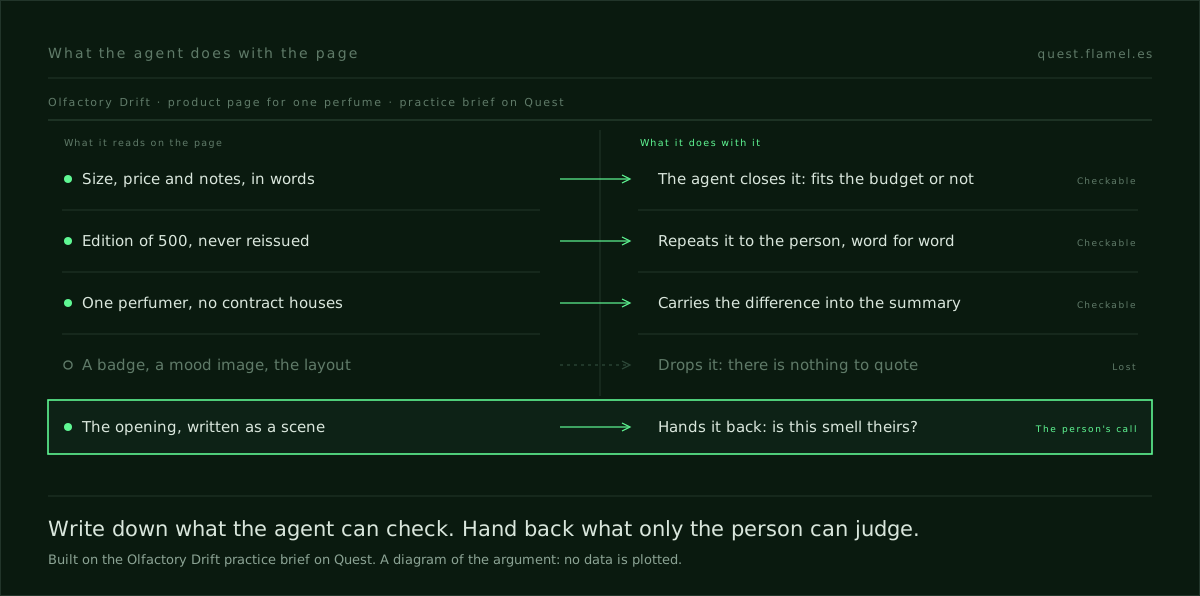
A source is judged by what it says plainly and consistently. Size, price, what is in it, when it ships, what happens if it is wrong for you: an agent looks for those as facts, and a page that only implies them through layout gives it nothing to quote. If a difference exists only as a badge, a mood image or a position on the screen, it is the first thing the summary loses.
This is the split that runs under the product designer's AI workflow: what can be judged from the artefact alone, and what needs the reason the work was asked for. An agent reading your page sits on the artefact side by construction. It has what is written and nothing else, so anything you want it to carry has to be written.
Worked example: a perfume an agent cannot smell
Olfactory Drift, one of the practice briefs on Quest, is a solo perfumer's house in Grasse that releases two perfumes a year in numbered batches of 500 bottles that sell out and are never reissued. Its product page has a problem that is already the agentic one in miniature: most buyers cannot smell the product, and the page leans on a photo and a notes list they could find on any retailer.
The starting design in the brief is the standard one: a gallery on the left; name, price, notes list, size selector and add to cart on the right; a description below and reviews at the bottom. Read by an agent, that page reduces to a 50ml perfume, a price and a few notes. What makes the house different, one perfumer, a batch that closes, long-form notes shipped with every bottle, is buried or missing, so it never reaches the summary.
The buyer in the brief makes it sharper: a collector who already owns five or more niche perfumes, reads Fragrantica and will not blind-buy without a strong sensory narrative. They browse on mobile in bed, save tabs and come back on desktop to buy. If they ever hand those saved tabs to an agent to compare, the narrative they need is exactly what a careless page lets the agent drop.
What agentic UX asks you to write down
A redesign of this brief in the Quest showcase makes the first move. In the 71-minute case, the hero carries "50 ML · EDITION OF 500" next to the product and the purchase, and a section titled "One composition. One edition." says that once the edition sells out, the composition is closed. Those are written claims an agent can repeat word for word. The rest fits in a short list:
- The facts, once and consistently: size, price, notes, batch size and whether the batch is still open.
- The difference as a claim, not a mood: one perfumer, no contract houses, a batch that never returns.
- The smell as text. The brief asks for notes translated into scenes; for a person that is persuasion, for an agent it is the only description of the scent it will ever have.
- The conditions a buyer checks before paying. The brief states no returns policy, and that is a design question in itself: the agent will ask, and the page has no answer.
The brand's tone helps. The brief forbids "luxury", "indulgence" and "experience", which are also the words a summary drops first, because nothing in them can be checked. A scene is specific enough to quote.
The decision the agent hands back
Some decisions the agent can close on its own: whether the bottle is in stock, whether it ships to the right country, whether it fits the budget. One it cannot: whether this smell belongs to this person. A perfume makes the line obvious, but every product has one. The page should know which decision is the buyer's and give them the material for it, written so that the agent passes it on intact.
It is the same discipline as what to never let AI decide, which lists the five calls a designer keeps when a model does the work: the metric, the ethical line, the exclusions, the voice and the promise. Here there is one more, on the buyer's side of the counter: the call the agent has to return.
Designing for it works like any AI contract, with a preview and a visible point where the person takes control. The difference is ownership: the agent is theirs, so you cannot design its screen. You can only design the material it previews from, and make the hand-back impossible to miss.
That hand-back is a prompt, and Fogg's model, one of the mechanisms in the Quest skills library, is precise about prompts. The person reviewing is motivated, since they asked for this, but unable on the one dimension that matters: they cannot smell it either. That calls for a facilitator, a prompt that makes the action easier, not a spark that adds motivation.
On Olfactory Drift, the facilitator is already in the box: the long-form perfumer's notes shipped with every bottle. Putting an excerpt on the page, the scene the perfume opens with, is a design choice the brief leaves open, and it gives the agent something to quote and the person something to judge before the batch closes.
The ethical line moves with the reader. A false "only a few left" used to mislead one visitor; now it becomes a sentence the agent repeats to its person as fact. An edition of 500 that genuinely closes is a fact about supply. Write only claims you would be happy to have quoted back to you.
What does not change
None of this ends the product page: the collector in the brief will still read it in bed at night. What changes is that the page now has two readers, and the one that cannot smell is the one that writes the summary. Designing for that reader helps the other one too: every claim you write down for an agent is a claim a hurried person can find.
Practise it on one page this week
Take one product page, yours or the starting design of a practice brief, and write the three lines an agent would bring back using only what is written on it. Then write the three lines you would want the person to hear. Every gap between the two is either a claim to write down or a decision to hand back.
Then write the hand-back itself as one sentence with a verb and an object the person can act on when they review. That sentence is a prompt in the strict sense, and the skill that trains it is the explicit prompt: the action stated inside the prompt, placed where motivation and ability meet.
You are a senior product designer reviewing a product page for a visitor who is an AI agent sent by a buyer, not the buyer in person. The page: [paste the page text, or describe its sections in order]. The product and what makes it different: [describe it]. The buyer the agent works for: [who they are and what they asked the agent to find]. Do not suggest visual changes. 1) Write the three-line summary the agent would bring back, using only what the page states in words. 2) List each difference I described that is missing from that summary, and the sentence the page would need to carry it. 3) Name the one decision the agent cannot make for the buyer, and write the hand-back as a single prompt with a specific verb and a specific object. 4) Flag any claim that would mislead the buyer if the agent repeated it as fact.
Frequently asked questions
What is agentic UX?
The term covers two jobs. One is designing the interface of an AI agent: how it shows what it is doing and how a person stops it. The other, the one this post covers, is designing for a user who sends an agent to your page instead of coming. There the page becomes a source the agent reads and summarises, and the person reviews the summary.
Is agentic UX the same as UX for AI agents?
Mostly, yes: both phrases cover designing for agents, either as the product you build or as the visitor you receive. The second case changes the page more, because you cannot design the agent's screen. You can only design what it reads: the facts, the claims that make you different, and the decision it has to return to its person.
How do I design a product page an agent can read?
Write everything that matters as a sentence: size, price, what is in it, availability, conditions and the claim that makes you different. Anything carried only by an image, a badge or the layout falls out of the agent's summary. Then name the decision only the buyer can make and give them the material for it, written so the agent can quote it intact.
Which decisions should an agent hand back to the person?
The ones that depend on the person rather than on facts: whether a perfume's smell is theirs, whether a style fits them, whether a promise is worth the price to them. The agent can close the checkable ones, like stock, shipping or budget. The hand-back works best as an explicit prompt: a specific verb and a specific object.
Does designing for agents mean the product page is dead?
No. People still arrive in person and still read the page. What changes is that some visitors read it through an agent, and that reader keeps only what is written. Designing for it also helps people in a hurry, because every claim you write down for an agent is one a person can find too.