

Every product team that has ever looked at Duolingo has proposed a streak. Most of those streaks did nothing, because they copied the number and not the Duolingo streak psychology underneath it. This teardown is about the mechanism, not the component.
It is the clearest small example of what design work is now. Ask any model for a streak component and you will get a good one in seconds — the counter, the flame, the calendar, the celebration state. What you will not get is the answer to whether a streak is the right instrument for your product at all. That question is the job.
A streak is not a reward. Nothing is given to you when the counter goes up. It goes up, and that is all that happens — no points you can spend, no content you unlock, no status anyone else can see unless you go and show them.
What it actually is: an asset you built, that the product holds, and that only you can destroy.
The mechanism is investment, not reward
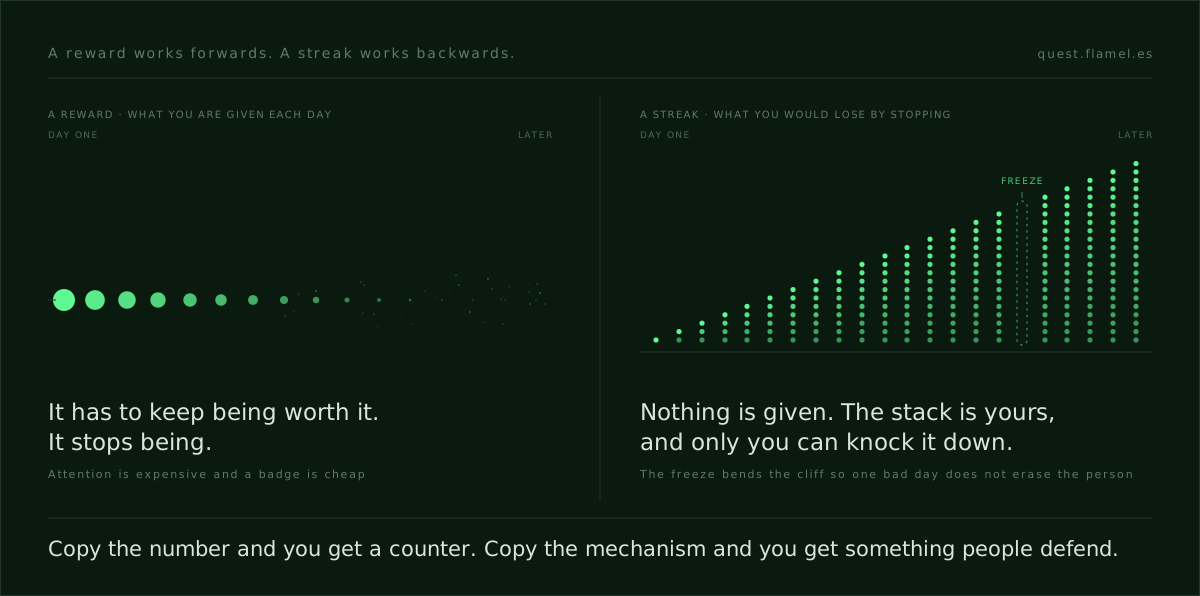
Rewards work forwards. You do a thing, you get something, and the something has to keep being worth it — which is why loyalty points and badges decay so fast. Attention is expensive and a badge is cheap.
Investment works backwards. Every day you show up, the thing you would lose by stopping gets slightly larger. On day three, quitting costs you almost nothing. On day two hundred, quitting destroys two hundred days of work — work that has no other use, cannot be sold, and cannot be partially recovered.
The elegance is that Duolingo never had to give you anything to make that true. You built the asset. The product simply agreed to remember it and put it where you would see it.
This is also why the number has to be visible and permanent rather than something you check. A counter you have to go and look up is a statistic. A counter that greets you is a balance.
The second mechanism is identity
Underneath the arithmetic, something quieter does at least as much work.
After a few weeks, the streak stops being a record of what you did and starts being a claim about who you are. You are not someone who has done 60 days of Spanish. You are someone who does Spanish every day. That is a different kind of statement, and people defend it far harder than they defend a number.
This is commitment and consistency, and it is the part teams almost never reproduce. It requires that the behaviour be small, daily, and identical every time. A streak on a product people use twice a week cannot become an identity, because there is no repetition for the identity to attach to. It just becomes a counter that makes people feel bad on Wednesdays.
If your product does not have a natural daily unit, you do not have a streak problem. You have a product problem wearing a streak.

The streak freeze is the honest part
The most interesting element gives value away.
A streak freeze lets you miss a day without losing everything. Economically, it weakens the mechanism — the whole force of the thing comes from the cliff. So why include it?
Because without it the design collapses on first failure. The day you break a 200-day streak, the asset goes to zero, and along with it the identity. What follows is not a bad day. It is people who quit the product entirely, because the version of themselves the streak described no longer exists and starting again from one is unbearable.
The freeze buys back the identity at a small cost. It is what a mechanism looks like when the designer has accepted that the user is allowed to have a life.
Where the line is
The same machinery is one small step from being unfair, and the step is well marked.
It is fair while the asset is real, the cost of losing it is one you understood when you started building it, and the release valve is affordable. It stops being fair when the product charges you to repair a streak it made you afraid of losing — at that point the fear is the product, and the company benefits from your distress rather than from your practice. Notification copy that performs disappointment sits in the same place. The same test works on any nudge: the line between dark patterns and persuasive design is whether the claim is true and the user could check it.
The test for whatever you are building
The general test is the same one, and it applies to whatever you are building: does the user end up with something they actually wanted, or only with a state they now have to defend?
Every mechanism in the skills library carries that line explicitly, because it is the part that is easiest to cross without noticing. The rest of the map — which mechanism to reach for, and when — is in the persuasion principles guide. For the same test run on a different moment, the Airbnb social proof teardown takes apart one module doing three jobs at once.