

There is a behavior your product wants and is not getting. People sign up and never invite a teammate, or they come back on Monday and not again until the following Monday. The meeting about it goes the way those meetings always go: somebody proposes copy, somebody proposes a redesign, somebody proposes a notification, and the loudest one wins. The fogg behavior model is worth an hour of your life because it ends that meeting before it starts.
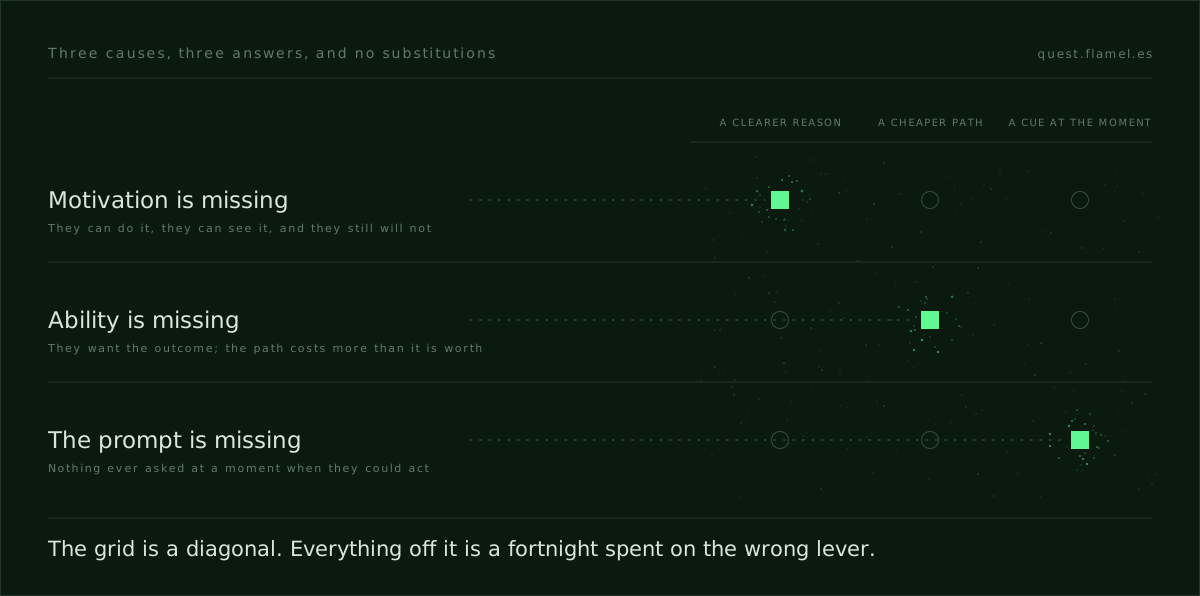
The claim fits in a sentence. A behavior happens when motivation, ability and a prompt land in the same moment, and fails when any one of the three is missing. Three causes, three answers, and the answers do not substitute for each other. Copy does not rescue a form that takes four minutes, removing a step does not create a reason to act, and a well-timed notification cannot prompt something nobody can do.
Which is why it survives the current round of tools. A model will write the notification, the shorter form and the new pricing page faster than you can brief them, and hand all three over with equal confidence. What it will not do is tell you which one was worth building. That decision stays on your side of the table, and B=MAP is the cheapest way to make it where the rest of the team can check it.
What the model actually claims
Motivation is the felt reason to act right now, not in principle. Ability is how easy the action is for this person in this moment: time, money, effort, and how much they have to learn before they can start. The prompt is the cue that says do it now.
BJ Fogg's design puts the first two on a curve. High motivation buys you a hard action, high ability lets a weak reason carry a trivial one, and a prompt that arrives when either is too low does nothing at all. The curve is the useful part, because it says the three trade against each other rather than adding up.
The last of the three is the one teams skip, and skipping it is expensive. A prompt that fires below the curve is not neutral. It burns the channel, teaches people to dismiss you on sight, and takes the next three prompts down with it. Most of what gets filed under notification fatigue is not volume, it is a run of prompts issued at moments when the behavior was never going to happen.
Then there is the part that makes it a diagnostic rather than a tactic. You do not optimize B=MAP. You use it once, at the start, to decide which of the three you are spending the sprint on, and then you go and do the ordinary work of that lever. Its whole value is in what it stops you from building.
When motivation is the thing that is missing
Suspect motivation when the action is genuinely easy, clearly visible, and still ignored. The tell is people arriving, understanding, and leaving anyway, or using a free tier hard for months without once opening the upgrade page. Nothing is broken. They can see what you are offering and they have decided it is not worth the trade, which is information rather than a bug.
Motivation work changes what the action means rather than how it is performed. It is a clearer promise, a risk taken off the table, or proof from somebody the person actually resembles. It is also the slowest lever and the easiest to fake with a discount, which buys the behavior once and teaches people to wait for the next one. If you are spending the sprint here, spend it on the principles that move willingness rather than the tactics that borrow it.

When ability is the thing that is missing
Ability is where most teams should be looking and where the fewest of them look, because it is unglamorous. The signals are specific: drop-off concentrated at one step rather than spread across the flow, completion rates that fall off a cliff on mobile, support tickets that all describe the same three minutes of the product. People want the outcome. The path costs more than the outcome is worth to them today.
The reason to prefer this lever is that it compounds and it is honest: nobody has to be convinced of anything. You take the cost out, and the behavior appears for everyone whose motivation was already sufficient. It also fails visibly, which matters more than it sounds. Halve the effort, watch nothing move, and you have learned that ability was never the constraint. Or that you took out the wrong cost, because ability is not one thing: the four kinds of friction each come out with a different intervention.
When the prompt is the thing that is missing
This is the failure that looks like nothing at all, which is why it survives so long. Motivation is there, the action takes eleven seconds, and the behavior still does not happen, because nothing ever asked at a moment when the person could act. The behavior is not being refused. It is not being remembered.
Prompts come in two kinds, and the difference decides the design. An external trigger is something you place in the world: the email, the badge, the empty state, the object left where the person will walk past it. An internal trigger is a state the person is already in, boredom or anxiety or a half-formed intention, that the product learns to be the answer to. External triggers start the behavior and are rented; internal ones are what a habit is made of.
How to tell which one you are missing
Ask what would have to be true for the behavior to happen, then go looking for which of the three is not. If you paid this person a thousand euros to complete the action, would they? A yes means motivation is your problem, because the ability was there all along and the money supplied the missing reason. A no points at ability, and at a specific step you can go and time with a stopwatch.
Then check the prompt separately, because it hides behind the other two. Look at the moments when the behavior did happen and ask what preceded them. If you cannot name the cue, you do not have one, and every improvement you ship will be waiting for a moment that never arrives. Write down which of the three you picked, so the retro has something to argue with.
What the model will not do for you
It will not tell you whether the behavior is worth causing. B=MAP works just as well on the behaviors that serve the person and the ones that only serve the quarter, and it is silent on which is which. That silence is where most of the criticism aimed at behaviour design actually belongs, and it is yours to answer.
It will also not survive being used as a checklist. Applying the fogg model ux teams often reduce it to three boxes ticked in a template, which produces a document rather than a decision. The output is meant to be one sentence naming one missing piece. If your version of the exercise produces three workstreams, you have used it to authorize everything you already wanted to do.
The triggers, one by one
Motivation and ability are the levers people reach for, and they are the two a model can now help you execute quickly. The prompt is the one that stays manual, because it depends on knowing when a specific person is in a specific state, and nobody has written that down for you. It is also, in most products, the piece that is actually missing.
So start there. Take the behavior you most want, find every cue that currently exists for it, and note when each one fires against the moment the person could act. Then work the two kinds separately: the cues you place in the world, and the states you make the product an answer to. Both are trainable, both sit on the skills you can drill one at a time, and neither is a thing a generator hands you finished. Choosing which lever the moment calls for in the first place is the part of design AI cannot copy.