Key takeaways
- Behavioral design starts by naming the one trigger that moves this person now, not by picking biases from a list.
- In an abandoned cart the trigger is already internal: a doubt, or a flicker of regret, about a choice half made.
- Write each candidate doubt as a sentence in the buyer's voice, pick one, and leave the others for another case.
- Match the prompt to the state: a facilitator when the doubt blocks a decision, a signal when they were only interrupted.
- Measure conversion per reminder sent against unsubscribes, and keep one bad event flat in the same window.
Behavioral design is often taught as a list of biases to sprinkle on a screen, which is why so much of it lands nowhere. The working version is narrower: identify the trigger that moves this person at this moment, then design for that trigger and nothing else. An abandoned cart teaches it better than any other screen, because the trigger is already inside the buyer.
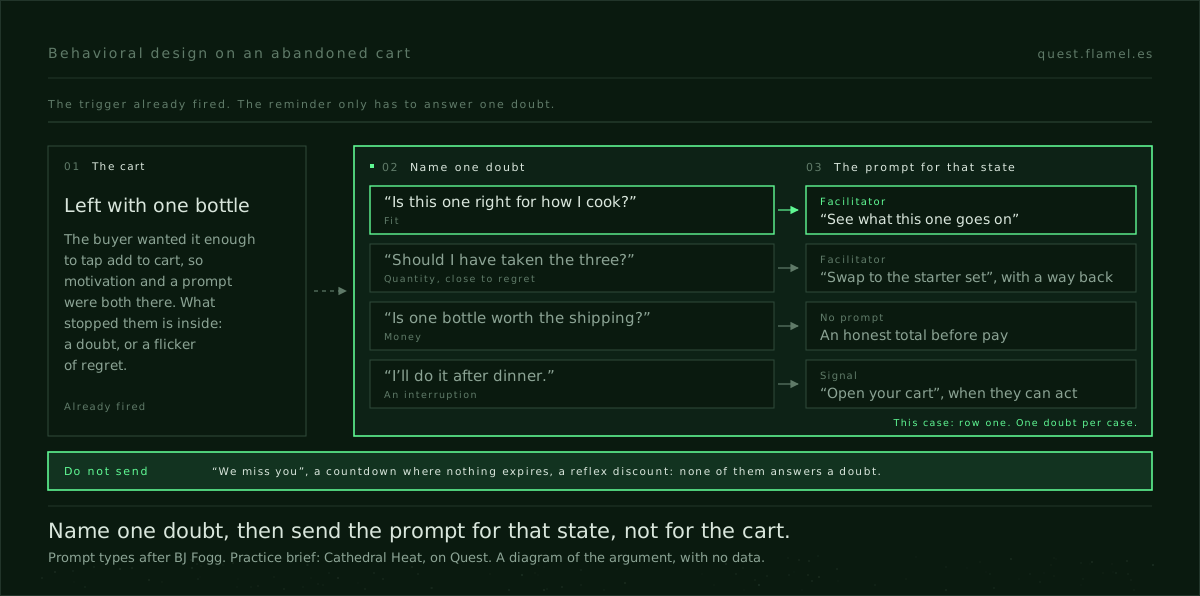
Someone wanted the product enough to put it in the cart, then stopped. What stopped them is a doubt or a flicker of regret, not a missing banner. Your job is to decide which doubt the reminder answers, and with which explicit prompt.
A full cart is a trigger that already fired
The Fogg Behavior Model says a behavior happens when motivation, ability and a prompt land in the same moment, and fails when one of the three is missing. A filled cart is evidence about two of them. Something prompted the visit, and the person wanted the product enough to tap add to cart, so motivation and a prompt were both present a few minutes ago.
What changed between add to cart and pay usually happened inside the person. Nir Eyal calls that kind of cue an internal trigger, and the emotions behind it are unglamorous and frequent: indecision, uncertainty, mild anxiety. In the map of persuasion principles, products start with external triggers and win when use attaches to an internal one. In a cart that order is already reversed.
That is why the usual reminder does so little. "We miss you" and "Don't forget about us" are the failure mode the explicit prompt skill describes almost word for word: no next action, nothing answered, noise dressed as urgency. Both assume the prompt went missing. The prompt was never the problem; the doubt was.
Name the doubt first
Take Cathedral Heat, one of the practice briefs on Quest: an artisanal hot sauce brand from Austin with four SKUs, a loud Instagram voice and a bundle page that has to sell a three-bottle starter set. Its buyer is a flavor-curious home cook who treats condiments as a personality test and arrives on mobile from Instagram. The brief stops at the bundle page. One screen past it is the cart that was left with one bottle in it.
The internal trigger skill borrows Eyal's method for finding the cue: ask why about the stated need until the answer is an emotion rather than a task. "They left the cart" is a task. Ask why and you reach "they were not sure about the choice"; ask again and you reach "they did not want the wrong bottle in a fridge that is supposed to say something about them". That is a feeling, and you can design for it.
You do not have to invent the candidates. Every Quest brief lists the buyer's goals and pains, as the sample brief shows, and the doubts are usually written there already. Cathedral Heat's buyer "doesn't want to overthink picking a bundle" and is tired of brands that look indie but sell generically. Turn each pain into a sentence in the buyer's own voice:
- "Is this one right for how I cook?" A doubt about fit.
- "Should I have taken the three instead?" Indecision about quantity, close to regret.
- "Is one bottle worth paying shipping for?" A doubt about money.
- "I'll do it after dinner." No doubt at all, just an interruption.
Pick one per case. Four answers in one reminder make a brochure, and a buyer unsure about one thing now has four things to read. Choose with what you can see: what is in the cart, where the visit came from, what the bundle page said before they left.
Match the prompt to the state
The explicit prompt skill is precise about this, following Fogg. A spark carries a reason, for people who can act but do not care yet. A facilitator makes the action easier, for people who want it and are blocked. A signal only marks the time, for people already willing and able. Most failed prompts are the right words sent to the wrong state.
Read the four doubts against that. Fit and quantity block a decision, so they want a facilitator: the reminder carries the answer and one action that settles it. The interruption wants a signal, a plain line that lands when they can act and opens straight on the cart. A spark is the one you should rarely need, because the cart already proves motivation existed.
The rule for the words is a specific verb plus a specific object. For the fit doubt, that could be "See what this one goes on", opening a recipe card from a real cook, the kind the brand already ships with every bundle. For the quantity doubt, it could be "Swap to the starter set", one tap to the three bottles, with a clear way back to the single one they chose.
The money doubt is not a prompt problem. If the total with shipping stopped them, the fix is an honest total before the pay button; no copy covers a bill. Fogg files that under ability: take the cost out or state it plainly, and the reminder becomes a signal again.
What not to send
Two habits do most of the damage. The first is fabricated urgency: a countdown on a cart where nothing expires, or a stock warning nobody can check. The internal trigger skill draws the line between meeting an emotion the buyer already has and inventing one, and invented anxiety in the copy of an ordinary purchase reads as manipulation, usually spotted at once.
The second is the reflex discount. As the Fogg post puts it, a discount buys the behavior once and teaches people to wait for the next one, and in a reminder it answers a doubt about money the buyer may never have had. For Cathedral Heat it costs more than margin: the brief says the brand voice is the product, and a coupon line is the one sentence that brand would never write.
Practise it one screen past the brief
You can rehearse the whole decision without a store or an email tool. The brief gives you the brand, the buyer and the voice; the screen past it is yours. Work it in this order, writing each answer down before you draw:
- Write three or four candidate doubts as sentences in the buyer's voice, using the pains in the brief.
- Pick one and write why: the cart, the source, the last screen they saw.
- Name the buyer's state and the prompt type that fits it: spark, facilitator or signal.
- Write the prompt as a verb and an object, in the brand's voice, in one line.
- Write the action you expect it to cause and the bad event you will keep flat. If you cannot, you chose the words before the doubt.
Measure the doubt, not the recovery
Do not set a recovery rate as the goal; you have no baseline for it, and the number flatters the loudest variant. The explicit prompt skill measures conversion per prompt sent rather than total conversions, against the opt-out rate of the same campaign. A reminder that converts while unsubscribes climb is borrowing from a channel you will need again.
Then check that the doubt you chose was the real one. The internal trigger skill suggests asking returning users about the moment before they acted: if they describe a feeling rather than a task, you found the trigger. Psychology in UX design adds the discipline that keeps it honest: commit to a bad event that has to stay flat, measured in the same window as the lift.
The part a model will not choose
A model will write ten versions of the reminder in seconds, and every one will sound plausible. It will not tell you which doubt the buyer had, which state they were in, or which of the four sentences deserved the email. That choice is the craft, on a cart, an onboarding screen or a renewal.
So behavioral design here is not a bag of principles. It is one internal trigger, named in the buyer's words, matched to one explicit prompt, with the rest left alone. Train the first half on the internal trigger page, where the mechanism, the failure mode and the ethical line sit together, then practise the whole decision on the sample brief.
You are reviewing a cart reminder with me. First ask me for: the product and what was left in the cart, where the visit came from, the last screen the buyer saw, the buyer's goals and pains from the brief, and the channel (email, push or the cart page itself). Then: 1) Write three or four doubts the buyer might have, each as one sentence in their own voice. 2) Ask me which one I choose and why, and push back if my evidence is thin. 3) Name the buyer's state and the prompt type that fits it: spark, facilitator or signal. If the doubt is about money, tell me the fix is the total, not the copy. 4) Draft three versions of the prompt, each a specific verb plus a specific object, in the brand's voice. 5) For each version, name the action it should cause and the bad event I should keep flat. Do not invent urgency, stock levels or discounts, and never answer more than one doubt in one reminder.
Frequently asked questions
How do I know which doubt stopped the buyer?
Start from what you can see: what is in the cart, where the visit came from and the last screen before they left. Write the candidates as sentences in the buyer's voice, pick one, then test it by asking people who came back what they were unsure about. If they describe a feeling rather than a task, you found it. The internal trigger page explains the method.
Should a cart reminder be a spark, a facilitator or a signal?
Usually a facilitator or a signal. The cart proves the buyer wanted the product, so motivation was there; what is missing is an easier decision or the right moment. A spark only fits when motivation has really faded, and then it needs a true reason. The explicit prompt page sets out the three types, following Fogg.
Is a discount a good way to recover an abandoned cart?
Only when the doubt really is about money, and even then an honest total usually comes first. A reflex discount buys the purchase once and teaches people to wait for the next one, as the Fogg Behavior Model post argues. It also answers a question the buyer may never have asked.
What should I measure instead of the recovery rate?
Conversion per reminder sent, against the unsubscribe rate of the same send, plus one bad event you commit to keeping flat in the same window, such as refunds after a swap. That pairing, explained in psychology in UX design, stops a pushy variant from winning the test while it spends the channel.
How do I practise this without access to a real store?
Use a brief. It gives you the brand, the buyer's goals and pains, and the voice, which is everything the decision needs. Take it one screen past what it asks for, to the cart left with one item, and write the doubt, the prompt type and the line before you draw. The sample brief shows the format.