Most inventories of what AI can't do in design are written to reassure, which is why they age so badly. They name a corner the models have not reached yet, you move into it, and six months later the corner is gone. A useful inventory does the opposite. It concedes everything that has genuinely been lost first, and only then draws the line.
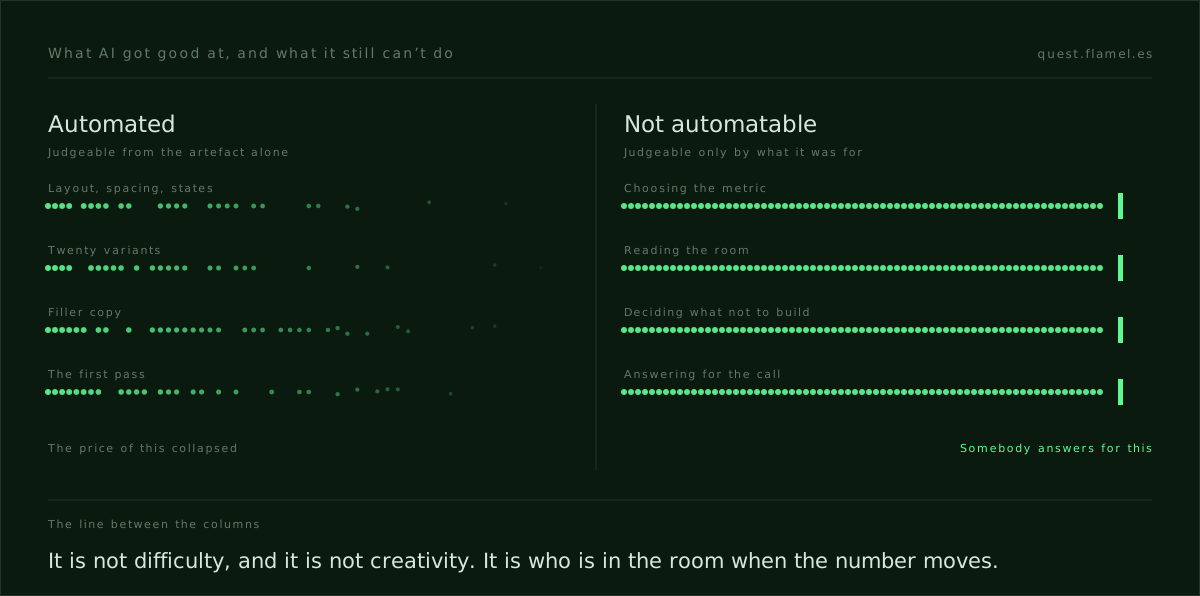
So here are two columns. The left one is work that used to be yours and is not any more, and pretending otherwise helps nobody. The right one is not a list of things the models happen to be bad at this quarter. It is a list of things with no path to automation at all, because the obstacle is not capability.
The left column got long, fast
Producing a competent screen is the clearest case. Layout, spacing, states, the twenty variants of an empty table, the filler copy that goes in them — that was hours of work and it is now a sentence. It is not that the output beats yours. It is that it lands close enough, arrives in seconds, and there are five of them.
Iteration went the same way, and that one costs more than people admit. The old constraint on exploring three directions was that building three directions was a fortnight you did not have. That constraint is gone, which sounds like a gift until you notice it also removed the thing that used to make picking one direction look like expertise.
Everything in the work that has already been automated shares a shape. It is work whose quality can be judged from the artefact alone. If a competent stranger can tell whether the output is right without knowing why it was asked for, the model can do it, and soon it will do it for nothing.
The right column is not about difficulty
Everything on the right shares one property: judging it requires knowing something that is not in the artefact. Choosing the metric a screen is supposed to move is the plainest example. A model will optimise for whatever you name, and name it well, but nothing inside the design tells you whether activation or retention was the right thing to chase this quarter.
That is a decision about the business, made with information the model does not have and cannot infer from a screenshot. Get it wrong and every choice downstream is efficient in the wrong direction. It is the first of five calls that never survive delegation. This is what naming the mechanism behind a behaviour means in practice, and it is the difference between a brief that produces work and a brief that produces output.
Reading a person is not a soft skill
The second item is reading the client, or the product manager, or the room. Half of what a stakeholder tells you is a proposed solution wearing the costume of a requirement, and the job is hearing the constraint underneath it. That is not empathy as decoration. It is diagnosis, and it happens in a conversation the model was never in.
The third is deciding what not to build. Every roadmap is mostly a list of reasonable things, and the work is subtraction — knowing which reasonable thing will cost more attention than it returns. Weighing what a step actually costs the person taking it is a discipline with a mechanism underneath it, and mechanisms can be learned.
The line falls at accountability, not capability
Notice what actually separates the columns. It is not difficulty, and it is certainly not creativity, because the models are fine at both. It is that the right column is made of decisions somebody has to answer for afterwards, out loud, in a room, on the day the number moves the wrong way. Accountability cannot be handed to something that cannot be held to it.
Which is also why the right column does not shrink as the models improve. Cheaper execution makes the decision that directed it worth more, not less, and that is the same argument running underneath whether the job is still worth doing at all.
What to do with an inventory
An inventory is only worth writing if it changes where the next month goes. If your reputation currently lives in the left column, that is the finding, and it is better to have it now than at your next review. The move is not to work faster than the models. It is to become demonstrably good at the right column.
The honest version of what AI can't do in design turns out to be short, and every item on it is a decision rather than a task. Those decisions run on the behavioural principles that explain why people act, and the principles come apart into twenty-seven you can practise one at a time. That is the right column, broken into pieces small enough to train.