Parts of your job have already gone. You watched a model produce a passable screen from a sentence and felt the floor shift under your chair. You still ask, "Will AI replace UX designers?" It already replaced tasks.
It took the first draft, the variants, the filler copy, the sample data, the admin. It did not take the decision of which problem deserves a feature. That is where you now compete.
The first draft went first
Turning a written brief into a competent screen is solved enough for speed. Describe the feature in plain words and you can get a layout with hierarchy, a plausible component set, spacing that will not embarrass you, and a colour scheme that passes a cursory look. Ask for three alternatives, a dark mode, and a mobile take and you get them without opening a file. Go a step further and ask for a working skeleton in code, with routes, a design-token scaffold, and components you can run locally.
It is not perfect, but it removes the part of the meeting where someone asks to see something on canvas. The hour you used to spend drawing a first pass is not a billable hour any more. Get to first pass faster than ever, then spend your time on the choice that decides whether any of it was worth doing.
The dull edges are now generated
You can generate button states, form validations, error messages, empty states, skeleton loaders, and placeholder content from the description of a field and a tone. You can create alt text, aria labels, and copy variations in minutes and then review them. You can produce a CSV with forty records that include weird edge cases, international numbers, and names that stretch your layout without sweating over Excel. You can translate interface strings to twenty languages and use pseudo-localisation to test expansion before you commit to a market.
You can remove a background, recolour a set of icons, and render passable illustrations for a one-off empty state without booking an artist. Stop polishing every corner by hand. Start owning the rule set and the state machine that decide when those corners show. Own the system, not the surface; that is the leverage left in this slice of work.
Research grunt and delivery admin collapsed
What used to take a week of tagging now takes an afternoon of curation. Recordings transcribe themselves and flag moments. Summaries of interviews are a prompt away, with quotes in context.
Paste ten support threads and you get a first pass at themes with contradictions and outliers marked for you to chase. Start a Jira ticket from a good template and have a model fill acceptance criteria you can then tighten. Pick the question worth asking before you collect a signal, and write the trade-offs into the ticket in language that makes the risk explicit.

The part that resisted sits off-canvas
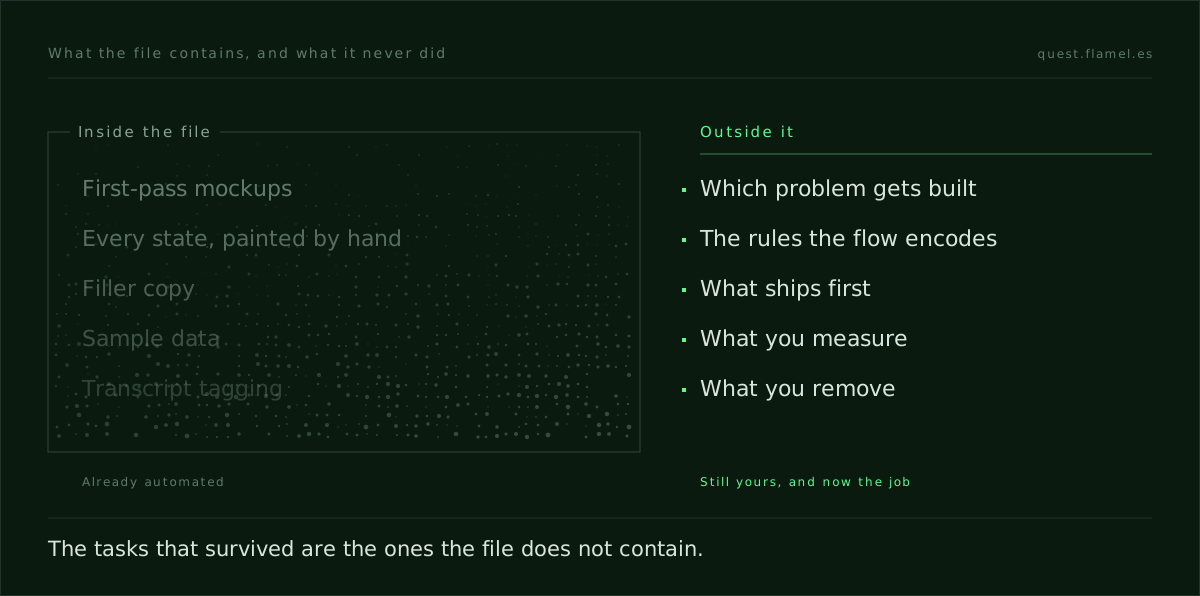
The tasks that survived are the ones the file does not contain. Choosing which problem deserves a feature is not automated, because the choice sits in a knot of constraints, timing, and politics you have to surf, not pattern-match. You feel this most when you try to encode permissions in a B2B app where a user can be in many teams, with roles that vary by feature, and content privacy that changes per client contract. You write rules for who can see or do what, when, and why, and you make them legible to someone who did not write them.
You design invoice flows that allow split payments across sources and currencies, partial refunds, and tax reversal rules that change by state and by product. You respect social login and enterprise SSO, map group entitlements to app roles, and design a migration path off a legacy identity provider without locking anyone out. You plan for account recovery in a way that beats SIM-swap fraud and still helps someone who lost their device. Compliance is an everyday constraint, not a side quest. You encode retention and deletion rules tied to actual regulations, not vibes, and ensure the UI does not invite anyone to break your own policy.
Sequencing and measurement beat polish
A perfect spec that waits six months on a platform migration is an expensive ornament. Your leverage is in cutting a path through constraints that gets value in front of a person with the least risk you can manage. You choose to ship a read-only version of a dashboard first, to validate queries and cache behaviour under load, and to learn which cards anyone actually reads. You choose to stub one happy path so Sales can demo truthfully and pull forward the next five calls without blowing smoke. You cut two pet features to hit a two-second start time in low signal, and you make it explicit why that start time buys you trust you can cash later.
You write the event spec before you build, with names and properties that reflect a state machine, not just clicks. You choose a primary metric you can actually move and a guardrail that prevents harm. You set a rollback trigger for the moment the test burns more trust than it buys you, and you stick to it when the week gets noisy. A model can draft an event schema and write a neat chart title. It cannot sit with your head of data and cut sampling accuracy for latency without breaking your SLA or fooling yourself. That trade is yours.
Subtraction is where taste shows
You will be measured by what you remove. Every choice you add forces someone to think. Reducing the cognitive effort of a flow is the cleanest path to more completions and fewer mistakes, and it is in your hands now that making new screens is cheap. If you need a name for it, start with the detail on the mechanism of reducing cognitive effort and use it on the feature you are in right now.
Cut a step and let the system do the work that the user used to carry. It is subtraction you can justify, in plain words, tied to a real cost and a real gain. That is the judgement that still gets bought.
The inventory: stop doing, now own
- Stop drawing first-pass mockups; own the framing of the direction and the evidence behind it.
- Stop painting every state by hand; own the state machine and the rules that trigger it.
- Stop writing placeholder copy; own the voice for the moments that change behaviour and the rules that hold it together.
- Stop manual transcript tagging; own the question, the sample, and the decision the research will unlock.
- Stop defending polish as value; own sequencing and the measurable bet of the smallest coherent release.
Read that list against your week. If most of your hours still live on the left, you are exposed. If most of your hours live on the right, you are doing the part that survived. It is about moving your energy to the choices that carry consequences and away from the surfaces that are now cheap to produce.
Make it visible and start where the machine stops
If you want the two columns side by side, here is what the models got good at and what they still cannot do. Hiring managers no longer need proof that you can draw a clean screen. They need proof that you can pick a problem, model its constraints, make a cut in public, and measure the result without lying to yourself. Your next case study has to show the decision, the trade, and the loop you used to learn. Show the path.
If you want a standard to judge your own work against, read what a UX case study has to show and rewrite your last project until it meets it. If you need the wider career view once you have moved your hours, read whether becoming a product designer in 2026 is still worth it. Take a real client brief, use a generator for the mock and the filler, and spend your hour on the selection of the problem, the smallest coherent release, the event spec, and the rollback trigger you will not ignore. Start where the machine finishes and take responsibility for what comes next.