You have probably asked some version of this in the last year, and probably not out loud. It sits underneath the job now — while you watch someone generate in forty seconds a screen that would have taken you an afternoon, while you read another post announcing that the discipline is finished, while you wonder whether the thing you spent six years getting good at was worth getting good at.
The honest answer is yes, it is still worth it. But not to the job you trained for, and anyone who tells you nothing important has changed is either not paying attention or trying to sell you a course.
So here is the specific version, without the reassurance and without the funeral.
What actually got taken
Be precise about this, because vagueness in either direction is what makes the anxiety unmanageable.
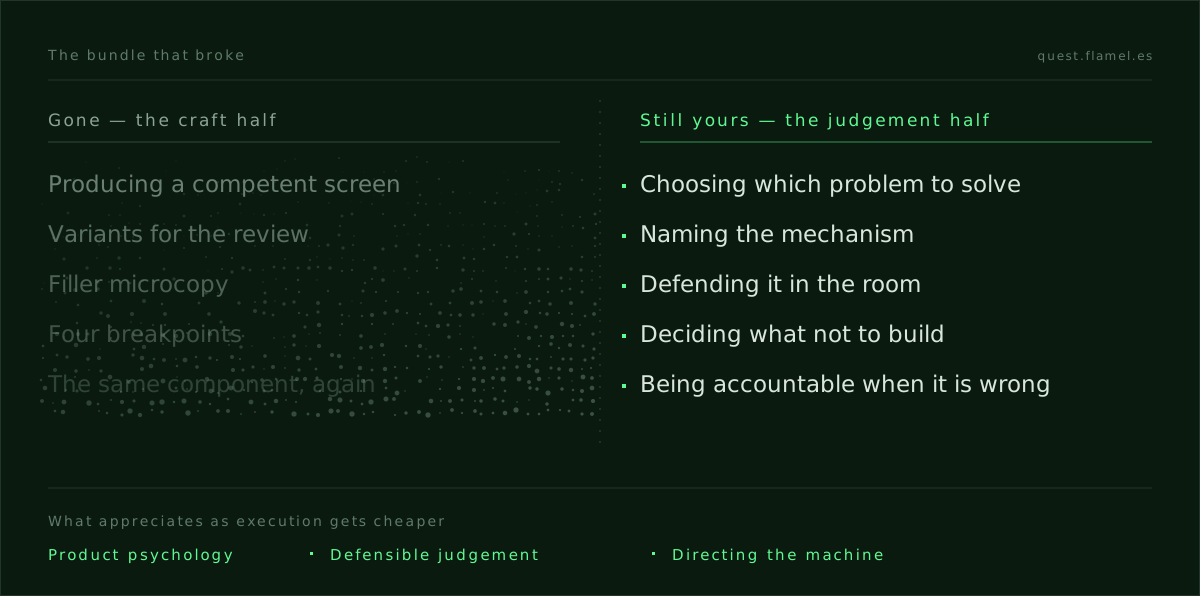
Producing a competent screen from a written description is solved. Not approximately — solved. Layout, spacing, type hierarchy, a plausible component set, states, a dark mode, three variations, all of it in less time than it takes to open the file. If your professional identity rested on being the person who could turn a description into a good-looking interface, that identity is gone, and no amount of craft argument brings it back.
Along with it went a set of tasks that used to fill real hours: producing variants for a review, writing filler microcopy, adapting a layout to four breakpoints, building the flat version of a flow so someone could see it, redrawing the same card component for the fifth product line. That was never the interesting part of the work, but it was a great deal of the paid part, and it is not coming back either. The longer version of that inventory is what the models have actually replaced.
What did not get taken is smaller than the internet suggests and more important than it sounds. Deciding which problem is worth solving. Reading a situation well enough to know which mechanism will actually change a person's behaviour, and which will only look like it does. Being able to say why, in a room, to someone who disagrees and outranks you. Choosing what not to build. Being accountable when the choice turns out to be wrong.
Notice that all five of those are decisions, and none of them is an artefact.
The two bad answers
The question gets answered badly in two directions, and both are worth naming so you can stop being pulled between them.
The first is the comforting one: AI can't be creative, it has no taste, it doesn't understand people. This is partly true and completely useless, because it invites you to sit still. Taste, in the sense of recognising which of five options is better, is real and valuable — but it is not a moat if you cannot explain the recognition to anyone else. And plenty of work that was called creative was in fact recall: applying a pattern you had seen before to a situation that resembled it. That part transfers to a model very well.
The second is the catastrophic one: design is over, retrain, get out. This one ignores that the demand for software did not fall — it rose, because building it got cheaper. More products get made now, which means more decisions get made about them, which means more places where a wrong decision is expensive. The bottleneck moved. It did not disappear.
The useful answer sits between them and is less comfortable than either: the part of the job that was easy to hire for is gone, and the part that was always hard to hire for is now the whole job.
The confusion that made this feel worse than it is
For about fifteen years, our profession let two different things share one name.
One is craft: the ability to produce a clean, well-considered interface. The other is judgement: the ability to determine what that interface should be doing to a person, and why, and how you would know if it worked.
They were bundled because they arrived together. You learned craft first, and if you stayed long enough, judgement accumulated quietly underneath it. Job titles, portfolios and interviews all measured craft, on the reasonable assumption that judgement travelled with it.
The bundle has broken. Craft is now available on demand at near-zero cost, and judgement is not. And because we spent fifteen years measuring the wrong half, an enormous number of good designers have judgement they have never had to articulate, cannot demonstrate, and therefore cannot get paid for.
That, rather than the technology, is why this feels like an emergency. It is not that you have nothing. It is that what you have is invisible, including to you.
The three things that are worth more now
If the value moved to judgement, the practical question becomes what judgement is actually made of. It is not one mystical quality. It is three learnable things, and all three appreciate as execution gets cheaper.
Product psychology and behaviour design. Knowing that a screen works is not the same as knowing why. The why is a finite, teachable body of knowledge about how people decide: what reduces effort, what raises motivation, what supplies evidence, what triggers action. A model can reproduce the visual pattern of social proof flawlessly. It cannot tell you that in this product, for this customer, at this moment, social proof is the wrong lever and what you actually have is a cost problem. That judgement requires understanding one specific person in one specific situation, and it is the closest thing our profession has to a moat. The vocabulary for it exists and is smaller than you would expect — around twenty-seven mechanisms cover most of what product design actually does to people.
Defensible UX and CX judgement. Not opinions about interfaces: positions you can hold under pressure. The ability to say I changed this, because it makes that easier, and we will know within three weeks — and then to survive the four objections that always follow. This used to be a nice-to-have that separated seniors from mids. It is now the thing being bought, because when everyone in the room can generate a screen, the person who can explain which screen and why is the only one adding anything.
Knowing how to direct AI rather than compete with it. This is the one designers resist most, and it is the cheapest of the three to acquire. Using these tools well is not prompt trickery; it is the same skill as briefing a junior designer well. State the business model, the objective, the customer, the constraint, the success criterion — and then evaluate what comes back against a standard you set in advance. Designers who already knew how to write a brief are most of the way there and mostly do not realise it. Designers who refuse to touch the tools are choosing to compete on the one axis where they cannot win, which is why competing with AI is the wrong frame.
Those three compound. Psychology gives you the mechanism, judgement lets you defend it, and directing AI means you can test five versions of it in the time you used to spend building one. They are also the three skills that appreciate as the models improve.
The part that is genuinely bad
An honest answer has to include this.
The bottom rung of the ladder has been sawn off. The tasks that used to let a junior get paid while accumulating judgement — production work, variants, redlines, small screens — are exactly the tasks that got automated first. Getting the first job is harder than it was, and it is harder for reasons that have nothing to do with the person's ability.
Mid-level roles are being compressed too, because a senior with good tooling now covers work that used to need two people. If you are in the middle of the ladder, the pressure you feel is real and it is not a confidence problem. It is worth knowing what mid and senior now measure, because the rungs stopped meaning what they meant three years ago.
None of that changes the direction of the answer, but it changes the urgency. The move is not to wait and see whether it settles. It is to make the judgement half of your work visible, deliberately, starting now — because visible judgement is what is being bought, and almost nobody has organised their portfolio, their vocabulary or their practice around it.
This lands differently depending on where you sit
"Designer" covers several jobs with very different exposure, and the generic answer hides that.
Web and marketing designers got hit first and hardest. Producing a landing page — layout, copy, imagery, responsive behaviour, even the build — is the single most automated task in the whole field, because it is well-defined, high-volume and easy to evaluate. If you sell pages, you are selling the cheapest thing in the room. What is not automated is knowing which objection this particular visitor has and where in the page it has to be answered. That is conversion judgement, it is behavioural, and it is worth several times what page production ever was.
Product designers in-house are the most protected and the slowest to notice. The context you hold — why this constraint exists, what was already tried, what the sales team promised a customer in March — is not in any model, and it is most of what makes your decisions correct. The risk here is not replacement, it is stagnation: staying valuable because of accumulated context at one company, and discovering it does not transfer when you try to leave.
App and interface designers sit in the middle. Screens are automated; flows are much less so, because a flow encodes decisions about sequence, effort and commitment that only make sense against a business model.
Freelancers and studios feel it fastest in pricing, because clients now have a rough idea of what generation costs and price the whole engagement against it. The answer is not to defend your hours. It is to change what is being bought: not the deliverable, which is now cheap, but the decision behind it and the responsibility for the outcome — which is what agencies with real judgement have always actually sold.
Different exposure, same conclusion. Everywhere in software design, the value moved from producing the thing to deciding what the thing should do to a person.
What that looks like in practice
Three things, in order of how quickly they pay.
Name the mechanism, every time. For the next month, do not let yourself change anything without finishing this sentence: I changed X, because it makes Y easier or more likely, and we will know by Z. If the middle is empty, you had a preference, not a decision. This is free and it will feel uncomfortable for about two weeks.
Practise deciding, not making. Most design practice is execution practice, which is now training for the automated half. What you need is repetitions of the decide-defend-evaluate loop, which means a real business context, a hard constraint, and something to be judged against. That is the whole reason a one-hour format works and an open-ended side project does not.
Make the thinking the artefact. Your portfolio, your case studies, your reviews — all of it currently shows outcomes. Outcomes are no longer evidence of anything, because everyone's outcomes look good. Show the discarded option and why you discarded it. That is the only part of your work that could not have come from a model, and it is now the entire signal.
So: is it worth it?
If what you wanted was to make beautiful screens, the market for that has collapsed and it is not honest to pretend otherwise.
If what you wanted was to decide how software should behave towards people, and to be responsible for the answer, then this is a better moment for that than any in the last decade. The tooling removed the part of the job that was tedious and kept the part that was hard. There is more software being built, more decisions to get right, and fewer people who can explain their reasoning under pressure.
The job did not disappear. It got harder to fake, which is a different thing, and — if you are willing to do the unglamorous work of learning why things work rather than only that they do — a much better one.
That is what Quest exists for: a real client brief, an AI draft already on the table that you have to beat, sixty minutes, and a score against twenty-seven named mechanisms rather than against how it looks. You start where the machine finishes. That is the job now.