

Key takeaways
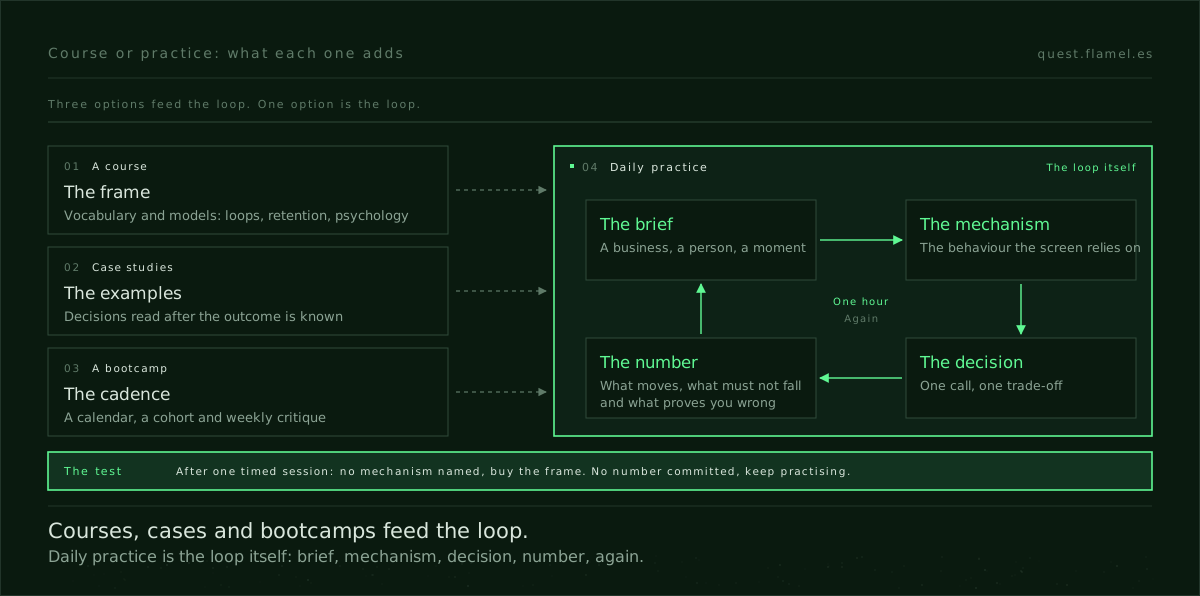
- A course gives the frame; daily practice gives the repetitions. Most designers choosing between them are really deciding which of those two gaps to close first.
- Reforge's Growth Foundations teaches the system a growth team uses; turning that model into a decision on a specific screen stays your job.
- Growth.Design teaches the psychology through free cases and a paid masterclass; reading a decision after the outcome is not making one under a clock.
- A bootcamp sells cadence and critique; check that its briefs carry a baseline and its reviews judge the mechanism, not the visuals.
- Run one timed session first: if you cannot name the mechanism, buy the frame; if you cannot commit to a number, keep practising.
A growth design course and a daily practice habit train different things, and most designers comparing them are really deciding which gap to close first. A course gives you the frame: the vocabulary of loops, activation and retention, and the psychology behind why a screen changes behaviour. What it rarely gives you is repetition, dozens of decisions against a brief with a business, a customer and a number you have to defend.
Below are the options designers actually weigh, what each one trains, and when you need none of them. Quest is a daily practice product, so read the comparison with that in mind. If you want to see the practice side before paying for anything, open the sample brief: no account needed.
Judgement is trained in cycles, not hours
Growth work asks a designer for one thing above the rest: choosing the behavioural mechanism a screen should rely on, for a specific person at a specific moment, and saying in advance which number should move and which must not fall. That is judgement, and it grows with the number of times you make the call and see it checked.
Twenty one-hour sessions give you twenty complete cycles of decide, make and evaluate; one twenty-hour project gives you one. Behaviour design has a name for why that compounds. Fogg lists prior familiarity as an ability factor: actions you have done before are easier, even when they are objectively complex.
The same holds for a method. The first measurement plan you write for a hero section costs an hour; by the twentieth it is routine, and your attention goes to the part that is actually hard. So the useful question about any option is what it adds to those cycles: the frame, the examples, the critique, or the cycles themselves.
Reforge Growth Foundations: the system view
Reforge's Growth Foundations, formerly the Growth Series, is a live four-week cohort created by Brian Balfour and Andrew Chen. Its modules cover retention and engagement, acquisition, monetization and growth models, built around one question: how does this product grow? Enrolment requires a Reforge membership.
What it does well is give you the model the rest of a growth team already uses. If your PM talks about loops and your data lead about retention curves, this is the shortest route to following that conversation, and to challenging it. What it does not set out to do is train the screen-level call: it teaches growth as a system, so turning a model into a decision on one surface stays your job.
Growth.Design: the psychology, with a case library
Growth.Design publishes 52 free case studies that reverse-engineer the reasoning behind shipped products, from Duolingo to Trello. Its paid Product Psychology Masterclass is self-paced, runs five modules from understanding user behaviour to communicating product decisions and designing ethically, and lists a solo seat at $1,500. Lessons follow a learn, practise, apply format, with exercises on your own product.
This is the option closest to a designer's daily language, and the psychology is solid: Quest's own skills library cites Growth.Design as a source. The limit is in the format. A case study shows a decision after the outcome is known, with the false starts edited out, and an exercise on your own product needs a product where you can move a number. A good case shows you what clarity looks like; it does not make the call for you.
A bootcamp: cadence and critique
A bootcamp sells structure: a calendar, a cohort, deadlines and someone who reviews your work every week. For a career switcher that structure is often the whole point, and presenting to peers under a deadline is closer to a real review than anything you do alone.
The trade-off is depth. Many programmes optimise for a finished, presentable portfolio, which pulls time towards polish and away from the measurement plan. Before paying, ask three things: does each brief include a business with a baseline and a constraint, does the critique judge the mechanism or the visuals, and do graduates' case studies explain a decision or only show screens? Vague answers mean you are buying a calendar.
Daily practice: the cycles none of them sell
Daily practice is the cheapest way to get the cycles themselves: a brief, a clock, a decision and a short written rationale, repeated. Take the sample brief. Cassette Futurism, a four-year-old indie label in Lisbon, has an AI-generated release page where 70% of visitors scroll once and bounce, and email capture sits around 3% against a target of 10% or more on mobile.
The visitor arrives from an Instagram story at night, headphones already on. In an hour you have to choose: lean on anticipation with a countdown, on scarcity with the early-listener window, or on belonging with the growing tribe count. Then you write which number should move, what must not fall, and what result would prove you wrong.
Practice has its own blind spot, the mirror of the course's: without a frame, you repeat your instincts faster. The fix is in the brief and the write-up. Work from realistic design briefs with a business behind them, use a brief template that closes decisions when you write your own, and follow a 30-day plan if you want a month of structure.

How to choose, and when you need none of them
- You cannot follow the growth conversation. If loops, activation and retention curves are new vocabulary and you sit near a growth team, a systems course like Growth Foundations is the fastest frame. Pair it with weekly practice so the model turns into calls.
- You ship screens but cannot say why they work. Start with the psychology: the free Growth.Design cases, and the masterclass if you want structure and can expense it. Then practise naming the mechanism before you design.
- You are switching careers and need structure. A bootcamp earns its price if its briefs carry baselines and constraints and its critique judges the mechanism. Otherwise you are paying for a calendar.
- You have the frame but few repetitions. Practise daily on realistic briefs for a month before you buy more content. When the practice exposes a specific gap, buy the course that closes that gap.
- You need none of them if your team already runs experiments on your surface and you get a reviewed decision every week. Your job is the practice; write the rationale down each time.
- Training will not help if what you lack is permission. If you cannot get a surface, a baseline or a sprint slot, no syllabus fixes it: that is a conversation with your manager.
Run one hour before you pay
Before spending money, run one session on the sample brief and write three sentences at the end: what you changed, which mechanism you relied on, and what result would prove you wrong. If you could not name the mechanism, your gap is the frame, and a course is a good buy. If you named it but could not commit to a number, your gap is repetition.
Whichever way the hour goes, try the sample brief first; it needs no account. If you have already decided that repetition is your gap, create an account and you get a new brief like it every day, with a starting design to beat and 60 minutes on the clock. It is free to start.
You are a blunt mentor for product designers moving into growth work. I will paste three recent design decisions I made, each with: [the product and surface], [who the user was and the moment], [what I changed], [why I thought it would work], and [the number I expected to move, if any]. For each decision, tell me: 1) Did I name a behavioural mechanism, or only describe the screen? 2) Did I state a number that should move and one that must not fall? 3) Did I name a result that would have proved me wrong? Then diagnose my main gap as one of: frame (I lack the vocabulary and models), clarity (I decide well but cannot explain why), cadence (I know how but rarely practise), or access (I have no surface or baseline to work on). Recommend one route for the next eight weeks: a systems course, a psychology course, a bootcamp, daily practice on realistic briefs, or none. Say what would tell me after four weeks that the choice was wrong. Ask for anything missing before answering.
Frequently asked questions
Is a growth design course worth it for a product designer?
It is when the frame is your gap: if loops, activation and retention are new vocabulary, a course is the shortest route to them. If you already speak that language, the return drops fast, because what you lack is repetition, not concepts. Run one timed session on the sample brief first; if you cannot name the mechanism you relied on, buy the frame.
Reforge or Growth.Design: which one should a designer take?
They teach different layers. Reforge's Growth Foundations teaches the system: how a product grows through retention, acquisition, monetization and growth models. Growth.Design teaches the psychology behind a single screen, closer to a designer's daily work, and its case studies are free. If your gap is following the growth team, start with the first; if it is explaining why a screen works, start with the second.
Can daily practice replace a growth design course?
For judgement, mostly yes: the call under a clock is trained by repeating it, and no syllabus shortcuts that. For the frame, no; without vocabulary you repeat your instincts faster. The practical order for most designers is practice first, then a targeted course when the practice exposes a named gap. Realistic design briefs keep the practice tied to a business.
Do I need a bootcamp to become a growth designer?
No. A bootcamp helps when what you lack is structure, a cohort and weekly critique, which is common in a career switch. It is a poor buy if its briefs have no baseline or constraint and its reviews judge visuals over the mechanism. If you already work near a growth team, reviewed experiments on your own surface teach more than any cohort.
How much time does daily practice take?
About an hour a session: the 60-minute challenge splits it into reading the brief, choosing the mechanism, building, making it interactive and writing what you learned. Twenty one-hour sessions give you twenty full cycles of decide, make and evaluate, which is why short daily sessions beat a long weekend project for training judgement.





