Key takeaways
- The laws of UX each describe a cost: Hick's is thinking, Fitts's is reaching, Jakob's is learning and Miller's is remembering.
- Knowing the list is easy; the skill is recognising which law governs this screen, for this person, in this moment.
- Laws disagree: Jakob's law argues for the familiar product grid, and Hick's law argues against it for a buyer in a hurry.
- On a gift finder, Hick's law counts questions, not buttons, and a question the buyer cannot answer is the most expensive one.
- Before designing, write one sentence: which law is in play, what you will change and what you will keep.
The laws of UX are a short set of findings about how people decide, reach, learn and remember on a screen; Hick's, Fitts's, Jakob's and Miller's are the four most designers quote. Knowing them is easy. The skill is recognising which one governs the screen in front of you, because two laws can point in opposite directions and only the person and the moment decide which wins.
Most of us cite them late, to justify a layout already drawn, when they help least. This post reads one screen law by law: a toy brand's gift finder, from a practice brief on Quest, used by someone in a hurry. There, Hick's law decides how many questions to ask, not how many buttons to show.
The four laws of UX most designers can quote
The best-known collection, Jon Yablonski's, runs to more than twenty entries. Four of them turn up in nearly every critique, and the useful way to hold them is by the cost each one describes:
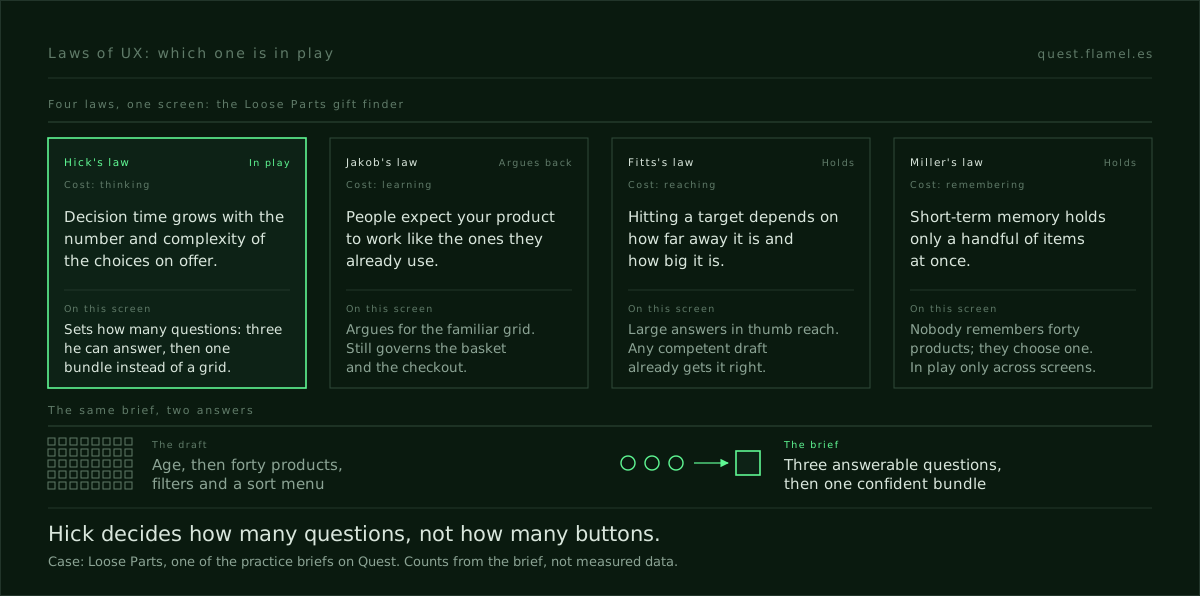
- Hick's law: the time it takes to decide grows with the number and complexity of the choices on offer. The cost is thinking.
- Fitts's law: the time it takes to hit a target depends on how far away it is and how big it is. The cost is reaching.
- Jakob's law: people spend most of their time in other products, so they expect yours to work the way those do. The cost is learning.
- Miller's law: short-term memory holds only a handful of items at once, about seven in George Miller's 1956 paper. The cost is remembering.
Three of the four describe mental effort and one describes physical effort, which is why the four kinds of friction are a better place to start a diagnosis than the list. Name the cost the person is actually paying, and the law that describes it follows.
Why knowing the list is not the skill
Each of these UX laws is true, and that is the problem. On most screens all four apply at once, and they do not always agree: Jakob's law pulls a page towards the pattern every competitor uses, while Hick's law can pull the same page away from it. A law tells you what a cost is, not whether it is the cost that matters here.
That depends on who is in front of the screen and what they are trying to do in that moment, and it is the part a model will not settle for you. Ask one for a gift finder and it produces the most probable gift finder, which honours Jakob's law perfectly because it is the average of every shop it has seen. Deciding that this person needs something else is the part of psychology in UX design that AI can't copy yet.
The screen: a gift finder that returns forty products
Loose Parts is one of the practice briefs on Quest: a nine-person toy brand that makes unfinished wooden and fabric parts designed to be combined. Its gift finder asks for an age and returns a grid of forty products. The person the brief describes is the uncle buying on the way to the party, who sees the child a few times a year and has no idea what they already own.
He is on a phone, in transit, and wants to be done in three minutes. He is afraid of turning up with the boring present, forty options make that fear worse, and he leaves for a marketplace. The draft a model produces from the brief is the conventional one: a filter sidebar for age, price and category, the grid, a sort menu and a shop-all banner.
Nothing in that draft is broken, which makes it a fair test. The brief asks for a finder that decides for him: three questions, one confident bundle and enough reasoning that he can repeat it out loud when he hands the present over. Every law on the list has something to say about this screen; only one explains why the conventional version fails him.
Hick's law decides how many questions, not how many buttons
The obvious reading of Hick's law here is about the grid: forty products is too many, so show twelve, or add sharper filters. That reading counts buttons. It leaves the uncle with the same job, choosing a toy for a child he barely knows, only with fewer tiles, and every filter adds a decision of its own before he has seen a single product.
Hick's law is about decisions, and on this screen the decisions are the questions. Each one the finder asks is a choice the buyer has to make, and the law says its cost grows with the number of options and with how unsure he is of the answer. A question he cannot answer, such as what the child already owns, is the most expensive one on the screen, however few buttons it has.

So the law sets the spine of the finder before anything is drawn: three questions he can answer without guessing, then one bundle instead of a filtered grid. The brief's own wording is the test: ask only what a distant relative can actually answer. Age passes it, and so does a budget. Finding a third question that passes it and still tells the bundle something is the design decision of the session.
That gives you fewer decisions, not merely fewer elements, and a way to be wrong. If buyers still leave, look at where they stop: a stall on one question means it is not answerable, which is still Hick's law. A drop after the bundle appears means the problem has moved from deciding to trusting the recommendation.
What the other three laws say on the same screen
Jakob's law is the one that argues back. A filter sidebar and a product grid are what every toy shop uses, so the conventional draft is the familiar one, and familiarity is worth a lot: a pattern learned elsewhere costs almost nothing to operate. For a parent browsing the catalogue on a quiet Sunday, the grid would be the right answer. For the uncle three minutes from the party, it hands him the one task he came to avoid.
Jakob's law still governs everything after the decision: the basket and the payment step should look like every other shop, because this buyer, in the brief's words, will pay for next-day delivery without blinking if it removes the decision. Knowing which law is in play also means knowing where it stops.
Fitts's law holds and does not decide. On a phone held in one hand the answers need to be large and within thumb reach, but any competent draft gets that right, and bigger buttons will not keep a buyer who does not know what to pick. Miller's law is the most misquoted: nobody is trying to remember forty products, only to choose one. It would come into play if the finder made him compare bundles across screens.
How to tell which law is in play
The read takes a few minutes and works on any screen, as long as it starts from the person and not from the list:
- Name who is in front of the screen and the moment they are in: how much time they have, what they already know, what they are afraid of.
- Name the one action the screen exists to get.
- Find where the effort lands: thinking, reaching, learning or remembering.
- Pick the law that describes that effort and write one sentence: on this screen, X is in play, so I will change Y and keep Z.
On Loose Parts it might read: Hick's law is in play, so I will cut the job to three answerable questions and one bundle, and keep the basket and checkout like every other shop. It names what changes, what stays and why, which makes it defensible in a review. The laws describe the cost of acting, not the reason to act; that is where the persuasion principles every product designer should know take over.
The same costs can be trained as skills. The design psychology skills library on Quest groups 27 of them by framework, from Cialdini to BJ Fogg's behaviour model, and the cost Hick's law describes sits in Fogg's, as one of the levers of ability.
Train the read, not the list
Memorising more laws will not make the read faster; practising it on real screens will. Pick one screen this week and write the four lines and the sentence before you open a design tool. The skill underneath this post is mental simplicity, the ability lever Hick's law describes: cutting what a decision costs in thinking, often with a short diagnostic that narrows many options to one. Train that, and the list stops being something you quote after the fact.
You are a senior product designer helping me decide which law of UX governs one screen. I will paste: [what the screen is for], [who uses it and in what moment: time available, what they already know, what they are afraid of], [the one action the screen has to get], [a description or screenshot of the current design]. Do not redesign the screen and do not list every law that applies. Do this, in order: 1) Say where the user's effort lands, thinking, reaching, learning or remembering, with one line of evidence from what I pasted. 2) Name the law of UX that describes that effort (Hick's, Fitts's, Jakob's or Miller's) and the law that argues against it here, if any. 3) Write one sentence: on this screen, X is in play, so I will change Y and keep Z. 4) Tell me what I would see in the screen's numbers if the law I picked was the wrong one. If any input is too vague to answer, ask me one question first.
Frequently asked questions
What are the laws of UX?
They are findings from psychology about how people decide, reach, learn and remember, collected for designers. The four most quoted are Hick's law (decision time grows with the number and complexity of choices), Fitts's law (hitting a target depends on its distance and size), Jakob's law (people expect your product to work like the ones they already use) and Miller's law (short-term memory holds only a handful of items).
What is Hick's law in UX?
Hick's law says the time it takes to make a decision grows with the number and complexity of the options. In UX it applies to every decision the user has to make, not only to the number of buttons on a screen. On a finder or a quiz each question is a decision, and a question the user cannot answer confidently costs more than one with many options.
How do I know which law of UX applies to a screen?
Start from the person, not the list. Name who is using the screen and the moment they are in, the one action the screen exists to get, and where the effort lands: thinking, reaching, learning or remembering. The law that describes that effort is the one in play, and the four kinds of friction help you name the effort before you choose.
Can two UX laws contradict each other?
Yes, and that is why knowing the list is not enough. Jakob's law favours the pattern users already know from other products, while Hick's law can favour removing that pattern when it hands the user too many decisions. Which one wins depends on the person and the moment: a relaxed browser is served by the familiar grid, a buyer in a hurry by a short finder that decides.
Is Miller's law about limiting menus to seven items?
Not quite. George Miller's 1956 paper was about how many items people can hold in short-term memory, not about how long a menu should be. A list people can see does not need to be remembered, so choosing from it is a decision problem, which is Hick's law. Miller's law comes into play when a design makes people carry information between steps or screens.