

Key takeaways
- Most Hooked loops fail by skipping investment; design investments that store value so the next trigger lands stronger.
- Make triggers meet ability with Fogg’s gate; show one state-aware primary action that fits the moment and device on each surface.
- Use variable rewards that fit the tribe—progress reveals, real replies, and credits—rather than cosmetic randomness.
- Design investments with receipts that change what happens next, like tags, follows, votes, or pinned builds, and measure their lift on return.
- Pick a live moment and number, then write the trigger top copy, state-aware action label, one-sentence reward, and one investment ask with a dated receipt.
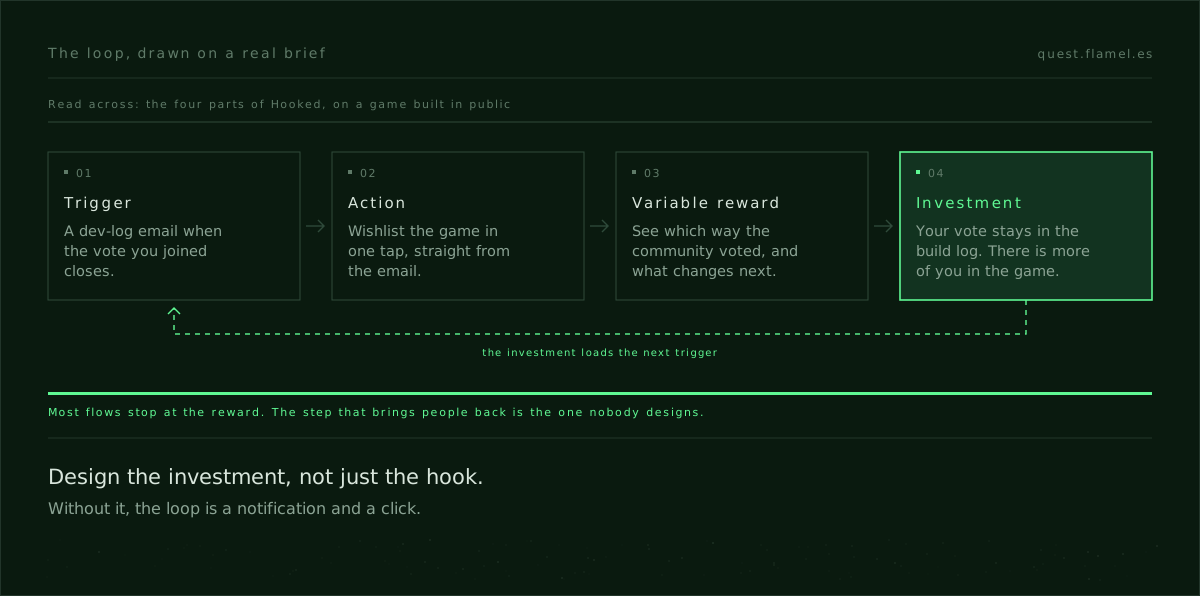
The hooked model shows up in slides more than in screens, and the leak is the fourth step: teams forget to design the investment that makes people return. Triggers and rewards work, but the action doesn’t store value, so the loop evaporates. Cross the hooked model with Fogg’s gate and lessons from streaks without copying either. The result is retention that compounds without tricks. To keep it honest, draw it on a real brief: Black Salt Games, an indie studio that builds its game in public and needs wishlists and a community around its devlogs. The moment is familiar: a player sees a trailer, adds the title to a store wishlist, and joins Discord to follow progress. Today, updates get posted and hope does the rest; tomorrow, every action stores value so the next trigger lands stronger.
Draw the loop on one real brief
Name the number, the timeframe, and the failing moment, for example: players who wishlisted and are still engaged after 30 days, among those who join the community in the next two weeks. The surfaces are known: a Steam page, a site, a mailing list, a Discord or forum, and the game launcher. Constraints are also clear: no budget for paid loops and limited engineering time.
Updates ship twice a month, which means every one needs to carry its own next step. External triggers are trailers, tweets, and seasonal events; internal triggers are the check-in habits your community builds. Actions are simple: add to wishlist, follow updates, and comment. Rewards have to be variable and tribal: progress reveals and real replies beat shiny badges.
The missing piece is investment. In this loop, investment is anything that makes the next trigger more likely to be noticed and the next action easier. A saved build setting, a followed thread, a tagged interest, or a devlog pinned to a profile all count. Each one stores value for the person and the system, and each one lifts relevance next time.
Trigger and action share a wall
A trigger only works when the action is easy and makes sense at the exact moment it arrives. This is Fogg’s gate: motivation, ability, and prompt must meet, or nothing moves. Before you polish rewards, make the action pass the Fogg behavior model for designers test on each surface you control.
For the wishlist loop, the external trigger might be a devlog headline such as “Caves reworked” sent on the store page, social, and email. The action must be frictionless and legible by state: “Add to wishlist” if you have not, “Follow updates” if you have, and “Discuss changes” if you follow. One screen, one primary action that matches the state, with the “why” right under it.
State awareness is not a growth hack; it is manners. A returning player should see a different button and reason than a new one, and the action should respect device norms. If the update lands on mobile, the tap target is thumb-ready; on desktop, it respects keyboard. Triggers that ignore state create silent drop-off no reward can fix after the click is gone.
Variable rewards that belong to a tribe
Variable rewards work when they match the identity of the group that cares, not when they dangle generic surprises. A studio has a rich palette: progress reveals, tool breakdowns, community picks, and Q&A where a developer answers one tough question a week. The Duolingo streak is cited as the poster for variable rewards, but its strength is not a number; it is changing content under a consistent promise. A similar pattern without badges: a weekly poll where the community votes on which feature gets a devlog, and the winner is covered next week with names credited. The teardown is here: Duolingo streak teardown.
Cosmetic randomness is tempting because it ships in a sprint. Resist it and shape the reward around what the player considers progress: “we reworked camera motion, fixed loading stutters, and the cave lights no longer flicker.” The uncertainty is which problem you solved this week, not whether you will show up.
To check that a reward does not drift into tricks, use the persuasion principles for product designers: is it valued by the people you are asking to return? If it reads like vanity confetti, it is.

Design the investment or the loop leaks
The missing quarter in most Hooked examples is the investment: what the person puts in that makes next time easier or better. In wishlist and community flows, investments can be small and still compound: choose tags for alerts, follow a thread so it floats to the top, or submit a bug that earns a thanks and a fix note in the next build.
A designed investment has three traits. It is voluntary and specific, it modifies what the system does next, and it pays the person back on a visible timeline. “Pick two features you care about and we’ll front-load those devlogs to your feed” is an investment with a receipt. “Complete your profile” is not, unless the next update reads it and changes in a way you can see.
Measure investments by return rate and by the percent of players who see their own fingerprints in the next touch. Attribute returns to the last investment seen to observe lift without overfitting. You are looking for compounding relevance, not raw volume. The investment skill trains patterns that are honest and light to ship, and the sample brief is a quick place to try one.
The finest-grained investments are editorial: a reaction the studio really uses to decide what to cut next, followed by a public “we changed X because Y asked”. Patterns for this live in variable reward, tribe.
Place it on product surfaces
This is not a slide. It is copy and controls on the screens and messages people actually see. Map each step to a surface and a sentence, then test the sequence with a timer. Aim for continuity: the “yes” to the action should agree with the trigger that brought them here, and the investment should sit where the reward is still fresh.
For “Caves reworked,” the store page, site, email, and Discord post each open with one clear reason to care and a state-aware primary action. Above the fold, a wishlist prompt for newcomers, a “follow updates” for wishlisters, and a “discuss changes” for followers. Inline, one sentence explains why this action matters now.
Then place one optional investment linked to the reward on that same screen: “Pick two tags for alerts,” “Follow the cave thread,” “Vote on next week’s devlog,” or “Submit a 10-second clip; we reply.” In the launcher, let people pin builds with the features they care about so the next hotfix floats to the top. In email, a two-choice poll picks next week’s topic.
Instrumentation and thresholds
Measure loops, not likes. The core metric here is 30-day retained engagers among those who took the wishlist action, not raw wishlist counts. Instrument the four steps with step stamps: trigger sent and seen, action clicked by state, reward consumed and scrolled, investment taken with type and context.
Set hypotheses before you ship, for example: “Adding tag-based alerts and crediting voters in devlogs will raise 30-day return after wishlist with unsubscribes flat.” Add thresholds and a stop-loss: if unsubscribes rise above current by 0.5 points or “too many pings” tickets exceed 1% of messages, roll back alerts and keep state-aware CTAs.
Track the delay between investment and payoff: if it is invisible within a week, expect decay. Move the receipt forward: “you chose caves and lighting, so next Thursday’s devlog will cover both” is a promise you can schedule.
Practice and coach AI
What you are training is the ability to turn a psychology model into screen-level decisions you can defend and measure. Place the action where Fogg allows it, craft a reward that belongs to a tribe, and design investments that store value with a dated receipt. You can direct AI to draft copy, but you choose the why, the order, and the thresholds.
You can also train restraint. A model will happily generate badges and spins; you will choose not to use them because this community respects clarity more than confetti. Ethics is a skill: promises should sit next to their controls and get proven in the next release.
Pick a live product moment and a number, then draw the loop across actual surfaces. Write the exact top copy for the trigger, the state-aware label for the action, the sentence that names the variable reward, and the investment ask with its receipt. If you want a neutral place to practice, start with the Sample brief and sketch the loop on paper first.
Put all four lines on a single page and read them out loud. If the “why now” is clear and the receipt is dated, ship. If not, cut and reorder. The point is not to memorize a model; it is to place copy and controls that make the next trigger work better than the last. Name the investment, set a threshold you will honor, and measure the return in 30 days.
Role: Senior product designer and retention coach. Your task: design a state-aware, investment-led Hooked loop that compounds retention without tricks. Context: [describe your product and audience], [state your exact goal metric and target lift with timeframe], [list the surfaces you control], [name your failing moment], [name the next update or trigger], [list real constraints], [list possible investments], [define stop-loss thresholds]. Produce a one-page loop spec that includes: 1) Top copy for the trigger. 2) One primary action label per state (new, engaged, returning), matched to device norms. 3) One sentence that names the variable reward in the tribe’s language. 4) One optional investment ask with a dated receipt that changes what happens next. 5) A surfaces map showing where each line lives. 6) Instrumentation: step stamps, time-to-action, reward consumption, investment type/context, attribution to last investment. 7) One hypothesis with thresholds and rollback rules. Constraints: pass Fogg’s gate for each state, keep “why now” explicit, keep copy concrete and under 25 words per line, avoid cosmetic randomness, and protect trust with the stop-loss.
Frequently asked questions
How do I design an investment if engineering time is tight?
Use editorial and routing before code. Ask for two tags, a follow, a vote, or a 10-second clip, then show the receipt next update with credits. Change ordering, not features: pin threads, float chosen topics, or segment emails by tag. Attribute any return lift to the last investment seen. Patterns live here: https://quest.flamel.es/skills/investment.
How do I make variable rewards feel tribal for my audience?
Name progress in the group’s language and give real access. Let people vote on next week’s deep-dive, credit names in the post, and answer one tough question weekly. Rotate reveal types: fixes, tools, teardowns, picks. Avoid loot-box shine. Study tribe-fit patterns and cadence here: https://quest.flamel.es/skills/variable_reward_tribe and the streak teardown: https://quest.flamel.es/blog/duolingo-streak-teardown.
How do I know if the loop worked beyond more wishlists?
Track 30-day retained engagers among those who took the key action, not raw counts. Instrument step stamps for trigger seen, action by state, reward consumed, and investment taken with context. Attribute returns to the last investment seen. Watch time-to-action and payoff delay; move the receipt forward if it drifts past a week. Keep a stop-loss on unsubscribes and “too many pings” tickets.
What stop-loss thresholds should I set to protect trust?
Baseline unsubscribes, spam reports, and “too many pings” tickets first. Pre-commit numbers, e.g., roll back alerts if unsubscribes rise by 0.5 percentage points or related tickets exceed 1% of messages. Keep state-aware CTAs even if alerts pause. Log every rollback decision. The point is compounding relevance, not short-term spikes that drain goodwill. Stick to it even during launches.
How do I adapt this to B2B SaaS without a community forum?
Map surfaces to app, email, docs, and release notes. Triggers are “Feature X shipped for Role Y.” Actions are state-aware: “Enable,” “Try it on sample data,” or “Share feedback.” Rewards are resolved pains and measurable gains. Investments are saved views, followed topics, notification preferences, or pilot enrollment with a dated promise. QA with Fogg’s gate per role: https://quest.flamel.es/blog/fogg-behavior-model-for-designers. If stuck, use the sample brief: https://quest.flamel.es/sample-brief.





