Most advice about future proof design skills is really advice about hiding. Find the corner of the job a model cannot reach yet, move in, and wait. It is a bad bet, because the corner keeps shrinking and you will spend the rest of your career moving house.
There is a better question. Not which skills survive AI, but which ones get more valuable every time the models improve. Those exist, there are three of them, and none of them is a tool.
Why anything appreciates when execution gets cheap
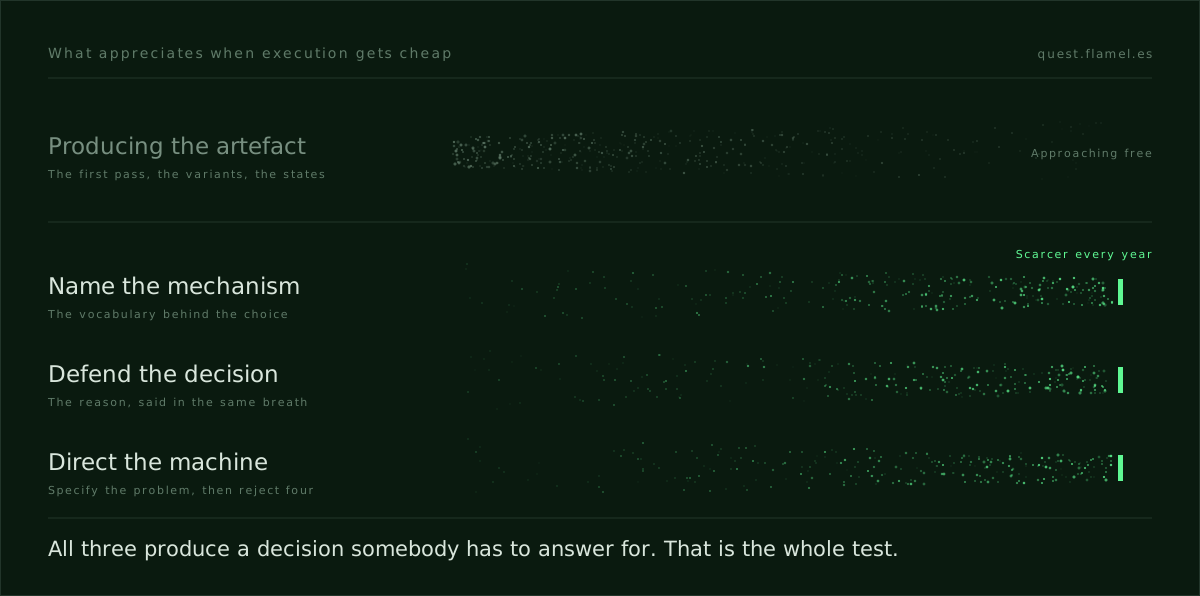
When the price of one input collapses, the things that complement it get more expensive, not less. That is the whole mechanic, and it is already visible in your week. Producing a competent screen used to cost hours; it now costs a sentence. The scarce input is no longer the screen.
Before, the constraint was how many directions you could afford to build. You picked one early because building three was a fortnight you did not have. Now you can have five by lunchtime, and the constraint has moved to knowing which of the five deserves to ship, and being able to say why in a room where everyone else also has five.
None of that is a forecast. It is an inventory of what has already been automated — the first pass, the variants, the filler copy, the twenty states of an empty table. Every one of those was once a reason to hire you, and none of them is any more.
So a skill is not future proof because AI cannot do it. It is future proof because it becomes the binding constraint once AI does everything around it. That is a much narrower list than the one you have been sold, and it is the same argument underneath whether the job is still worth doing at all.
One: naming the mechanism, not the pattern
Ask a model to improve onboarding and you get a nicer onboarding. Tell it that people abandon at step three because they are asked to commit before they have been given a reason to, and you get different work — because you brought the diagnosis and it brought the hands.
That diagnosis has a vocabulary. Commitment, reciprocity, social proof, variable reward, each of the flavours of friction that Fogg separates into time, money, effort and mental load. These are not decoration on top of design. They are the layer where you decide what the interface is supposed to make someone do, which is the layer a model has no access to because it never met your user.
Product psychology is the least fashionable of the three skills and the most defensible, for a boring reason: it is the only one that is a body of knowledge rather than a habit. You can be taught it, you can be tested on it, and someone who has it can tell you in one sentence why a screen works. The full taxonomy sits in the behavioural principles behind interface decisions.

Two: judgement you can defend out loud
The review meeting changed shape and most designers have not noticed. Taste used to be a credential because producing an alternative was expensive: if you said a layout felt wrong, nobody could cheaply prove otherwise. Now the PM opens a tab and has four alternatives that also feel fine before you finish the sentence.
What survives that room is a decision with its reasoning attached. Not "this feels cleaner" but: this is the behaviour we want, this is the mechanism that produces it, this is the trade-off we are accepting, this is the number that would tell us I was wrong. Four sentences, and none of them is about aesthetics.
In practice it sounds unglamorous. We want people to finish the second upload, not admire the gallery. Showing the first upload back to them as progress is the mechanism, because a streak in motion is harder to abandon than one not yet started. The cost is a busier screen for people who only ever upload once. If second-week uploads do not move within a month, I was wrong and we take it out.
Most designers have the judgement already and lose the room anyway, because the argument arrives as preference and gets answered as preference. The shape that stops that happening is learnable, and it is mostly a matter of carrying the reason in the same sentence as the recommendation. Defensibility is not seniority and it is not confidence. It is the habit of carrying the reason in the same breath as the recommendation, every time, until it stops feeling like a performance.
Three: directing the machine instead of racing it
A brief and a prompt are the same artefact. Both are an attempt to make someone who is not you produce the thing you had in mind, and both fail for the same reason — you specified the output and not the problem. The people getting useful work out of these tools are not better at syntax. They are better at saying what the constraint is, who the person is, what state they arrive in, and what would count as success.
Then they read the result properly, which is the half nobody talks about. The model is fluent and confident and produces something plausible on the first try, and plausible is exactly the failure mode that costs you a quarter. Directing means specifying, then evaluating, then rejecting four of the five without apology.
Notice that this is not a tools skill. Whatever you learn about a specific product this year expires next year; what does not expire is the ability to write a brief tight enough that a stranger could execute it. That was always the job. It just used to be optional, because the stranger was you.
What the three have in common
They produce decisions, not artefacts. That is the entire test, and you can run it on any skill you are thinking of investing in this year. If the output is a file, the price is falling. If the output is a choice somebody has to answer for, the price is rising.
The second thing they share is that they are trainable, which is not obvious. Product psychology is a curriculum. Defending a decision is a rehearsal, and it improves at the speed you get feedback on it. Directing is repetition until the non-routine becomes routine, which is exactly the ability lever that prior familiarity gives you — the same mechanism you use on your users, pointed at yourself.
None of this is comforting, and it is not supposed to be. The part of the job that consisted of producing correct screens is gone and it is not coming back. What is left is smaller, harder and considerably more valuable, and it is the part that most designers were never given time to practise.
Where to start this week
Start with the vocabulary, because the other two lean on it — you cannot defend a decision you cannot name, and you cannot brief a model on a mechanism you do not have a word for. Twenty-seven of them, each with the evidence behind it and the line where it turns manipulative, are laid out in the taxonomy.
Then use them on something real, out loud, with the reasoning attached. Once a week is enough, and it lands faster once you have settled what you hand to the machine and what you keep. The skill you are training is not drawing faster than the machine — that race is the wrong one to enter — but being the person in the room who knows which of the five it should be.