
You have been in this meeting. You present the work. It is good work — you know it is good work. Then someone with more authority than you says "I'm not sure about this," offers a preference dressed as a concern, and the room follows them. You leave with a change you disagree with and no way to explain, even to yourself, why you were right. Most advice on how to defend design decisions starts one step too late, inside the meeting. The defence is built before it.
The usual diagnosis is that designers need to communicate better. That is not it. You lost because your argument and their argument were not comparable. Yours was about the screen. Theirs was about the business. When two arguments live in different currencies, the one closer to revenue wins by default, and it should.
A defensible design decision is one that has been converted into their currency before you walk in.
This was always true and it was always survivable to be bad at it, because you had something else to trade: you could make the thing, and most of the room could not. That trade has expired. When the PM can generate three credible alternatives to your proposal before the meeting ends, being the person who produces screens buys you nothing. The argument stops being the wrapping around the work and becomes the work — the only part of your contribution that could not have come from a tool, and one of the few skills that get more valuable as the models get better.
Why "it's better" is not an argument
Say it out loud and listen to it: this version is better. Better at what? Compared to what? How would we find out if it were not?
An argument that cannot be wrong is not an argument. It is a preference with a confident tone. And a room full of people can produce preferences much faster than you can defend yours, which is why the meeting turns into a vote and you lose the vote.
The same is true of the more sophisticated versions. "It's cleaner." "It follows the design system." "It's more modern." "Users expect this pattern." Each one sounds like a reason and each one collapses the moment someone asks and therefore what? The design system is a constraint, not a purpose. Modernity is a taste. What users expect is a fact about the past, not a prediction.
None of this means taste is worthless. Taste is how you generate the option worth arguing for. It is just not how you defend it.
The shape of a defensible decision
Every decision you should be prepared to defend fits in one sentence with three parts:
I changed X, because it makes Y easier or more likely, and we will know within Z.
X is what a user would actually see. Y is the behavioural mechanism. Z is the observable consequence and the window in which it should show up.
Concretely, instead of "I moved the price above the fold and simplified the card", you say: "I moved the price above the fold because the main reason people leave this page is uncertainty about cost, and if that is right, the drop-off between view and add-to-cart falls within two weeks."
The second sentence is not longer because it is more elaborate. It is longer because it contains a claim that could turn out to be false. That is what makes it worth saying. Getting that sentence down on paper is a discipline of its own: how to write the rationale, one falsifiable line at a time.
Part one: name the mechanism
The middle of that sentence is the part designers skip, and it is the part that does all the work. You are always relying on something to change a person's behaviour. Naming it is what separates a decision from a preference. That naming is a vocabulary problem before it is an argument problem: the words that turn taste into a claim are the ones this whole sentence runs on.
There are four families, and almost everything sits in one of them.
You are removing effort. Something the person has to do is too expensive, so they do not do it. But "friction" on its own is too vague to defend — you have to say which kind. Is it mental effort, the number of things they must hold in their head? Physical effort, taps and typing? Time, the wait between wanting and getting? Or money, including the money they only suspect they might be charged? These four are removed by four different interventions, and picking the wrong one is the most common reason a "simplification" changes nothing.
You are raising motivation. The person can act but does not want to enough. Maybe they cannot picture the outcome, so you build anticipation. Maybe the product does not feel like it is for people like them, so you work on belonging. Maybe the thing is simply not pleasurable to use, which is a real answer and one designers are oddly shy about giving.
You are adding evidence. The person is unsure whether the claim is true. Social proof says other people like you did this and it worked. Authority says someone qualified vouches for it. Both are answers to the same question — why should I believe you — and they are not interchangeable: social proof works for taste and risk, authority works for competence and safety.
You are fixing the trigger. The person would act, and would be able to, but nothing brought them to the moment. Sometimes that is an external trigger — a notification, an email, a badge. More often, and more durably, it is an internal one: an emotion or a situation the product has taught them to associate with itself.
Once you have said which of the four you are relying on, several useful things happen at once. The conversation stops being about whether people like the design. Anyone who disagrees now has to disagree with something specific. And you have given yourself a criterion for the next fifty small decisions inside the same screen, which is why designers who work this way argue with themselves less.
If the four families are new to you, the map of which framework covers what is the place to start. The full set of mechanisms — twenty-seven of them, each with the UI patterns it shows up in and the point at which it turns manipulative — is in the skills library. You do not need to memorise it. You need to be able to name one, in the room, without hedging.
Part two: attach a consequence
Naming the mechanism makes the decision arguable. Attaching a consequence makes it fundable.
The consequence does not have to be a headline metric, and it should not be revenue unless you genuinely believe one screen moves revenue. It has to be the nearest observable thing the mechanism would move if you were right. If you removed mental effort from a form, the consequence is completion rate on that form, not lifetime value. If you added evidence to a pricing page, the consequence is the proportion of visitors who reach checkout, not churn.
Two rules keep this honest.
Name the window. "It should improve conversion" is a claim no one can ever collect on. "If this is right, we see it within three weeks of shipping" is a claim with a date attached, and a date is what turns an opinion into a position.
Say what would change your mind. This is the move that wins the meeting, and almost nobody makes it. When you volunteer the condition under which you would abandon your own proposal, you stop being someone defending territory and become someone reasoning in public. It is also, not incidentally, the fastest way to find out whether you were actually right.
Part three: survive the four attacks
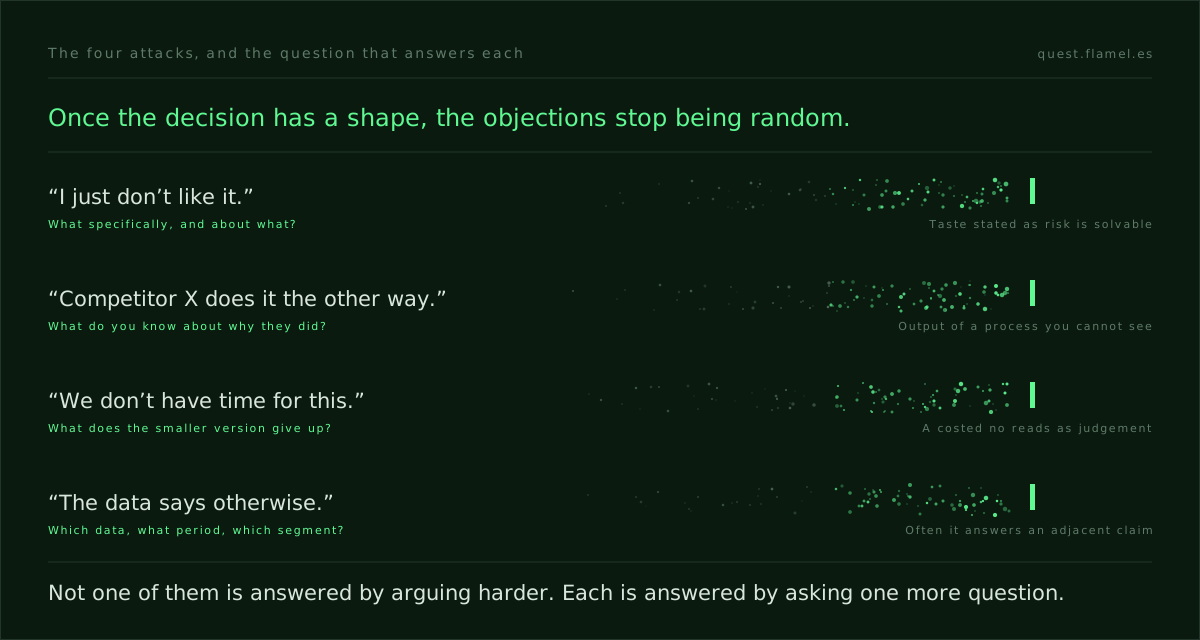
Once the decision has this shape, the objections stop being random. There are four, and each has an answer that is not a fight.
"I just don't like it." Ask what specifically, and about what. Almost always the honest answer underneath is a concern about a risk — it looks cheap, it looks aggressive, legal will hate it. That concern is legitimate and addressable. Taste stated as taste is a dead end; taste stated as risk is a design problem you can solve.
"Competitor X does it the other way." Ask what you know about why. If the answer is nothing, the observation carries no information: you are looking at the output of a process you cannot see, possibly a bad one. Competitors are a source of hypotheses, never of evidence.
"We don't have time for this." Agree, and price it. Say what the smaller version costs and what it gives up. A no that comes with a costed alternative reads as judgement; a no without one reads as obstruction. This is the single highest-leverage habit in the whole list.
"The data says otherwise." Ask which data, over what period, on which segment. Often the data says something adjacent — that a previous version of this idea, executed differently, did not work. That is worth knowing and it is not the same claim. When the data genuinely contradicts you, say so immediately and out loud. Nothing buys credibility for the next twenty arguments like conceding one cleanly.
Most of this happens before the meeting
There is a version of this article that is about rhetoric, and it would be a worse article. The reviews you win are mostly won in the days before them.
If the decision is significant, the person most likely to block it should not be hearing about it for the first time in front of an audience. Fifteen minutes with them beforehand costs you nothing and changes the shape of the meeting completely: either they raise the objection privately, and you arrive with the answer already built in, or they do not, and you have quietly acquired an ally who does not have to change their public position to agree with you. People defend the view they announced in a room far longer than the view they held in a corridor.
The same logic applies to the material. Send the thinking ahead — the sentence, the mechanism, the consequence — and present the screens. A room that has already read the argument spends the meeting testing it, which is what you want. A room that meets the argument and the artwork simultaneously will react to the artwork, because that is the part that is easy to have an opinion about immediately.
And a great deal of it is won earlier still, in whether people believe you generally. The designer who says "I don't know, let me find out" once a month, and who conceded cleanly the last time the data disagreed with them, gets the benefit of the doubt on the argument they cannot fully evidence. That credit is accumulated slowly and spent quickly, and it is worth more than any single technique here.
When you lose anyway
You will lose some of these, including some you were right about. Two things are worth doing when it happens.
Write down what you predicted, in the sentence structure above, and the date. Not to win later — to find out whether your model of the product is any good. Half the time you will discover you were wrong, which is worth far more than being proved right.
And then commit properly. A designer who argues hard, loses, and then implements the other version well is trusted with the next argument. One who sulks through the execution is not, and never finds out whether their judgement was sound, because they sabotaged the test. If the person who overruled you was the PM, there is a specific move that turns the loss into a bet you can still settle: what to do when the PM overrules your design.
How to get good at this
The uncomfortable part is that this is a skill of speed, not of insight. You do not usually get an afternoon to construct the argument. You get eleven seconds, in a room, after someone has just said something vague.
Which means it has to be trained separately from the design work, the way a musician practises scales rather than only playing pieces. Take any interface — one you built, one you use, one you are about to redesign — and force yourself to write the sentence. I would change X, because it makes Y easier or more likely, and we would know by Z. Then check whether the middle part names an actual mechanism or is just a nicer way of saying "it's better".
That is also the entire premise of a Quest session: the brief gives you a real business context, the clock stops you polishing, and the scoring is against the mechanism you claimed you were using rather than against how it looks. Sixty minutes, one decision, one defence.
The machine already draws. What it does not do is stand behind the drawing, and that is now the part worth showing.





