

Key takeaways
- Unsolicited redesign portfolios teach little because AI makes pretty screens cheap and, without constraints, your choices are unpriceable.
- Reviewers buy judgment under constraint, not looks; the test is a priced bet with gate, mechanism, metric, window, and stop‑loss.
- Concept galleries collapse into moodboards when mocks are costless and lack a stop‑loss, success metric with bite, and a read window.
- A strong case names the gate, constraints, MDC, stop‑loss, read window, revert path, and publishes stitched receipts with baseline, events, isolation, indexed deltas, and a power note.
- Replace redesign galleries with weekly reversible bets tied to a behavior, priced to a lever, and shipped with receipts beside claims.
Every unsolicited redesign portfolio reads like a taste exercise because there is no business model to price a choice against; the only knob left is aesthetics. That used to be wasted time; now the exercise proves even less, because a pretty Spotify screen is a one‑minute commodity for anyone with a prompt.
If there is no mechanism tied to a moment, no bound, and no check, the work is unpriceable. Reviewers are not buying a look; they are buying judgment under constraint. AI executes; it does not decide why. The test is still your bet, not your brush.
The costless mock problem
When mocks are costless to produce and swap, a gallery proves nothing about how you think under pressure. A reviewer scans for a priced decision, a stop‑loss, a success metric with bite, and a read window that can settle a fork.
Without those, your concept redesign portfolio collapses into moodboards. The asymmetry is brutal: AI can flood the zone with pixels; only you can publish receipts that survive a loupe. For reps with a brief already attached, work from practice projects in Figma.
Why “should I redesign Spotify?” is the wrong brief
A Spotify surface without streaming economics, licensing constraints, channel lock, and churn math turns every choice into ornament. You cannot pick a lever if you do not know the gate you are moving: free‑to‑paid, episode completion, or playlist saves.
“Cleaner UI” is behavior‑free; “reduce recall burden at the plan compare gate” is a mechanism. If you ask “should I redesign Spotify?” you have already lost the why, the moment, and the stop‑loss. That is why a redesign concept UX will not travel in rooms.

A concrete moment that would count
A case that reads as judgment would name the gate and price the exposure: “Ship recognition‑first plan compare for first‑time mobile visitors under a single‑scroll envelope and 200ms latency budget; stop‑loss −5% CTR; success is +10% plan selections with MDC 6% within 14 days; else revert.”
That is local to a lever, observable, and reversible. It gives a reviewer the spine: decision, constraint, mechanism, check, and revert. Screens without this spine are theater. To write the spine down before you open a design tool, start from a design brief template.
What to train and how to measure it
- Frame one reversible bet per week with a named constraint, a stop‑loss, an MDC you will power, and a read window that respects traffic; localize risk to the lever you are testing and prewrite the revert path.
- Tie your rationale to behavior at a moment: reduce extraneous load at the decision gate, increase pre‑attentive contrast on differentials, and lower recall by prefilling known fields; state why this lever should move this population now.
- Publish stitched receipts: inherited baseline, exact events, isolation tactic (gates, holdouts, or routing), indexed deltas within the declared window, and a power note; avoid raw revenue that cannot isolate the mechanism you touched.
Practice under business constraint, not in a vacuum
If you want your next week to count, replace galleries with briefs that carry context and a hard bound. Start with realistic constraints and a mechanism you can isolate so your work can earn a read. Use the library of realistic briefs in realistic design briefs to practice with and pick one where you can name the MDC and the stop‑loss up front. Timebox it as a 60‑minute design challenge.
Then run the exercise against a free sample brief with business context and keep the lever, checks, and revert visible. If AI drafts options, mark them and keep ownership of the frame. You train insight by deciding under pressure, not by matching a brand’s surface.
Replace concept galleries with receipts
A strong middle‑weight case names the inherited baseline, instruments events you can verify, and keeps the read clean with a holdout or a gate. Index deltas to your baseline and declare the window so seasonality cannot hide a miss or fake a win. Keep success local to the lever so a revert is honorable, fast, and cheap. For a scaffold that makes authorship readable in two minutes, steal the sequence in Prove the judgment was yours and make decision, constraint, mechanism, check, and revert carry on scan.
The screen is free; the decision is not
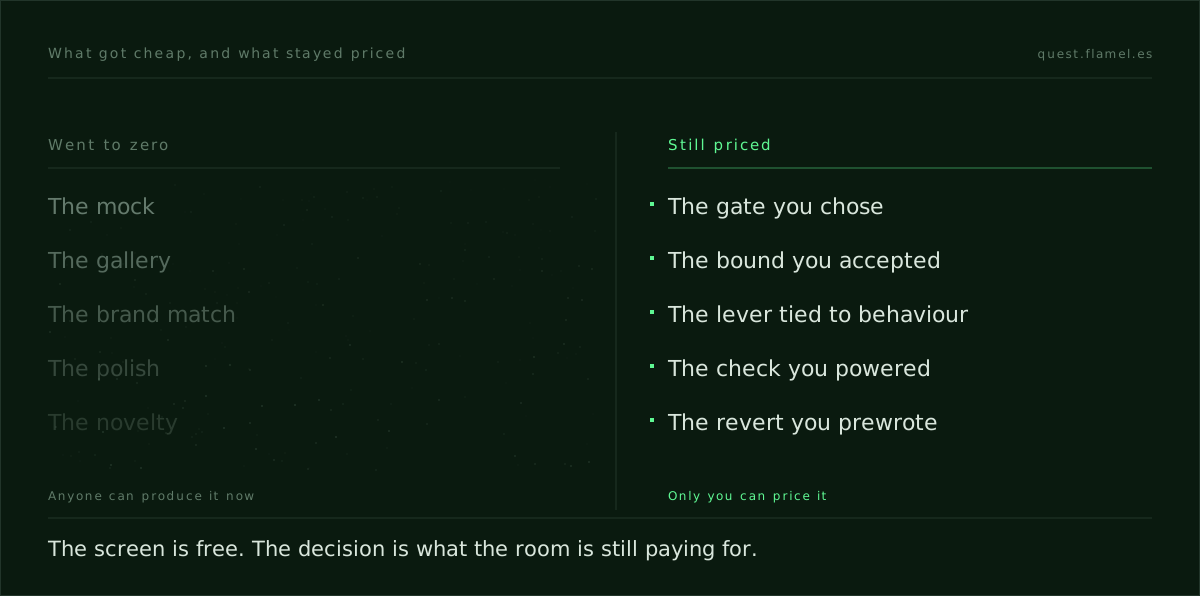
The reason “unsolicited” now reads as empty is not snobbery; the market can price pretty at near zero. What still costs is the choice you make under a hard limit with a lever tied to behavior, an MDC you will power, and a stop‑loss you will honor.
That work survives redaction and rounds. It travels across rooms because the bet is priced, the exposure is bounded, and the revert is prewritten.
Your next step this week
Pick one brief with a tight gate and a measurable outcome, write a two‑sentence reversible bet with the bound, MDC, read window, and stop‑loss, and ship it with receipts beside claims. Train your diagnosis and lever‑selection with the Insight skill so you can name the why before the what.
Then publish the read in indexed deltas, not vibes, with the revert you promised.
You are my design review partner focused on judgment under constraint. Using the specifics I provide, draft a two-sentence reversible bet and a receipts plan that are legible under NDA. My specifics: [product and audience], [moment/gate and target lever], [current baseline metric and variance], [traffic volume for the window], [hard constraints: latency budget, screen envelope, channel/policy limits], [stop-loss threshold], [read window], [NDA redactions]. Output: 1) Reversible bet with named gate, constraints, success metric, MDC sized to my traffic, stop-loss, and read window; include revert path. 2) Rationale tied to behavior at that moment and why the lever should move now. 3) Instrumentation: exact events, parameters, IDs. 4) Isolation tactic: holdout, gate, or routing; note risks. 5) Receipts template: inherited baseline, indexed deltas, declared window, and a power note. Be concrete and price the exposure.
Frequently asked questions
What makes a redesign case read as judgment instead of taste?
You name the gate and lever, bind the decision with real constraints, and preprice exposure with success, MDC, stop-loss, and a read window; then you publish stitched receipts (baseline, events, isolation, indexed deltas, power note) and a revert path. That spine lets a reviewer see decision, constraint, mechanism, check, and revert on scan, not just surfaces. For a scan-friendly scaffold, steal the sequence in Prove the judgment was yours.
How do I choose a stop-loss that is credible and safe?
Tie it to the downside you can localize at the gate you’re touching, not to global revenue. Use a threshold that protects the business and traffic quality, e.g., “revert if CTR −5% vs holdout within window,” justified by baseline variance. Prewrite the revert path so rollback is cheap and honorable. Keep it near the lever so a miss is quick to detect and limited in blast radius.
How do I set MDC when my traffic is limited?
Pick the smallest relative change you can realistically detect within the read window given your volume and variance, and state that as your MDC and power note. If you’re thin on traffic, widen the window, strengthen the isolation (tighter gate, cleaner holdout), or choose a lever with higher base rates. Be explicit: “MDC 6–10% relative, powered by N=, window=14d.” Practice sizing against a free sample brief.
How do I publish receipts under NDA without exposing sensitive numbers?
Tokenize entities, redact absolutes, and index all deltas to an inherited baseline (set baseline = 100). List the exact events and isolation tactic so the read is auditable. Declare the window and stop-loss you honored, then show indexed movement and the revert decision. This keeps authorship and mechanism visible without leaking PII or revenue. See the scaffold in Prove the judgment was yours.





