

Key takeaways
- In the UX portfolio AI era, polish is cheap; traceable judgment under constraint is the signal.
- Show the choice set, the lever, the bounds, checks, and reverts so reviewers can price risk.
- Lead each case with one sentence: decision and bound, mechanism and moment, MDC and read window, then surfaces.
- Make AI an instrument: show constraints, acceptance criteria, and a selection rubric; prove discernment over prompts.
- Publish a one‑page memo with receipts, MDC, window, and a revert; append the gallery last.
The finish is no longer a signal
In the UX portfolio AI era, finish has stopped being a signal; a week of prompts and a day of styling can make any flow look competent. Hiring managers know this, so polish no longer separates you; provenance does. What still differentiates is the chain of choices you made under constraint. Your portfolio must show the decision’s fingerprint, not just its sheen.
You did not miss the shortlist because a gradient was off; you missed it because the “why this, not that, under this limit” was invisible. If a reviewer must infer the decision from screens, they will default to brand bias and the safest recognizable pattern. When execution is cheap, ambiguity is expensive. Make your choice set, your lever, and your stop‑loss explicit to lower that price.
Treat your portfolio as evidence of judgment under constraint, not a gallery of surfaces. Name what you refused to ship and the price you were protecting, and tie each claim to a local check. Show the variant you killed and the rule that killed it. Your edge is not taste; it is defensible selection driven by mechanism and bounds, visible to someone who was not in the room.
This reality is not a funeral for design; it is a reprice of the signal. The market still rewards designers who change behavior under constraints leaders care about, and the job remains worth doing if you can prove that motion. For a sober read on the terrain you are entering, revisit whether the path still pays in 2026 in the piece on whether it is worth becoming a product designer in 2026, and calibrate your posture accordingly.
Your path to “how to stand out UX portfolio 2026” is not a shinier hero image; it is a tighter audit trail. Finish gets you a glance; traceability gets you belief. Reduce inference, foreground constraint, and make your claims falsifiable. You are not selling aesthetics; you are selling reliable decision‑making under real cost and real time.
Execution is commodity supply; judgment is scarce demand. Make your portfolio a ledger of decisions, mechanisms, checks, and reverts, and you will look singular even when the screens look similar. The reviewer should leave with one conclusion: you can choose the right lever for this population, in this moment, at this price, and you know when to undo it if you are wrong.
Prove the decision, not the surface
Lead every case with the decision and its bound, then pause. “Approve recognition‑first at price compare for new visitors under a fourteen‑day stop‑loss; success is +10% plan selections in‑session on mobile, else revert to copy‑only.” That sentence says what you chose, where it bites, how you will read it, and how you price being wrong. It makes risk measurable, not theatrical.
Follow with why the alternatives were not equivalent under your constraint. “Novelty extended discovery time; recognition reduced interpretation time we could not afford this quarter.” Tradeoff language proves you priced the cost before asking for permission. The goal is not to be universally right; it is to be specifically right for this population, this moment, and this window.
Name the lever you pulled and the exact decision gate it targeted. Pre‑attentive contrast and explicit grouping at compare reduce “stops to think” before plan selection; chunked benefits and recognition over recall reduce misclicks. When you connect mechanism to moment, you invite a local check and a faster yes. Without it, your “better” collapses into vibe and taste.
State your minimally detectable change and your read window so the claim competes with “ship now” on the same page. If your bound commits to a revert and your MDC is credible, your risk is priced, and the reviewer can compute the option. Anchoring your ask in this frame borrows the discipline taught in how to defend a design decision, and signals senior judgment without swagger.
Append surfaces last as proof of readiness, not as your sales pitch. If you sense the reader reaching for the gallery, re‑anchor to the choice and the bound, then proceed. The sequence that carries weight in the room also carries weight on the page: decision, mechanism, evidence, then surfaces.
Make judgment traceable end to end
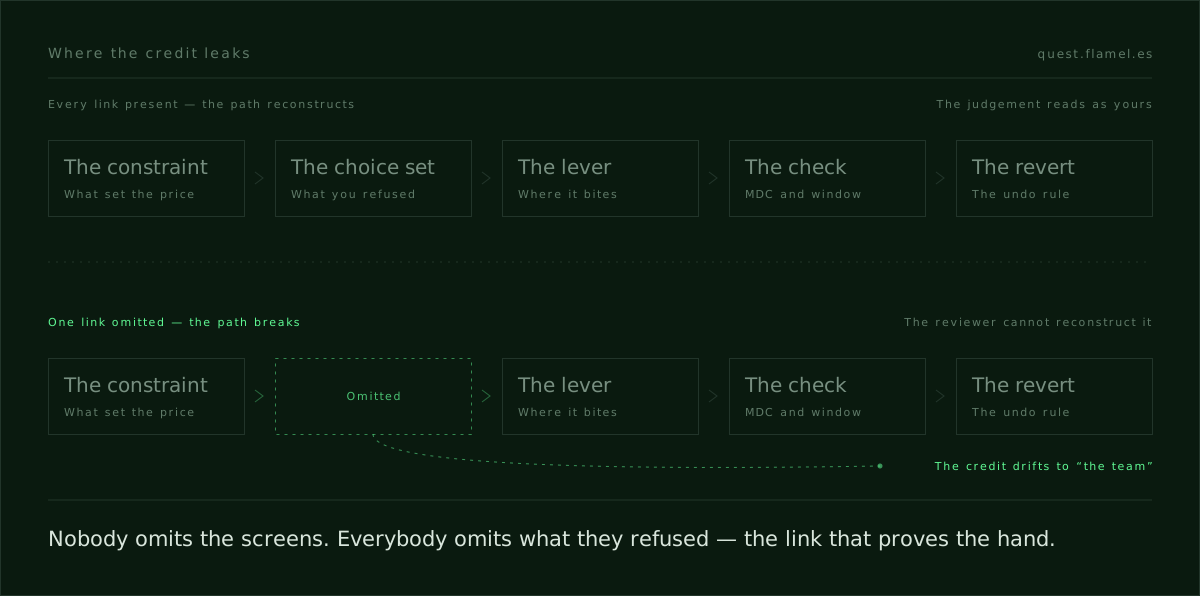
Judgment becomes legible when a reviewer can reconstruct your path: the moment you targeted, the lever you chose, the options you rejected, the check you used, and the rule that triggered revert. If any link is missing, the credit leaks to “the team,” “the PM,” or “the market.” Your job is to show attribution cleanly without erasing collaboration or inflating your certainty.
Start upstream with the constraint that set the price. “Quarterly revenue dependency and mobile latency budget capped discovery time to one scroll; we could only afford levers that shrink interpretation, not teach novelty.” The constraint frames your choice set and tells the reader why your options were narrow. An unpriced constraint reads like an alibi, not a reason.
Show the choice set and the fork you took. “We explored novelty‑first for upside learning and recognition‑first for speed; recognition won because it shortened first‑scroll compare without adding load.” Include a dead‑end variant or two with the rule that killed them; negative evidence proves you can stop. If you cannot show what you refused, your story reads like “we got lucky.”
Place receipts beside claims, not in a vanity appendix. Baseline behavior, named MDC, expected power, and isolation tactics belong near the relevant paragraph, even if summarized. Link deeper detail to a compact companion rationale so your mainline stays crisp. For guidance on this document type, read how to write a design rationale, and practice unadorned causality.
Structure is part of the proof. If you need a model to strip ornamental arcs and keep only the decision machinery, browse a few curated UX case study examples, and notice how the ask, the lever, and the bound travel together. They make the bet legible to someone who was not present when you argued it.
This is not storytelling flourish; it is attribution geometry. The shape of your case either forces the reader to infer your judgment from surfaces or lets them reconstruct it from choices under constraint. Make the path reconstructible and the judgment visible. That is how your authorship survives when your screens resemble every other competent screen.
Show AI as instrument; keep the why
AI does the part nobody will credit you for anymore: fast, plausible surfaces on demand. Own that out loud so your reviewer does not misread scarcity theater as skill. “We used AI to generate three plausible surface options; the choice here is not surface but mechanism and moment.” That line resets what is scarce: the decision, not the rendering.
Include the direction you gave the generator, not the prompt as performance. Show the constraints, acceptance criteria, evaluation rubric, and the disqualifiers you set before generation. “Reject variants that add a new concept above first scroll; prioritize recognition of plan tiers and price anchoring; minimize novel affordances on mobile.” This is how AI‑generated work still reads as yours.
Prove you can read outputs against the behavior you intend to move. “Variant B improved pre‑attentive contrast but introduced novelty at the decision gate; Variant C preserved recognition and reduced extraneous load; we chose C.” You are demonstrating discernment, not prompt craft. Keep your selection anchored to the lever and the moment, not to surface preference or tool novelty.
Show where AI sped you up on the trench work that does not threaten your attribution: variant exploration, copy optioning, alt text, and visual harmonization. Then show where you assumed judgment: framing the decision, choosing the lever, pricing the bound, and naming the revert. The split maps to the month’s argument: the generator executes; the team decides why.
Make failure visible so the trust climbs. Include the off‑target variant you generated and rejected, the failure mode you anticipated, and the rollback plan you had in place. Judgment shows most under pressure. Screens that cruised through unchanged do not prove anything; screens that survived because you protected the risk do. That is the difference between luck and decision.

Structure your case study for attribution
Open the case with a one‑sentence decision and bound, then move into the mechanism and the moment, then the receipts, then the surfaces. This order travels furthest in hiring loops because it reduces inference and prices risk. The reverse order asks the reviewer to guess your why from your what. In a stack of ten good‑looking projects, guesswork is death. Getting that opener wrong is the first of six case study red flags reviewers notice in the first minute.
Name the realistic alternatives and why they were not equivalent under your constraint. “This quarter’s growth target and marketing calendar meant discovery time was scarce; recognition over novelty paid faster with lower variance.” Tradeoff language signals you did not back into your decision from preference. It tells a hiring manager they can trust you around cost and variance. For an interview exercise, practice explaining the decision behind a design take-home, including the alternative you rejected and what you would check next.
Put the revert in the plan, not as a concession. “If minimally detectable change is not achieved by day fourteen, revert behind the flag and ship copy‑only improvements.” This line lowers the price of being wrong and earns time to run tighter tests. It also proves something many candidates cannot prove: you know how to make a safe bet fast.
Calibrate tone to authority without inflation. Overclaiming reads like bluster; hedging reads like abdication. Cite a prior ship‑and‑revert pattern if you have one; show the stop‑loss is not just a slide. If you need a primer on carrying weight cleanly, review the authority skill, and rehearse unadorned sentences that signal ownership without swagger.
Append the surfaces after the receipts, and annotate with the parts that exercise the lever. If you sense the reviewer skimming the gallery, re‑anchor to the bound and the check, then proceed. You are protecting attribution from a familiar derail: confusing polish with proof and novelty with movement. And when the agreement means you cannot append any surface at all, the memo still stands on its own: that is how to build a portfolio when your best work is under NDA.
Carry receipts an interviewer accepts
Most hiring manager questions reduce to four: cost, risk, speed, and impact. Answer in the same frame you opened with: the decision, the mechanism, the check, and the bound. If you are pulled into a tour, pivot with, “Happy to show screens, but the decision on the table was recognition over novelty at compare under a fourteen‑day stop‑loss; want to alter the bound or the lever first?”
Bring receipts that match your mechanism and moment, not ornamental dashboards. Baseline the current behavior, state your MDC, show expected power in your window, and name the analytics events you instrumented. Then stack your sources: prior experiments in similar flows, benchmarks that rhyme with your population, and canonical research that defends your lever. You are building confidence, not mystique.
Use small bake‑offs to settle taste and split rooms. Propose the smallest side‑by‑side that can resolve disagreement without stalling the roadmap, commit both variants to the same window and trigger, and write the revert in advance. Social proof and commitment move stuck decisions; they also prove you can steer a room. That posture reads as seniority because it is.
Execution is everywhere; attribution is not—show the receipts that your hand chose, not that your hand drew.
“We generated multiple surface options with AI; the differentiator here is choosing recognition over novelty for this segment under this bound and reading it locally.” The tool can flood the room with variants; it cannot decide which lever is right for this population under this constraint. That decision is the job.
Close with a publishable decision
If you want your work to survive a hiring loop, publish at least one case that starts with a decision, names a mechanism and a moment, states an MDC and a read window, and includes a revert clause. Put the choice and its bound in the first sentence, then show the receipts that justify the bet, and only then show the screens. Make the safe call obvious fast.
Start with a one‑page memo that can stand alone. Open with the ask, the lever, the window, and the revert in one breath, then link to receipts and append surfaces last. Practice saying the opening sentence aloud until the rhythm is automatic. Crispness turns ambiguity into an option the team can price, not a belief they must absorb on faith or aesthetics.
Treat AI as a force multiplier on prep, not your alibi. Use it to generate competent surfaces, to draft instrumentation lists and rollback plans you will verify, and to write plain‑language summaries you will edit. Anchor your posture in three skills: behavior design, defensible UX judgment, and the ability to direct the generator. For models where the decision is explicit and the check is tight, browse the Showcase, and notice how attribution survives without ornament. Then publish one piece this week with its decision up front, a credible stop‑loss, and a revert you will honor.
You are a senior product design coach. Ask me for the essentials of my case: [describe the design decision], [population/segment], [core constraint], [choice set], [minimally detectable change], [read window], [baseline], [expected power], [analytics events], [isolation tactic], [dead‑end variants], [acceptance criteria], [disqualifiers], [AI generation uses], and [revert plan]. Using my inputs, produce a one‑page decision memo that opens with one sentence stating the decision, the bound/stop‑loss, the success metric and window. Then write: 1) Mechanism and moment (which lever, where it bites, why now). 2) Choice set with the fork taken, and killed variants with the rule that killed them. 3) Receipts: baseline, MDC, expected power in the window, events, and isolation tactics. 4) AI split: constraints/rubric given, what AI generated, and how selection mapped to behavior. 5) Revert clause and rollback trigger. Close with a short interviewer pivot line and a note on what the gallery proves. If any field is missing, propose credible defaults and flag assumptions.
Frequently asked questions
How do I pick a credible MDC and read window with a small sample?
Anchor MDC to the smallest change that would change a roadmap call, not vanity deltas. Use your baseline rate, traffic, and variance to size a window you can afford; if power is thin, add leading indicators that rhyme with the decision gate and pre‑commit a revert. Prefer sequential reads and isolation tactics over prolonged tests you cannot power. State the trade and the stop‑loss up front.
How do I show authorship without erasing the team?
State the constraint source, your decision, and the rule that chose it; credit collaborators for exploration and execution. Show the choice set you framed, the variants you killed, and the revert you owned. Place receipts beside claims so attribution travels without inflating certainty. Calibrate tone to ownership without swagger; practice clear, bounded sentences and review the posture guidance in the authority skill.
How do I include AI in my case without looking like I outsourced design?
Show direction, not prompt theater. List the constraints, acceptance criteria, evaluation rubric, and disqualifiers you set before generation. Map AI to surface exploration, copy options, and harmonization; map yourself to framing the decision, choosing the lever, pricing the bound, and naming the revert. Include at least one rejected AI variant and why it failed the rule. Selection against behavior beats prompt lore.
What if stakeholders keep asking to see screens first?
Pivot to the decision and bound before the gallery. Use a crisp opener, name the lever and the read window, then show the smallest bake‑off that can resolve disagreement fast, with a prewritten revert. This reduces inference and prices risk on the same page as “ship now.” For tactics that carry in rooms, rehearse the frame in how to defend a design decision.
Does product design still pay if AI makes polish cheap?
Yes, if you sell judgment under constraint, not surfaces. The market still buys designers who can choose the right lever for a population, in a moment, at a price, and undo it fast if wrong. If you want a sober read on trajectory and posture, start here: is it worth becoming a product designer in 2026. Then publish a case with a decision, a bound, receipts, and a revert.





