
Key takeaways
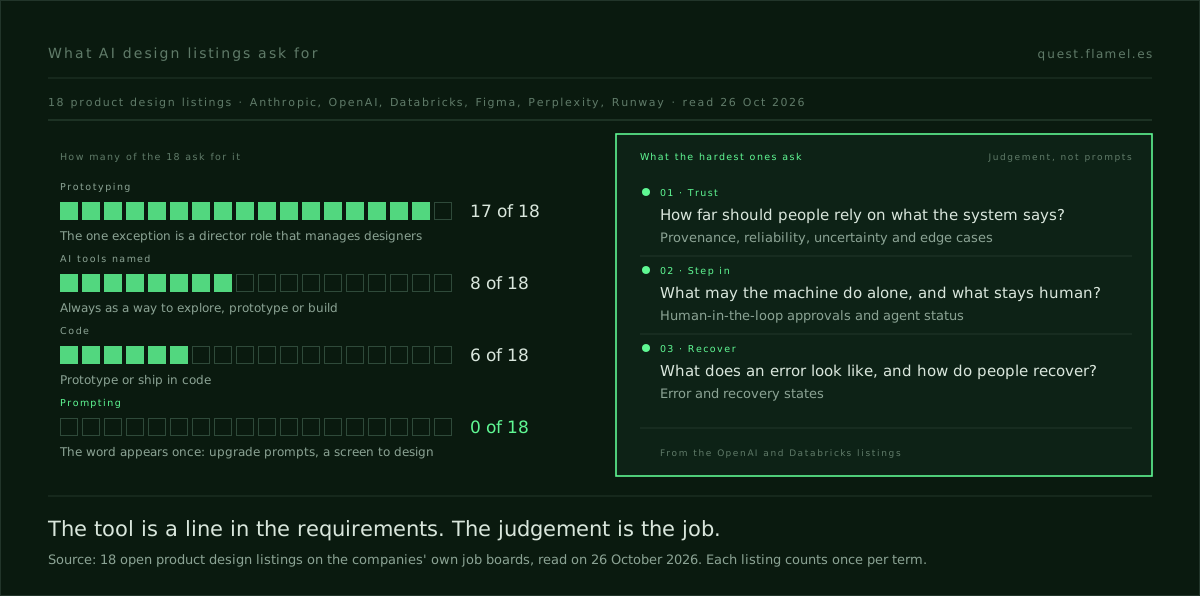
- Of 18 product design listings open this October at six AI companies, none asked for prompting and 17 asked for prototyping.
- AI tools appear in 8 of them, always as a faster way to explore, prototype or build, never as the job itself.
- The hardest listings ask when people should trust a system's output, when they should step in and how they recover.
- Growth roles ask for evidence that your work changed behaviour, not for more screens.
- Prepare with one working prototype, one written decision about trust and error, and one result you can explain.
AI design jobs ask for less prompting than the tutorials suggest. If you came for openings, this post reads them for you: 18 product design listings at six AI companies, open this week. None asked you to know how to prompt; 17 asked you to prototype. The hardest asked what no tool supplies: when people should trust what a system tells them, and what happens when it is wrong.
That gap matters if you are deciding what to learn next. Prompting is the visible part of working with models, so it is what most advice sells. The listings are buying something else: designers who decide what a machine should do alone, what it should only propose, and what an error looks like before a user meets it. Here is what they ask for, in their own words, and how to prepare without changing trade.
What we read
We started from a curated board of design roles at AI companies, which listed 439 positions at 166 companies on 25 October, and read every open product design role at six of them: all of OpenAI's, Perplexity's and Runway's, plus two at Anthropic and one each at Databricks and Figma. That is 18 listings, read in full on 26 October 2026. Brand, motion, web and engineering roles at the same companies were read too, and kept out of the count.
It is a snapshot, not a survey. Listings change every week, and a bank hiring its first designer for an AI feature will write a different advert. But these are the teams closest to the models, so their listings show what the work looks like where it is newest, before the wording settles into templates.
Prompting is missing. Prototyping is not
Not one of the 18 asks you to know how to prompt. The word appears once, in "upgrade prompts", which is a screen Runway wants you to design rather than a skill it wants you to have. Prototyping, by contrast, appears in 17 of the 18. The exception is a director role at Figma whose job is managing designers.
AI tools do appear, in 8 of the 18, and always next to the same verbs. Anthropic's growth role asks you to "prototype and test ideas quickly with Claude Code and other AI tools". OpenAI wants designers "fluent in using AI to explore, prototype, communicate, and extend what you can build". Two of Runway's three product design roles list functional prototypes made with Claude Code or Cursor under "bonus points". The tool is how you reach a working version sooner. Nobody is hiring for the typing.
Six of the 18 go further and ask for code: prototyping with front-end code at Anthropic, "shipping small design changes directly in the codebase" at Databricks, "comfort prototyping or coding your ideas" at Perplexity. When a listing leans that way, it describes something close to a design engineer, who hands over the interface users get rather than a file someone else rebuilds.
What they ask for instead: when to trust the machine
The most specific requirement in the sample sits in OpenAI's listing for a product designer in Engineering Acceleration, the team building its internal data and experimentation tools: "understand how provenance, reliability, uncertainty, permissions, and edge cases affect whether people act on a system's output." Read it twice. It is not asking how to get good output from a model. It is asking what a person needs to see before they act on output that might be wrong.
Databricks asks the same thing about agents. Its staff designer for agentic coding has to work out "how people supervise fleets of agents", and the listing names the hard part plainly: "helping people know when to trust, when to step in, and how to recover when work goes off track." Its surfaces include human-in-the-loop approvals, agent status and transparency, and error and recovery states. OpenAI's consumer listing wants "strong instincts for trust, safety, transparency, and user control".
Strip the vocabulary and it is one judgement in three parts: how much a person should rely on what the system says, what a wrong answer looks like when it arrives, and which decisions stay in human hands. They are the same three questions that sit behind the AI UX designer title: trust, error and control. No prompt answers them, because each has to be decided before anyone writes one.
Growth roles ask for proof, not screens
The growth listings add a second demand, and it is just as far from prompting. OpenAI's growth role is "most interested in designers with strong product judgment, exceptional craft, and evidence that their work meaningfully changed user behavior or business outcomes." Anthropic's wants you to "judge results with a nuanced view of how we win, not just the topline metric". Runway's asks for comfort "running and reading quantitative experiments, not just shipping a single 'best' design".
It is the same shift running through the whole field. When a model can produce the screen, the screen stops being evidence of anything. What a hiring team cannot generate is your account of a decision: the behaviour you expected to change, why you expected it, and what actually happened. A portfolio of polished screens answers a question these listings have stopped asking.
Four jobs behind one search
Part of the confusion is that one search covers several jobs. Sarah Gibbons at Nielsen Norman Group splits AI design into four kinds of work: designing with AI, designing AI products, designing for AI agents, and designing the AI itself. The skills differ. For the first she names prompt literacy and workflow integration; for the last, model evaluation, principle setting and collaboration with ML engineers.
Every one of our 18 is, in some sense, the second kind: the product has a model in it. The first kind is folded in as a line in the requirements. That gives you a quick way to read any listing. If the AI appears in the requirements, it is a tool you will use. If it appears in the description of the product, the model's behaviour in front of users is the job, and the interview will probe trust, error and control.
How to prepare without changing trade
None of this asks you to retrain. The trade is the same; what moved is which half of it is scarce, and these listings describe the scarce half with unusual precision. Three things prepare you for it, in order of how quickly they show.
Build one prototype that behaves. Pick a flow you know and build it as a working prototype with the tools the listings name, including the states a static file skips: loading, empty, failed. It answers the requirement in 17 of the 18, and it teaches you where a model's draft breaks, which is the trust question in disguise.
Write one trust decision. Take a feature where a system tells someone something: a recommendation, a summary, a pattern in their own data. Decide when it knows enough to speak, what it shows when it does not, and what the person can do next. The mechanism underneath is the moment of insight: it needs enough input to say something true, and an insight the person cannot act on leaves them worse off. OpenAI's listing says it in another vocabulary: "a trustworthy answer and clear next step".
Explain one result. Choose one change you shipped, or one practice brief you solved, and write three lines: the behaviour you expected to move, the mechanism you bet on, and how you would know. If you have a real number, add it; if you do not, say what would have proved you wrong. That page answers the growth listings better than ten screens.
Where to start this week
Open three listings for roles you would actually apply to and underline every requirement that is not a tool. If they look like our 18, you will underline trust, recovery, experiments and outcomes, and no prompts. Take the one you underlined most and practise it on purpose, with a brief and a deadline rather than a tutorial. Each of those requirements maps to a mechanism you can name, and the skills library lays them out one at a time: what each gets you, how it fails and what to measure.
You are a hiring manager for a product design role at a company whose product has an AI model inside it. Here is the job listing: [paste the listing]. Here is my portfolio summary or one case study: [paste it]. Do not rewrite my work and do not suggest tools or prompts. Do four things. First, list every requirement in the listing that is not a tool, in the listing's own words. Second, sort them into four piles: prototyping, trust and error, evidence of outcomes, and anything else. Third, for each requirement, quote the line of my material that answers it, or write "missing". Fourth, name the single missing requirement most likely to come up in the interview and ask me one question about it that I should be able to answer in two minutes.
Frequently asked questions
Do AI design jobs require prompt engineering?
Not in the listings we read. Of 18 product design roles open at six AI companies in October 2026, none asked for prompting. AI tools appeared in 8, always as a way to explore, prototype or build faster. The only design listing in our wider sample that asked you to prompt was a marketing role making video ads.
What skills do AI product design roles ask for?
Prototyping above all: 17 of the 18 listings mention it. Beyond that, the most specific requirements are about trust: how provenance, reliability and uncertainty affect whether people act on a system's output, and how they step in and recover when it goes wrong. Growth roles add evidence that your work changed user behaviour or business outcomes.
Do I need to code to get a design job at an AI company?
Usually not, but it helps. Six of the 18 asked for code in some form, from prototyping with front-end code to shipping small changes in a codebase. When a listing leans that way, it describes something close to a design engineer, who hands over the interface users actually get.
What are the different kinds of AI design work?
Nielsen Norman Group names four kinds: designing with AI, designing AI products, designing for AI agents and designing the AI itself. They need different skills, from prompt literacy and workflow integration for the first to model evaluation and principle setting for the last. All 18 listings we read are the second kind, with the first folded into the requirements.
How do I prepare for an AI designer job without changing careers?
Build one working prototype that includes its failure states. Write one decision about when a system should be trusted and what the person does when it is wrong. Then explain one result: the behaviour you expected to move, the mechanism you bet on and how you would know. Those three answer most of what the listings ask.