
Key takeaways
- Staff is judged by how far a decision travels: which other teams changed their plans because of a call you wrote down.
- GitLab's public ladder moves from spotting cross-team gaps at senior to solving them across releases at staff, and saying "not like this" before build.
- A redesign can show reach: list the decisions it hands to people outside design and the one you would challenge first.
- A move to staff is argued from a year of written decisions; show what another team used instead of claiming alignment.
- This week, add a "who inherits this" page to your last case study.
A staff product designer is a senior designer whose decisions change what other teams decide, not one who designs better screens. If you came for job listings, this is the other half of the search: what the role asks after senior, how it shows in an interview, and the evidence a year of work has to leave.
The short version: senior is about choosing the right problem and answering for it, and staff is about how far that choice travels. The clearest way to see the difference is a piece of work where the reach is visible, so this starts with one.
A 73-minute redesign that reached past the page
Press Black is one of the practice briefs on Quest: a four-person risograph and silkscreen studio in Amsterdam, six years into the European indie design scene. Its service page reads like a printer's price list, and the first version the studio's own model produced is exactly that: a list of services, a pricing table by format and a contact form. The brief asks for a page that shifts inquiries from "how much per copy" to "can we work together".
A 73-minute redesign in the Quest showcase answers it in twelve screens. The visitor starts from the idea for their collection, gets a compatible artist recommended, chooses between three levels of collaboration and ends at a shared working session with the artist and the studio. A Build in public package lets the client's audience follow the first print run before launch. As a page, it does what the brief asked: the question moves from what it costs to print to who you want to make the collection with.
Read it at staff level and something else shows. Three of those decisions are not page decisions. Three levels of collaboration is a pricing model: someone at the studio has to price each level and turn down the jobs that fit none. A recommended artist is a roster the studio has to recruit and keep. Build in public is a service someone has to run every week of a commission. The brief describes four people; the redesign hands work to people the studio does not have yet.
That is not a flaw in the redesign. It is the most interesting thing about it, and a senior write-up would leave it out: twelve screens and the mechanism behind them, connection, explained well. The staff write-up adds one page. Which decisions does this design hand to other people, who has to agree before anything is built, and which one deserves a "not like this" now, while it is still cheap to say?

What the ladder actually asks after senior
Most career ladders are internal documents, which is why the role looks vague from outside. GitLab publishes its product designer job family in full, and reading the senior, staff and principal levels side by side shows where the line moves.
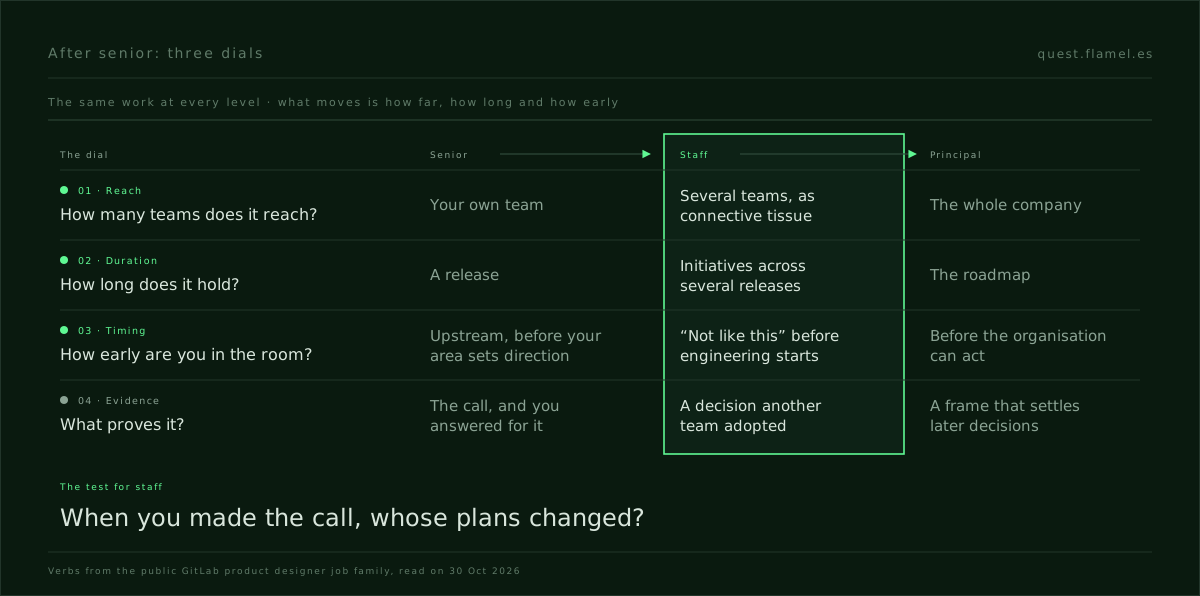
At senior, the verbs are already strategic: shape roadmap priorities, operate upstream before direction is set, and "identify cross-boundary gaps and drive collaboration across teams". At staff, the same ideas reach further. The designer should "identify systemic gaps spanning multiple teams, act as connective tissue, and drive solutions to cross-boundary problems", lead "strategic initiatives that span multiple releases", and be "positioned to say 'no' or 'not like this' before engineering starts". Staff is also where the ladder asks you to "delegate tactical execution while maintaining standards".
At principal, the assignment changes shape. A principal is assigned to projects rather than to a group, and is asked to "reduce scope, complexity, and ambiguity of the most challenging initiatives to enable organizational action".
Read the verbs as three dials rather than a list. How many teams a decision reaches: your own, several, the whole company. How long it holds: a release, several releases, the roadmap. And how early you are in the room: reviewing what was built, or saying no before it is. Other companies word their levels differently, but those three dials are a useful way to read any ladder you are handed.
Senior vs staff product designer: one question tells them apart
The new design seniority ladder drew the line below this one: a senior designer decides which problem is worth solving, names the criterion and answers for the call. Staff keeps all of that and adds a second question. When you made the call, whose plans changed?
If the honest answer is your own team's backlog, that is senior work, however large the project. If another team rewrote part of its plan because of a decision you wrote down, that is the staff pattern, whatever your title says this quarter. The Press Black redesign is the small version: one page that, if it shipped, would move the studio's pricing, its roster and its weekly workload.
Two things staff is not. It is not management: the reach comes from decisions other people can adopt without you in the room, not from people reporting to you. And it is not a bigger portfolio of screens. A principal product designer turns each dial one notch further, and the output often gets smaller: one frame that makes a dozen later decisions obvious to people who never meet you.
How staff shows up in an interview
What design interviews test at senior is a priced bet: the lever, the constraint, the metric and the point where you stop. A staff answer is the same bet plus its consequences outside your team, told before the interviewer has to ask for them.
Prepare three stories, each with something you can show:
- A decision another team adopted: the document, the date and what they changed.
- A "not like this" said before build: what you stopped, who disagreed and what it saved.
- An initiative that held across releases: what kept it coherent when the people working on it changed.
Notice what is missing from that list: the screens. They come up, and they should be good, but at this level they are the proof under the story, not the story.
The evidence a year of work has to leave
A move to staff is rarely argued from one project. It is argued from a year in which the same pattern repeats, and most designers lose that evidence because nobody writes it down while it happens. Keep a decision log: for each call, the date, what it changed outside your team and a link to whatever the other team actually used.
Then present it the way authority, one of the principles in Quest's skills library, works on a well-made service page: shown, not claimed. "Drove cross-team alignment" is a claim, and a promotion panel discounts it the way a visitor discounts "expert curation". A line like "support stopped tagging refund tickets by hand after the returns flow shipped, and here is their changelog" is the kind of specific detail only someone who did the work could write. The same rule protects you from the opposite failure: credit for a call that was really the product manager's is authority borrowed from someone else, and the panel usually knows.
A good year tends to leave four kinds of entry: a decision another team adopted, a no that saved a build, a pattern that became a default in the design system, and a designer who now makes calls you used to make. The last one is the easiest to forget and the closest to what the ladder means by delegating while keeping the standard.
Practise the staff move on a brief
You cannot get a year of reach from a practice brief, and a portfolio should never pretend otherwise. What a brief can train is the habit that produces the evidence: finishing a redesign and asking what it hands to other people. Do the redesign inside its time box, then write the extra page. List every decision the design makes that someone outside design would have to carry out, name who, and mark the one you would challenge before it is built.
Do it for the Press Black case above and the list writes itself: pricing for three levels, an artist roster, a weekly service. Do it for your last real project and you will find the material your staff case is missing. Then put that page at the end of the case study, after the section a good case study structure closes on, what you would do differently: it is where a reader decides how senior you are, and the page is what shows them the reach.
You are a design manager reviewing a promotion case from senior to staff. Here is one project: [what the team shipped, my role, the decision I made and when I made it]. Do not judge the screens and do not invent outcomes.
1) List every decision in this project that someone outside design had to carry out: pricing, support, sales, engineering, operations or another product team. For each one, name who.
2) Mark which of those I wrote down and another team actually adopted, and ask me for the evidence.
3) Name the one decision I should have challenged before build, and write what "not like this" would have sounded like.
4) Rewrite my one-line summary of the project so it states the reach as a specific detail, not as a claim like "drove alignment".
5) Tell me what is still missing for this to count as staff-level evidence.
Frequently asked questions
What does a staff product designer do?
A staff designer does senior work whose consequences reach other teams: finding gaps that span several teams, leading initiatives that hold across releases, and saying "not like this" before anything is built. The screens still matter, but the role is judged by which decisions other people adopted because of yours. It is an individual contributor role, not a management one.
What is the difference between a senior and a staff product designer?
A senior designer chooses the right problem and answers for the call. A staff designer does the same and is judged on how far it travels: whose plans changed, over how many releases, and how early the decision was made. One test: if the work stopped at your own team's backlog, it was senior work, whatever its size.
Is staff a management role?
No. Staff is an individual contributor level, and it does not come with reports. The reach comes from decisions other people can adopt without you in the room, from coaching other designers, and from patterns that become defaults. Moving to staff is usually a choice to stay close to the work rather than a step towards managing people.
How do I show staff-level impact in a portfolio?
Add one page to your strongest case: the decisions the design handed to people outside design, who carried out each one, and the one you challenged before build. Back each with something a reviewer could check, such as another team's document or changelog. A practice redesign can show the habit; only real work can show the reach, so label which is which.
What comes after staff?
Usually principal. In GitLab's public ladder, a principal is assigned to projects rather than to a group and is asked to reduce the scope, complexity and ambiguity of the hardest initiatives so the organisation can act. The work often gets smaller on the page: one frame that makes many later decisions obvious to people you never meet.