

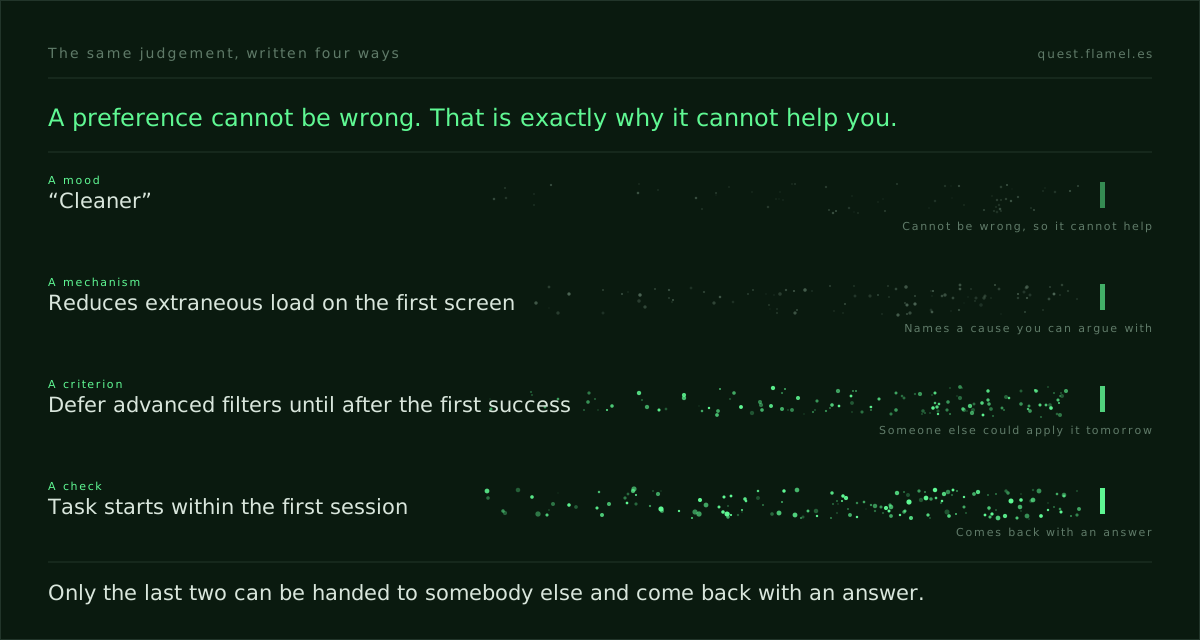
If you are asking how to talk about design decisions, you are really asking for the words that make "I like it" behave like a claim. "Looks better" is a mood; it cannot be wrong, so it cannot help. Name the mechanism and your claim becomes a bet about cause and effect. That is the part a generator cannot do for you.
What turns taste into an argument
An argument names the change, the mechanism it should trigger, and the check that would show it happened. Change the button label to a verb because action phrasing increases perceived affordance at the moment of choice, and we will know by the uplift in same-session task starts. With a mechanism you debate psychology; without it you debate palette.
Mechanisms come from three dependable families. Perception: grouping, contrast, and salience set the pre-attentive stage. Memory: recognition over recall, progressive disclosure, and chunking reduce stops to think. Motivation: loss aversion, social proof, reciprocity, and elevation nudge action. Use these as causes, not ornaments, and say where in the flow they matter.
Name the mechanism, not the mood
"Cleaner" often means reduced extraneous cognitive load, fewer competing foci, or tighter proximity grouping. Say which, and where that mechanism helps momentum. "Friendlier" usually hides the liking effect from perceived similarity or effort; surface the social lever you intend to pull. "Modern" tends to mean convention alignment that speeds recognition and shortens interpretation.
If you want a fast primer on the motivational side, revisit the map of persuasion principles for product designers. If you are invoking warmth to increase compliance, say you are applying liking. If your aim is to make a step feel significant, say you are designing for elevation.
From preference to criterion
A criterion is a rule that can be followed, inspected, and falsified. "Use progressive disclosure to defer advanced filters until after first success" is a criterion; it protects momentum by reducing choice paralysis at the starting line. "Make filters less busy" is a sentence that lets everyone nod and ship the opposite. Ask if someone else could apply your rule tomorrow.
Criteria live at the intersection of a person, a moment, and a tradeoff. "Raise text contrast to 7:1 to preserve legibility on low-end Android in sunlight" beats "make text pop," because it names who, when, and why the cost is worth it. "Show price in the compare table to reduce search cost at the deciding moment" beats "be transparent."
Vocabulary that travels across rooms
Cross-functional language works when it binds to outcomes everyone cares about. "Reduce extraneous load" travels better than "simplify," because engineering can model implications and analytics can read the effect. "Exploit loss aversion at cancellation" travels better than "be persuasive," because finance recognizes the lever and its risk. The same goes for "remove friction": say which of the four kinds of friction you mean, or nobody can check whether you removed it.
Build this vocabulary on purpose, not by collecting slogans. Keep a small, living set of perceptual and behavioral terms you can deploy precisely, and pressure-test them against flows you actually ship. If you need a place to stock the words, start with the full skills library.
Tie the word to the check
A named mechanism without a check is just better copy. Attach the first observable that would move if your cause is correct and make it the decision trigger. Not a dashboard, not a vibe - a behavior at a moment. That is also the only thing that survives a room where the PM overrules your design. For a refresher on turning bets into readouts, read how to write a design rationale and put your mechanism at the heart of the Y.
Strong: Move the primary action to the first scroll because pre-attentive placement and verb-first labeling should increase task starts on mobile, and we will know by the uplift in first-session conversions within 24 hours. Weak: Make the hero bolder to improve engagement, measured by retention. The first is a reason you can lose on; the second is a wish with a chart.
AI executes; you decide why
AI will flood you with alt layouts, friendly microcopy, and ten fresh modal variants before lunch. Your moat is naming a mechanism tied to a human moment and picking the smallest check that can retire a bad bet.
Train the three muscles that compound: product psychology and behavior design, defendable UX judgment, and the skill of directing AI instead of competing with it. If you want a starting point for sharpening the second, read how to defend a design decision and make your vocabulary carry load, not attitude.
Practise until it sounds boring
Take one decision on your desk and rewrite the taste into a mechanism, then the mechanism into a criterion with a check. Strip "nice," "clean," and "modern," and force yourself to write "reduces load by," "increases salience when," or "invokes loss aversion at." If the sentence does not feel a little boring, it probably still hides a vibe.
Then build your compact lexicon and keep it within reach. Ten perceptual terms, ten behavioral levers, and a handful of pattern names will cover most arguments you need to make this quarter.





