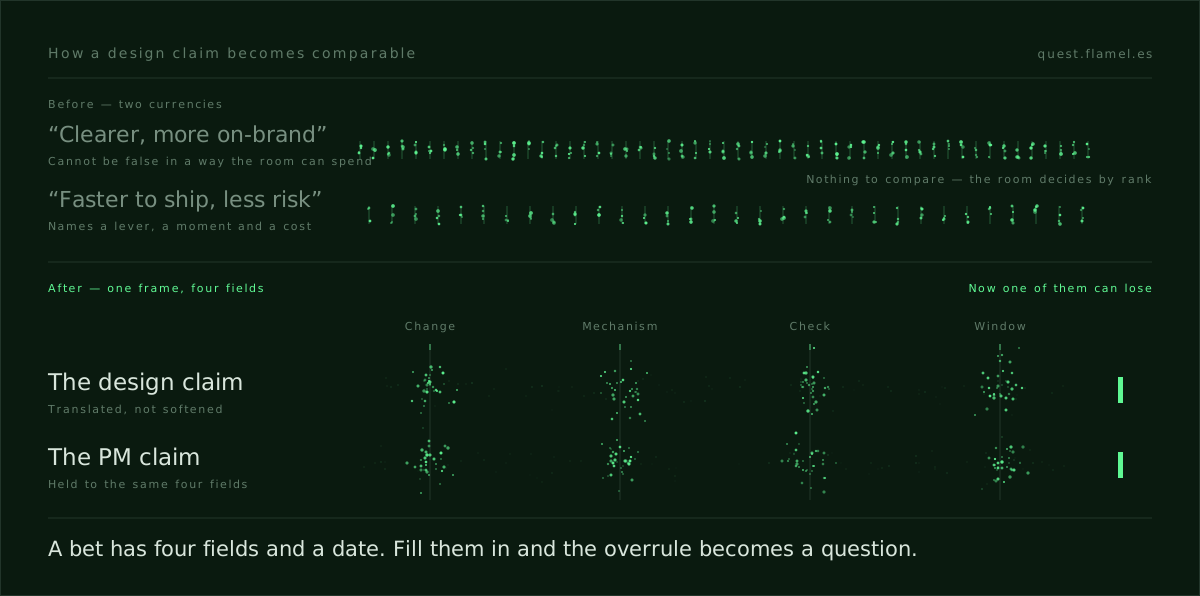
A designer product manager disagreement rarely kills a design on merit; it kills a claim that could not be compared to the PM’s. “Clearer” met “faster to ship with less risk” and lost because they are in different currencies. The fix is to convert the debate into a bet with a tie‑break check, then buy the smallest experiment that can settle it. Do this faster now, because the PM can generate a plausible alternative in minutes.
You did not lose on pixels; you lost on the frame. When a PM overrules your work, they’re usually protecting an objective function you did not make explicit. They optimize for speed‑to‑impact, risk, and effort under a date; you argued for quality, clarity, and confidence under a different clock. Two good intentions passed because the units did not match. Put both claims in one frame and you will win or lose on a reason, not on rank.
That frame has a target behavior, a moment, a population, and a cost envelope. If you pitch “delight,” the counter will be “slip,” because delight is unmeasured and slip is near‑certain. If you pitch “move price salience to first scroll to reduce abandonment at compare,” the counter has to meet you at mechanism, moment, and check. That is a debate you can survive and repeat.
Make the claims comparable. Comparable claims name the change, the mechanism that should cause an effect, and the check that would show it happened under your constraints. “Promote upgraded plan badges on the pricing card because pre‑attentive contrast should increase trial‑to‑paid conversion, and we’ll know by uplift in same‑session plan selections within three days” lines up against “ship now with copy only.” Now you’re both making time‑bound, falsifiable bets.
Translate moods into causes. “Cleaner” becomes “remove extraneous cognitive load in the plan grid by reducing competing foci,” and “friendlier” becomes “invoke similarity to trigger the liking effect in the help touchpoint.” If the counter is “ship a table we know,” call it what it is: “align to convention to increase recognition and shorten interpretation.” Comparable equals arguable; vibes equal vetoes.
State your minimally detectable change. Name a segment and a window. The more local and immediate the read, the more it can compete with “ship now” on the same page.
Turn conflict into a bet
Turn “PM overruled my design” into “we disagree about a mechanism and its yield; let’s bet on it.” Write the Y: if the mechanism is correct, a specific behavior will change at a defined moment, by a minimally detectable amount, within a window, or we revert. For a refresher on structuring that defense, read how to defend a design decision and put the mechanism at the center of the claim.
Make the reversion rule part of the bet, not a postmortem aftertaste. “If we do not see a +12% increase in same‑session starts among new visitors within seven days at N traffic, we remove the panel and ship copy‑only by end of day.” A bet with a revert clause sounds like risk management to a PM, because it is. Your leverage comes from reducing the price of being wrong.
If a PM proposes the generator’s draft, do not fight on vibe; fight on cause and check. “Your version leans on novelty; mine leans on recognition. On this flow, recognition is the faster horse; let’s settle by same‑session starts within three days.” You are meeting surface supply with decision discipline.
Name the mechanism and the moment
Say the perceptual or behavioral lever you intend to pull and where it bites. Pre‑attentive grouping, contrast, and proximity change what people notice without trying. Recognition over recall and chunking reduce “stops to think” at setup or search. Loss aversion, social proof, reciprocity, and elevation nudge action at key gates. Use these as causes, not adjectives, and tie them to one user moment.
If you need a clean motivational lever for “micro‑yes” flows, use commitment and consistency: people strive to act in ways consistent with a prior choice. Carve the first step small and salient, then echo the prior commitment at the next gate. “Place ‘Save for later’ before account creation to exploit consistency at sign‑up” is a reason you can inspect, not a mood you can ignore. For a quick primer, see the commitment and consistency skill.
Name the moment of truth in the journey. “Empty‑state first run,” “price compare fold,” “search refine after zero results,” “save vs. discard at editor exit.” If your lever does not bite there, your claim is a hope. If it does, you can price the slice that exercises it.
Buy the smallest check
The winner in a designer vs. PM conflict is not who argues longer; it’s who proposes the smallest, fastest check that can falsify their own claim. Pick an observable closest to the behavior you want, at the same moment, in the tightest segment that has power. Commit to a minimally detectable change that matters, and a time window long enough to see it and short enough to ship other work.
Resist ornamental dashboards; choose a trigger. “Uplift in first‑session task starts within 24 hours on mobile US traffic” beats “engagement” because it is local and immediate. “Reduction in help clicks at the empty state among returning users this week” beats “retention” because it moves before everything else.
Slice visuals to isolate the cause. If your mechanism is pre‑attentive contrast, do not change layout and copy. If your lever is recognition, keep iconography stable while you test label placement. Make the slice narrow, visible, and reversible. Price it with engineering in the room.
Disagree, commit, and revert
“Disagree and commit” is not “ship and pray”; it is “ship with a bound.” Make the commitment precise: the stop‑loss, the readout, the revert plan, and the time window. Ask the PM to commit in writing to the decision trigger you proposed so the arbitration is not taste‑in‑retrospect. You can lose the first round and still pre‑wire the tie‑break.
Use social levers to make the commitment real. Surface the prior statement on goals and constraints, then ask for consistency with the chosen check; you’re invoking commitment and consistency in a room that respects visible follow‑through. Replace “let’s see how it feels” with “we agreed uplift in X by Y date determines which path graduates.”
If the team still says no, finish strong. Document the mechanism you proposed, the constraint that beat it, the check you would run next, and the trigger that would reopen the decision. Park that note beside the ticket and your roadmap; it’s evidence, not attitude.
Handle scope, risk, and effort
Many overrules are not about value; they are about cost curves you did not put on the table. Propose the thinnest slice that still exercises the mechanism, and price its effort in real units with engineering present. “Ship the affordance change behind a flag on pricing only” often wins where “redesign checkout” must lose. Shrink the cost until the room can afford to learn. If the cost curve you have to answer to belongs to a VP, present the bet before the screens and the scope question answers itself.
Name risks and neutralize them in the design of the check. Scope creep is handled by flags and rollbacks. Regression risk is handled by isolating routes and segments. Analytics debt is handled by pre‑wiring events before you argue. When the PM hears you talk risk the way they do, your design starts sounding like a plan, not a wish.
Give PMs a better reason to be right. Tie your mechanism to the metric they already own and the risk they already fear. “Same conversion in half the scope,” or “same scope with faster readout,” are reasons to switch horses without losing face.
If debate stalls, buy a time‑boxed test or a live bake‑off. Grab an hour, define the mechanism and the check, and run a focused sprint with engineering and PM in the room. For a pattern that fits, see how to run a 60-minute design challenge and make the output a measurable fork, not a gallery. Speed earns permission for precision.
Train the muscle; win with AI
You do not build this muscle in the room; you borrow it from last week. Practice turning moods into mechanisms and mechanisms into checks on small, safe surfaces. Run tiny Y‑memos on internal tools, empty states, and release notes so you have patterns ready when the stakes go up. Repetition makes the boring sentences travel faster when the room gets loud.
AI will keep flooding the room with competent variants and friendly words. What it does not decide is why one variant is right for one moment with one population under one constraint. The race now rewards three trainable skills: product psychology and behavior design, defensible UX judgment, and the ability to direct AI instead of competing with it. Put your best hours there; stop competing on surface supply.
If you need working examples of arguments that survived the room, browse defended decisions in the Showcase. Study how the change, the mechanism, and the check travel together under pressure, and borrow the shapes that fit your flows. Then take the next overrule as a chance to reframe, bet, and learn in public.
The goal is not to win every vote; it is to retire bad bets faster. If you want a place to start, pick one flow this week and write two comparable claims, each with a mechanism and a check. Pitch the smaller bet first. And for a broader library of patterns and posts you can hand to teammates, the blog has the working kits.