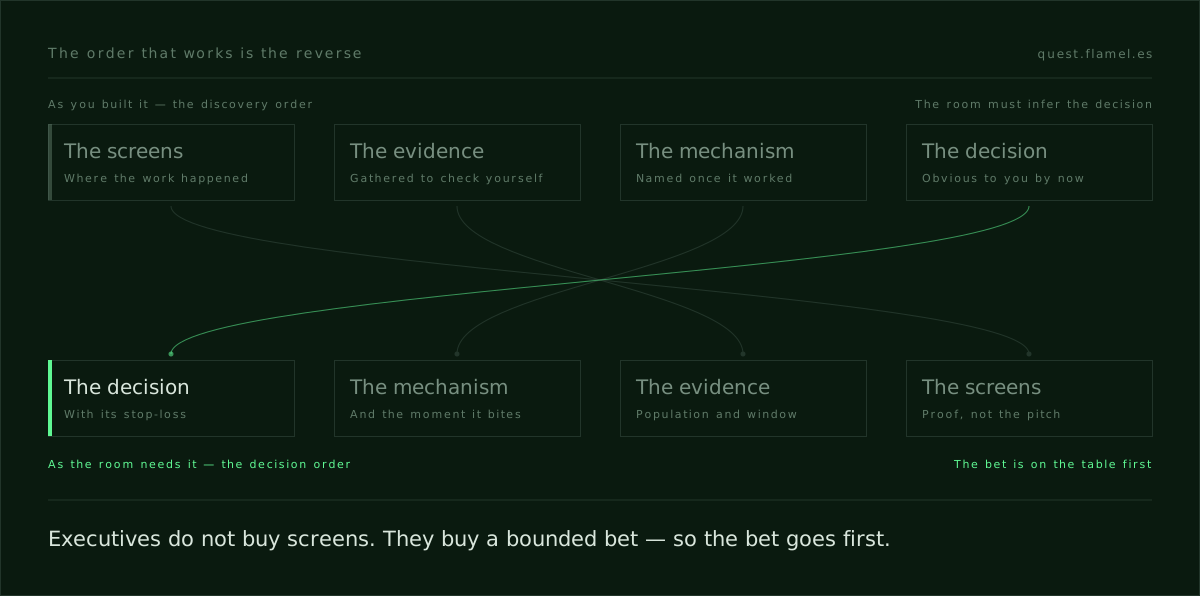
Executives do not buy screens; they buy reduced risk, faster impact, and controlled costs, and “presenting design work to stakeholders” is a translation job into that currency. The order that works in the room is the reverse of how you built it: decision, mechanism, evidence, and only then the surfaces. Screens are commoditized; the argument that moves an executive is why one path is safer and faster under the same constraint.
You did not lose a past pitch because the mockups were weak; you lost because the story started too late. When your first slide is a walkthrough, you are asking leaders to infer the decision from details while the clock burns. If they cannot see the choice and the stop‑loss before they see your gradients, they will reframe and pick the simplest recognizable path.
Translate your vibe words into causes and checks before you show a map. “Cleaner” is noise to a VP who is counting quarters; “reduce extraneous cognitive load at price compare to shorten time‑to‑choice” is a mechanism with a target moment. Tie your claim to a metric, a window, and a revert rule so their question becomes “does that bound cover my risk,” not “do I like this color.”
Executives already see AI produce convincing surfaces in minutes; that supply erodes your demo as a differentiator. Your edge now is choosing a mechanism that moves a specific behavior for a specific population under the constraints leaders already defend.
Start with the decision, not the demo
Open with the action you want and its bound in one sentence, then pause. “Approve the recognition‑first variant for pricing under a seven‑day stop‑loss at N traffic; success is +10% uplift in same‑session plan selections among new visitors, else we revert.” That sounds like risk management because it is, and it makes everything after it context, not theater.
Name the realistic choice set and why the options are not equivalent without turning the discussion into a beauty contest. “Recognition over novelty for this flow because recognition reduces interpretation time at compare; novelty adds discovery time we cannot afford this quarter.” You are arguing from mechanism and constraint, not taste. Tradeoff language signals you priced the cost before asking for time.
Put the reversion clause up front as part of the plan, not a concession. “If we do not see the minimally detectable change by day seven, we remove the affordance behind the flag and ship copy‑only.” That line lowers the price of being wrong and earns you room to run a tighter test. Executives buy the option; they do not need your perfect certainty.
Bring the discipline you use in conflict to your structure. Decisions travel further when they are explicit, time‑bound, and testable; vibes invite vetoes and revisits. If you need a compact scaffold to make your claim falsifiable and crisp, reread how to defend a design decision and practice saying the ask, the lever, the window, and the revert in one breath.
Name the mechanism and the moment
Say the lever you intend to pull and where it bites in the journey. Pre‑attentive contrast, grouping, and proximity change what is seen without effort at a glance. Recognition over recall and chunking shrink “stops to think” at decision gates. Loss aversion, social proof, reciprocity, and elevation nudge action when value is ambiguous.
Make the moment concrete so the check is local and immediate. “Price compare first scroll,” “save‑vs‑discard at editor exit,” “zero‑results refine,” and “first‑run empty state” are spots where small perceptual shifts cascade into behavior. If your lever does not bite there, your claim is a hope. If it does, you can price the smallest slice that exercises it without boiling the ocean.
Define the population, the window, and the minimally detectable change so your claim competes with “ship now” on the same page. “New visitors on mobile US traffic this week” is a window a VP recognizes. “+12% same‑session starts” is a change that matters and can be falsified without waiting a quarter. Isolate the cause and the read; you make the green light cheap.
Lead with evidence executives accept
Lead with receipts that match your mechanism and moment, not ornamental dashboards. Baseline the current behavior, state your minimally detectable change, and show the power you expect in your window. Then place your sources in a stack: prior experiments in similar flows, benchmarks that rhyme with your population, and canonical research that defends the lever. You are building confidence, not mystique.
Calibrate your tone to authority without overclaiming; the room will punish both hedging and bluster. Cite your prior ship‑and‑revert patterns as proof the stop‑loss is real, not just a slide. If you need a quick primer on carrying weight cleanly, review the authority skill and rehearse unadorned sentences that signal ownership without swagger. Executives buy crispness because it makes the risk computable.
Acknowledge the AI supply explicitly so your evidence is not misread as scarcity theater. “We used AI to generate three plausible surface options; the choice here is not surface but mechanism and moment.” The tool can flood the room with variants; it cannot decide which lever is right for this segment under this constraint.
Structure the deck backwards
Put the decision and stop‑loss on slide one, the mechanism and moment on slide two, the evidence and window on slide three, and the risks and mitigations on slide four. Append screens and flows last as proof of readiness, not as your sales pitch. If you sense the room reaching for the gallery, re‑anchor to the decision and the bound, then proceed. You are protecting the frame from a familiar derail.
Say plainly what you are not asking for today. “We are not redesigning checkout; we are asking to ship the recognition change on pricing behind a flag for seven days to test whether it moves same‑session plan selections.” Eliminate future‑tense fantasy by scoping your request to the slice that exercises the mechanism. The mental simplicity skill will help you cut sentiment until only the ask and the check remain.
Price the learning, not the dream. Put effort in real units with engineering present, show isolation tactics that shrink regression risk, and name the analytics events pre‑wired for the read. When you speak in bounds, flags, and rollbacks, you are talking in an executive’s unit system. You are no longer a pitch; you are a plan with a stop‑loss.

Handle questions without losing the frame
Most executive questions reduce to four: cost, risk, speed, and impact. Answer in the same frame you opened with: the decision, the mechanism, the check, and the bound. If you are pulled into a tour, pivot with, “Happy to show screens, but the decision on the table is recognition over novelty at price compare under a seven‑day stop‑loss; would you like to alter the bound or the lever before we look?”
When taste enters the room, do not fight on vibe; translate it into a cause and a check. “The concern you’re naming is novelty fatigue; the counter is that recognition reduces misclicks at compare in our population. Our check isolates that; if we do not see the uplift by day seven, we revert.” For a pattern to practice this move, read turning taste into an argument and rehearse in safe meetings until it’s automatic.
If the room splits, propose the smallest bake‑off that can settle the disagreement without stalling the roadmap. Put both variants under the same bound, same window, and same segment, and commit to the pre‑named trigger in writing. You are using social proof and commitment to move a stuck decision. For context on how seniority shows up in this posture, see the new design seniority ladder.
Direct AI; keep the judgment
Use AI to produce competent surfaces, plain‑language summaries, and alternative scripts that shorten prep, then move it out of the spotlight. Your job in the room is to choose the right lever, the right moment, and the right check, and to price the bound. Say this out loud: the generator executes; the team decides why. That line changes how leaders hear the next five slides.
Send AI to the trenches where it compounds your speed without diluting your argument. Ask it for structured “for/against” briefs on your mechanism that surface counter‑evidence you must address; use it to draft rollback plans and instrumentation lists you will then verify. Treat it as a force multiplier on execution and communication, not as your reason to ship. It is your assistant, not your alibi.
Anchor this posture in your team’s expectations of growth. The fastest path to credibility is to train the three skills that scale in the new supply curve: behavior design, defensible UX judgment, and the ability to direct the generator. Practicing these under pressure is the real ladder. The rest is noise.
Study decisions, not galleries
If you want to see what survives the room, study cases where the decision is explicit, the mechanism is named, and the check is tight. Browse defended decisions in the Showcase and notice how the ask, the lever, and the bound travel together. Then read a few curated UX case study examples and strip the ornamental arcs until only the decision machinery remains. You are building your own pattern library.
Practice on low‑risk surfaces until the rhythm is automatic. Write one‑page Y‑memos that open with the decision, name the mechanism and moment, state the minimally detectable change and window, and include a revert clause. Share them before meetings so live time is used to adjust bounds, not discover them. For help structuring the one‑pager, reread how to defend a design decision and trim until you can say it in one breath.
Bring this posture to your next executive session. Lead with the decision and the stop‑loss, explain the lever and the moment, show the receipts that justify the bet, and only then show the screens. Ask for the smallest check that can falsify your claim, commit to the trigger in writing, and make reversion part of the plan. Your goal is not to dazzle; it is to make the safe path obvious fast.