

Key takeaways
- Use countdowns only for real, checkable limits; anything else is a dark pattern that erodes trust.
- Real urgency uses server time, live stock by size, and cart holds tied to inventory locks.
- Place proof, the limit, the primary action, and the undo in one frame at the decision moment.
- Measure lift and regret together, write a hypothesis and stop-loss, and roll back if refunds or ‘timer’ complaints rise.
- Ship the drop ritual now: pre-announce with UTC, swap to live stock at open, show holds only post-add, and instrument the curve.
Countdown timer UX comes down to one rule: a timer is a contract you can name, check, and defend tomorrow. If there is no real cap or timebox behind it, the timer is a dark pattern, and the designer’s job is to say so in review, not to decorate the pressure. The rule is simple: no claim without a source, no urgency without a clock you do not control, and no limit that resets on refresh.
Below: how to tell real scarcity from staged urgency, how to design the honest version, and the line to use when a PM asks for fake heat.
Real scarcity vs staged urgency
Real scarcity is supply, time, or process you cannot fudge; staged urgency is a skin that reboots itself to manufacture FOMO. Real looks like “Size M: 17 left” pulled live from inventory, a queue you actually honor, or a drop that opens at a named UTC time with a server-sourced clock. Fake looks like vague copy and an expiring bar that never dies.
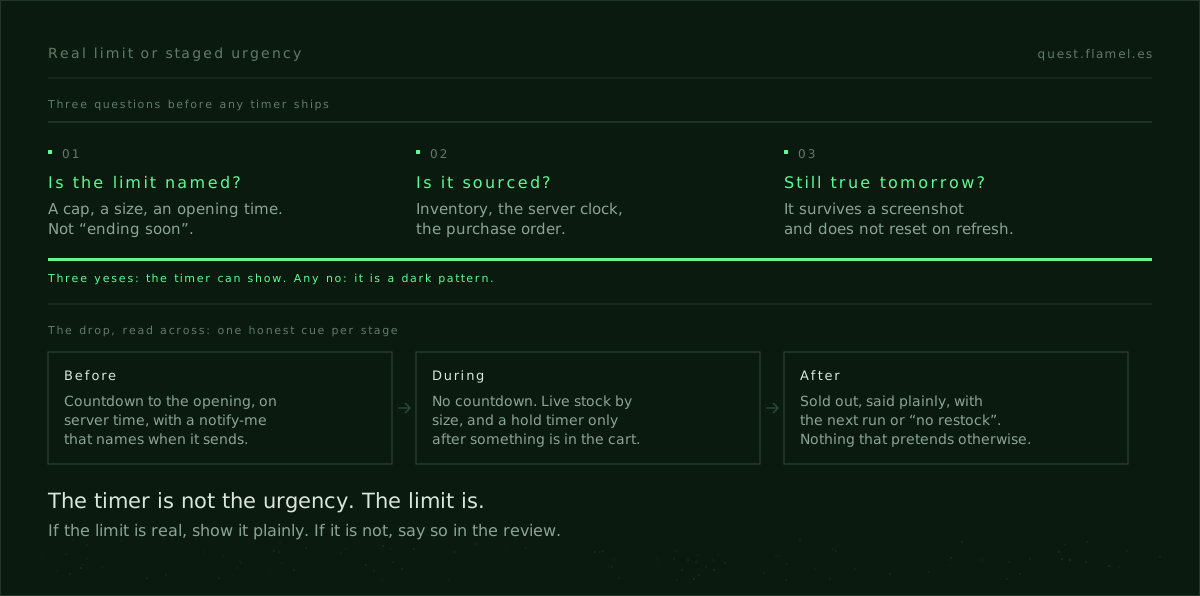
You can draw the line without drama. If the limit is named, sourced, and would survive a screenshot tomorrow, it is real. If the limit depends on your willingness to say so, it is theater. That is why live stock by size beats “limited” badges, named UTC openings beat “ending soon,” and cart holds tied to inventory locks beat site-wide countdowns.
A countdown is honest only if the limit can be named, checked, and will still be true tomorrow.
To sharpen this muscle, pair the bar for truth and placement in the persuasion principles for product designers with the concrete methods in the scarcity skill. The ethics line is set in dark patterns vs persuasive design: urgency without a verifiable constraint is not persuasion; it is a lie.
The drop is a ritual, not a banner
A drop is a sequence with a before, a during and an after, and what moves people is anticipation paired with control.
Before the drop: pre-announce with a clear time window, proof of the limit, and a “notify me” that names send time and timezone. During the drop: a server-sourced clock and live stock by size. After: a sold-out state with a waitlist that names the next run or the archive.
Control looks like a cart hold with a visible, short countdown that matches your inventory lock policy. Timing is a named UTC open that arrives when you said it would. Trust is built with sourced lines: the stock is deadstock, the cap is tied to a purchase order, and the clock is synced to the server.
If you want social proof, make it specific, fresh, and secondary to the limit. Ground it like the analysis in the Airbnb social proof teardown: use recent, precise signals that help the decision, not a generic crowd chant.
Case: Halfwild deadstock — 200 units, real cap
Halfwild has 200 units of true deadstock across sizes, with no restock because the fabric run is gone. The honest limited-drop landing page names the cap and shows the split by size straight from the inventory system (for example “S: 23, M: 54, L: 71, XL: 52”), updated live. The countdown exists only where time is the constraint, not as a floating scare line for browsing.
Define the metric that matters. It is not “traffic”; it is “sell-through curve to 80% inside 24 hours, refund rate at or below baseline, and ‘timer scam’ tickets under a small threshold.” That framing protects you from vanity wins and keeps trust in scope.
The before state gets a pre-announce with a server-time countdown to the opening moment, a one-line proof of finality, and a “notify me” that promises a specific send: “Email at 17:55 UTC, five minutes before open.” The during state replaces the countdown with live stock by size, shows a cart-hold timer only after a size is in cart, and labels it “5:00 hold to complete checkout,” tied to the lock.
Make claims checkable or skip them, especially with “deadstock.” Drop a compact proof module: a photo of original roll tags, a dated line from your production log, and a pointer to the cap’s source. If you add social proof, keep it modest and current, aligned with the social proof skill, and never let it crowd out the limit.

Placement that makes the limit legible
Place proof, opening time or stock cap, the primary action, and the undo line in one frame so the decision is legible, timed, and safe. The pre-open countdown sits in the hero with a UTC label, a “notify me at 17:55 UTC” secondary action, and an undo beside it: “You can unsubscribe anytime.” Put the check at the moment of commitment, not in the footer.
When the store opens, remove the countdown and swap the frame to a size picker with live stock and the “Add to cart” in reach. Add a clipped line for the cap and its source so the limit remains visible as context without stealing focus. Keep your proof above the fold but subordinate to the CTA and limit: brief, sourced, and linked to a longer appendix.
Cart holds, if you use them, should appear only after an item enters the cart and should use server time, not the client clock. Label them clearly: “5:00 hold; your cart will release when the timer ends.” Pair the timer with a small “Need more time?” explainer that tells users how to re-add if stock remains. To rehearse this on a real brief before your next drop, try the sample brief.
Measure lift and regret like a scientist
Instrument lift and regret together so your win is real and your ethics stay clean. For lift, track notify-me sign-ups per visitor pre-drop, open-to-click on the notify, add-to-cart per product view at open, and sell-through by hour, segmented by size. For regret, track support tickets that mention “timer” or “fake countdown,” cart drop-offs during hold, refunds inside seven days, and “not as described” flags if deadstock claims are questioned. Regret is the bill urgency sends: measure it as carefully as lift.
Write the hypothesis and the stop-loss before you draw. Example: “Showing server-sourced opening time with UTC, then swapping to live stock by size at open, will raise add-to-cart per view by 20% with refund rate flat and ‘timer’ complaints under 0.5% of orders.” Stop-loss: “If refunds rise by 1 point or ‘timer’ tickets exceed 0.5% in 72 hours, remove the cart timer and keep stock-by-size only.”
The line in review: refuse fake countdowns
You will be asked to add a countdown to “increase urgency” when inventory is not constrained or the date is soft. Say this, and say it early: “We should not ship a countdown unless the limit is real and checkable in the frame; otherwise it is a dark pattern and will backfire on refunds and trust.” Then offer the honest alternatives: “If we need urgency, we can name the next production date, show live stock by size, or timebox a cart hold tied to inventory locks.” That turns a no into a plan. When pushback comes, add a pragmatic frame: “A fake clock may spike adds today but will raise unsubscribes, ‘timer’ tickets, and refunds; we will trigger our stop-loss and roll back. If we ship live stock and a UTC open, we get durable urgency and can point to a screenshot tomorrow.” You are not blocking speed; you are buying compounding trust.
Ship this week: from brief to drop
Start with a one-page brief that names the number, timeframe, population, and failing moment: “Add-to-cart per product view at open, first 72 hours, visitors on the limited-drop landing page.” Pick the lever that fits the break — anticipation and control — and write the mechanism you will ship: server-sourced opening time, live stock by size, and a short, honest cart hold. Define the ritual. Pre-announce with UTC time and a short proof line; provide a “notify me” that names the send time and the undo. At open, remove the countdown and surface live stock by size with the add-to-cart tight to the picker. If you use a hold, show the timer only post-add, tied to inventory locks. When sold out, switch to an archive with the next window or “no restock.”
Instrument lift and regret on day one, write the hypothesis and stop-loss, and set a rollback you will honor. If regret spikes, remove the countdown first and keep urgency via stock-by-size; if “deadstock” is questioned, strengthen proof before adding any pressure. Read the curve: widen reach only when regret is flat and the mechanism is clean. If you extend the window, say why and show the new cap and date, or do not extend at all. For a template that forces the discipline (the number, the lever, the placement and the stop-loss), use the sample brief.
Practise the ritual, place the check at the action, and measure regret so false wins die fast. Your edge is not the timer; it is picking the moment, choosing the mechanism, and defending why it works.
Role: You are a senior product designer acting as the drop lead and ethics guardrail. I will give you context: [describe the product, the true cap or absence of it, size split, timezone, inventory system, cart lock policy in minutes, proof sources, and stakeholders]. Produce a one-page plan that includes: 1) a brief with number, timeframe, population, and failing moment; 2) the before/during/after ritual; 3) the in-frame placement (pre-open and at open) with exact copy; 4) a proof module checklist; 5) the cart-hold timer rules and labels; 6) the “line in review” to refuse fake urgency and offer honest alternatives; 7) a measurement plan with hypothesis, lift and regret metrics, thresholds, and a stop-loss/rollback. Constraints: countdown only where time is the real constraint; server-sourced time only; live stock by size; cart-hold timer appears only post-add and matches the inventory lock; all claims are specific and checkable; proof sits near the CTA without crowding it; measure sell-through and regret together; name UTC in all time copy.
Frequently asked questions
How do I justify a countdown timer to my PM without faking urgency?
State the rule and the risk. “Ship a countdown only if the limit is real, checkable, and survives a screenshot tomorrow; otherwise it’s a dark pattern that drives refunds and tickets.” Offer honest substitutes: name the next production date, show live stock by size, or timebox a cart hold tied to locks. For ethics framing, point to https://quest.flamel.es/blog/dark-patterns-vs-persuasive-design.
What exactly should be on the page at T-minus and at open?
Pre-open: hero with a server-sourced countdown labeled in UTC, a “notify me at [time] UTC” secondary action with an undo, and a one-line proof of the cap. At open: remove the countdown, show a size picker with live stock by size, tight “Add to cart,” a clipped line naming the cap and source, and proof above the fold but secondary to the action.
How long should a cart hold be and how do I enforce it?
Keep it short and real: 3–10 minutes, matching your inventory lock. Source the timer from the server, show it only after add-to-cart, and release the item on expiry. Label clearly: “5:00 hold; your cart will release when the timer ends,” plus a small “Need more time?” that explains re-adding if stock remains. Track hold drop-offs and “timer” tickets to tune it. See methods in https://quest.flamel.es/skills/scarcity.
How do I know the timer helped and not hurt?
Write a hypothesis and thresholds up front, then pair lift with regret. Track notify-me per visitor, open-to-click, add-to-cart per view at open, and sell-through by hour; watch refunds in 7 days, “timer” tickets, and cart drop-offs during holds. Set a stop-loss (e.g., refunds +1 point or tickets >0.5%), and roll back the timer first if tripped. Use https://quest.flamel.es/sample-brief to force the structure.
What proof convinces users the cap is real?
Show a compact, sourced module: a photo of original roll tags or batch IDs, a dated line from your production or PO log, and a pointer to the cap’s source (e.g., deadstock, PO quantity). Keep it brief, near the CTA, and link to a longer appendix if needed. If you add social proof, keep it recent and secondary; see https://quest.flamel.es/blog/airbnb-social-proof-teardown and https://quest.flamel.es/skills/social_proof.





