

Every design ladder used to be readable even where nobody had written it down. You could look at three people's weeks and rank them without asking anyone. One produced screens. One produced more screens, faster and cleaner. One produced a great many and unblocked everybody else while doing it. Almost no team defended that ladder out loud, and almost everybody climbed it.
That ladder is gone. It did not go because someone sat down and redesigned it, and it did not go because titles were inflated. It went because the thing it measured — volume of competent output — stopped being scarce. What is left is the ladder that was always underneath the first one: how far your decisions reach, and who answers for them afterwards. That is what the phrase senior product designer skills now describes, and it is not the inventory most people are carrying into their next review.
The old rungs measured production, and production got cheap
Look at what each old rung actually rewarded. Junior meant you could produce a screen that held together. Mid meant you could produce many of them, quickly, at a consistent finish, without someone checking the spacing. Senior meant you produced at that level and had enough left over to unblock other people's work.
Every one of those is a throughput measure with a quality floor attached. That was a perfectly reasonable thing to measure while producing a competent screen took a day, because throughput was a decent proxy for judgement. Someone who could turn out forty good screens had, somewhere along the way, learned why screens fail.
The proxy broke when the day became a sentence. It is not that the models produce better screens than a mid-level designer. It is that they produce adequate ones instantly, in fives, and the gap between adequate and good is now the entire argument rather than a rounding error. That is the same shift that makes people ask whether the job is still worth having at all, and the ladder is where the question gets concrete.
Mid vs senior designer, restated
Here is the restatement that survives the shift, and it is shorter than the old one.
A mid-level designer executes a problem somebody else framed, and executes it well. The frame arrives from outside — a brief, a PM, a strategy deck — and the work is to deliver against a criterion that was stated rather than chosen. That is real work and it is not a lesser kind of work. It is where craft is built, and no amount of tooling produces it by itself.
A senior designer decides which problem is worth solving, names the criterion the work will be judged against, and answers for that choice out loud when the number moves. Not "has more experience". Not "makes prettier things". Decides, names, answers.
The clean test between the two takes one question: when the direction turns out to be wrong, whose call was it? If the honest answer is that you delivered exactly what was asked, you were doing mid-level work, however senior the output looked. If the answer is that it was your read of the problem, you were doing senior work, whatever your title said that quarter.

Senior product designer skills are not a longer list of tools
The list that gets circulated as senior product designer skills is usually a longer inventory of the same category: more tools, more systems, more platforms, a prototyping library, a bit of code. Those are worth having and none of them separate the rungs any more, because a tool inventory is exactly the sort of thing that gets cheaper every quarter.
What separates them is a different category of skill entirely. Choosing which metric the work is meant to move, when three plausible metrics are available and the choice sets the whole quarter. Hearing the constraint underneath what a stakeholder actually said, since half of every request is a proposed solution wearing the costume of a requirement. Deciding what not to build, which is subtraction and is the least visible work there is. Being able to say why, in a room, on the day it goes wrong.
Those hold their value as the models improve, and the reason is structural rather than hopeful: they are decisions somebody has to be accountable for, and accountability cannot be delegated to a system that cannot be held to it. It is worth being precise about which skills actually appreciate as the tools get better, because the appreciating ones and the fashionable ones are not the same list.
The rung that disappeared, and what replaced the path
The uncomfortable part of this is not at the top. It is that the bottom rung was the training ground. You became a mid by producing volume, and somewhere inside that volume you learned which patterns fail and why. That apprenticeship was accidental, and it worked because there was no way to get the output without doing the reps.
There is now a way to get the output without doing the reps, which means the learning has to be made deliberate or it does not happen. A 30-day plan for practicing design decisions gives that work a daily structure. The replacement is not more screens. It is producing decisions with the reasoning attached: for each piece of work, the problem you decided it was, the criterion you chose, the alternative you rejected and the reason you rejected it.
That is also what turns a portfolio from a gallery into evidence. Most case studies still narrate a process and show a result, which is a claim about volume and finish — the old ladder, on a page. The ones that work now show the decision and its defence, and that difference is most of what separates a portfolio that gets a reply from one that does not. It is worth reading against what a case study is actually being assessed for before rewriting yours.
How to get promoted when the ladder changed underneath you
Practically, the move is to change what you bring to the review. Not a bigger volume of work, and not a demonstration that you are faster than you were: those now read as a claim you cannot win, because something in the building is faster.
Bring the decisions instead. Three pieces of work where you can name the problem you chose to solve, why the obvious framing was wrong, what you deliberately did not build, and what you expected the number to do. That is a case for decision scope, and decision scope is what the word senior now means.
It also has to be argued, not merely held, which is a distinct skill and a trainable one — the difference between having authority and being able to demonstrate it is most of what makes a good argument land in a room full of people who outrank you.
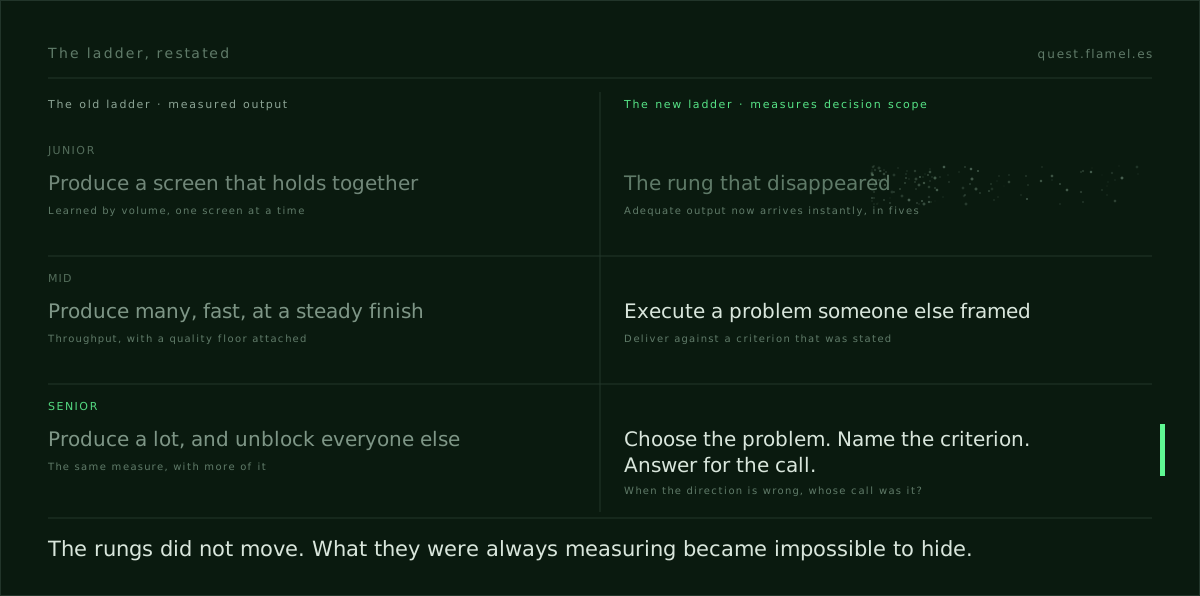
Design career progression in 2026 is not a harder version of the same climb. It is the same climb with the bottom step removed and the measurement made honest, which is worse news for anyone whose reputation rests on throughput and better news for anyone who has been making the calls without the title.
The practical question is where the evidence comes from, since you cannot show decision scope with screens alone. It comes from work you can explain: see what that looks like when the reasoning is published alongside the result.