

Key takeaways
- Reviewers buy decisions under constraint; ornament without a priced, reversible bet reads as filler.
- They scan for a choice, a stop-loss, a success metric, a read window, and a lever tied to the moment.
- You can stay credible under NDA by tokenizing entities, indexing numbers, using wireframes, and keeping the lever, MDC, check, and read window intact.
- Rewrite your opener into a reversible bet with a bound; add constraint, MDC, read window, mechanism-by-moment, and receipts with baseline, events, isolation, and indexed deltas.
Six UX case study mistakes show up in the first minute: no decision in the opener, no constraint or stop‑loss, no mechanism or lever, no receipts, no reversible path, and a model‑scented voice. If your opener cannot be reconstructed into a reversible bet, you are shipping ornament, not authorship. That is why “my portfolio got rejected” threads exist.
What reviewers notice in the first minute
Reviewers read for a choice framed to a constraint, a stop‑loss that prices risk, a success metric that bites, and a read window that can settle a fork. They also look for mechanism and moment: why this lever for this population now. Everything else is garnish. If they cannot see that spine on scan, they assume filler and move on.
Reviewers buy decisions under constraint, not decorated timelines.
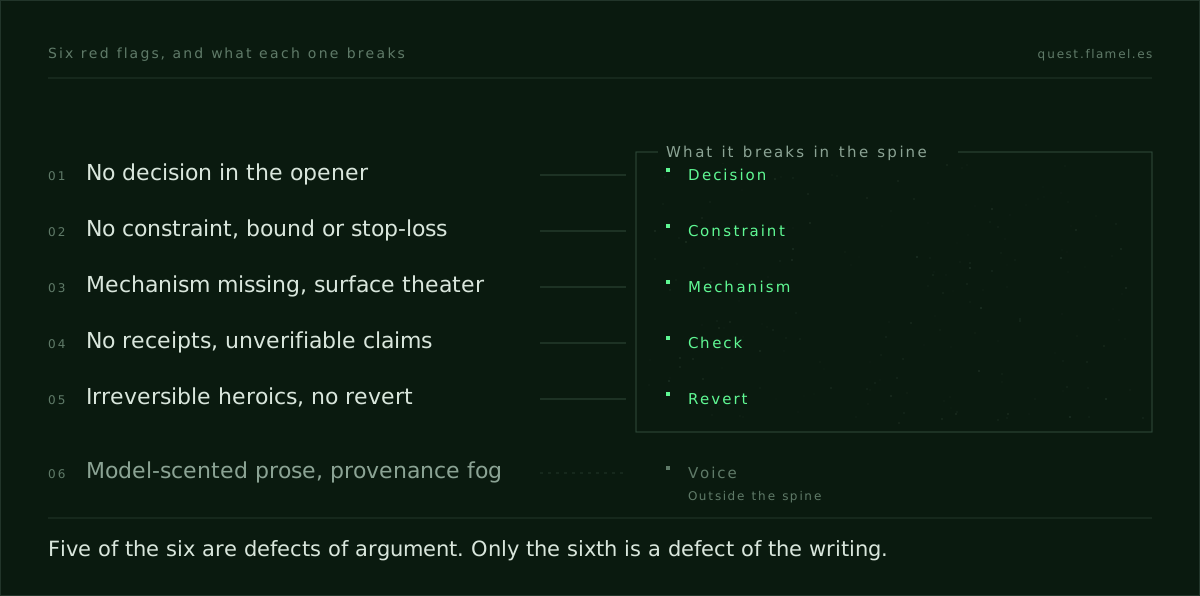
Six red flags reviewers spot fast
Red flag 1: No decision in the opener. “Redesigned onboarding to improve activation” is a vibe, not a choice. A defensible opener reads like a reversible bet: “Ship recognition‑first at compare for first‑time visitors under a 14‑day stop‑loss; success is +10% plan selections on mobile; else revert.”
Red flag 2: No constraint, bound, or stop‑loss. A case with unlimited real estate, time, or traffic is fantasy, and reviewers know it. Name the limit that actually priced your choices: latency budget, single‑scroll envelope, channel lock, calendar pressure, or thin samples. State a stop‑loss you would honor and the MDC that makes the risk local. Without a bound, you posture; with it, you manage exposure.
Red flag 3: Mechanism missing; surface theater. If your rationale is “cleaner UI” and “modern feel,” you are selling taste, not behavior. Replace aesthetics with mechanism tied to moment: reduce extraneous cognitive load at the decision gate, use pre‑attentive contrast on plan differentials, lower recall burden by prefilling known fields. Show why this lever should move this population now. That posture survives redaction and makes visual polish secondary.
Red flag 4: No receipts; unverifiable claims. “Engagement increased” without a baseline, events, and an isolation tactic earns a hard pass. Publish the inherited baseline, the exact events you instrumented, and how you kept the read clean: gates, holdouts, or routing. Use indexed deltas, direction, effect size, and the read window; not raw revenue. Study the concise, falsifiable structures in UX case study examples and copy the spine, not the shine.
Red flag 5: Irreversible heroics; no revert. A win that only comes in one flavor and requires a quarter to undo is risk theater. Price a reversible bet: define the revert trigger, prewrite the revert path, and make the bet local to the mechanism you are testing. “If mobile CTR drops −5% within seven days or power misses p≈0.8 by day 10, revert to control” reads as operational maturity. Reversible reads as senior; irreversible reads as cosplay.
Red flag 6: Model‑scented prose and provenance fog. Since 2026, reviewers spot model voice in seconds: generic superlatives, even cadence, and no local nouns like MDC, read window, or stop‑loss. If AI helped, say how: AI did variant expansion, copy optioning, harmonization, and alt‑text; you framed the decision, chose the lever, priced the bound, and named the revert. Mark what was generated and what you edited. Authorship is the asset; AI is the instrument.

Mechanism and moment beat ornament, even under NDA
You can show judgment without logos or dashboards. Tokenize entities, index sensitive numbers, and swap screenshots for wireframes that preserve flow and gates. Keep the lever, the check, the MDC, and the read window intact so a reviewer can still price the risk. If you cannot preserve behavior truthfully, skip the gallery and strengthen the receipts; that earns more trust than a pretty blur.
Fix it in one pass
Rewrite your opener into a reversible bet with a bound and a success check; keep it under two sentences. Add the constraint that actually priced your options and state MDC and read window. Tie your choice to a behavior mechanism at the exact moment you exercise it. Attach receipts: baseline, events, isolation, and indexed deltas within the declared window. If you need a sturdier scaffold, follow the sequence in Prove the judgment was yours so that decision, constraint, mechanism, check, and revert carry on scan.
Make authorship provable
Credit teammates for exploration and execution while claiming the frame, the lever, the bound, and the revert you owned. Place receipts beside claims, not in an appendix, and keep the argument falsifiable and reversible. Four 60‑minute redesigns with their decisions left visible sit in the showcase. That is what travels in rooms when the screen is off.
The deeper skill
AI executes; it does not decide why. What endures in loops is trained product psychology, defensible UX/CX judgment under constraint, and the ability to direct AI without ceding authorship. Practice by writing one one‑page decision memo this week with a priced, reversible bet, stitched receipts, and sanitized surfaces. Train that muscle with the patterns in Authority Skills, and your case will read as leadership, not filler. It is also the muscle the panel reaches for, because the same spine is what product design interviews actually test.
Role: Act as a senior UX reviewer. Turn my situation into a reversible bet opener and stitched receipts that read as accountable authorship.

My inputs: [describe the design decision], [target population], [moment in the journey], [constraint/bound], [stop-loss], [baseline metrics], [target success metric and threshold], [MDC], [read window], [traffic/sample context], [events you can instrument], [isolation tactic], [revert trigger], [revert path], [NDA redactions to apply].

Produce exactly:
1) A two-sentence reversible bet opener.
2) Three bullets on mechanism tied to the moment.
3) A receipts block: inherited baseline, exact events, isolation, indexed deltas, read window, power note.
4) A revert plan with trigger and operational steps.
5) An NDA sanitization note keeping lever, MDC, checks, and gates intact.

Constraints: Be concrete. Name the bound, stop-loss, MDC, read window, and population. Localize risk to the tested mechanism. Use indexed deltas, not raw revenue. Avoid generic adjectives. Mark any AI-generated parts.
Frequently asked questions
What is a reversible bet in a UX case study?
A reversible bet is a two-sentence opener that frames one concrete decision under a named constraint, with a stop-loss, success metric, read window, MDC, and a prewritten revert path. It localizes risk to the mechanism you are testing and states the trigger that returns you to control. It lets reviewers price exposure fast and read authorship, not ornament. For a scaffold, follow the sequence in Prove the judgement was yours.
What does MDC mean in case studies?
MDC is the minimum detectable change you commit to observe with power inside your read window. It turns vague hopes into a priced threshold, shapes sample needs, and bounds risk. You declare it upfront so a reviewer can see what effect size you considered material and what shortfall would trigger a revert. Pair MDC with a stop-loss to keep the bet local and reversible.
How do I show receipts if metrics are confidential?
Tokenize entities, index sensitive numbers, and replace dashboards with wireframes that preserve flow and gates. Publish the inherited baseline, the exact events you instrumented, your isolation tactic, and indexed deltas within a declared read window. Avoid raw revenue or logos. Preserve the lever, MDC, and checks so behavior remains falsifiable. For concise reference shapes you can copy, see the examples in UX case study examples.
When should I set the read window and stop-loss?
Set the read window to the minimum period needed to reach power on your MDC, given traffic and seasonality; for high-traffic funnels, 7–14 days is common; for low-traffic, 21–42 days. Choose a stop-loss that caps downside locally (e.g., −5% CTR or p≈0.8 missed by day 10) and define the revert action. Tie both to your gating moment so the bet is testable and reversible.
What is model-scented voice and how do I avoid it?
Model-scented voice reads like generic, cadence-stable prose with superlatives and no local nouns; it dodges constraints, mechanisms, and checks. To avoid it, name your bound, stop-loss, MDC, read window, and lever-by-moment in concrete terms, and mark what AI generated versus what you authored. Keep receipts beside claims. Train the underlying judgment with the patterns in Authority Skills.





