

Key takeaways
- In 2026, a product design interview buys priced judgment under constraint, not surfaces or taste.
- Panels test if you can name a gate, pick a lever, bind blast radius, and state mechanism, metric with bite, read window, stop‑loss, MDC, and revert.
- Execution is cheap; your readiness reads in product psychology, defendable UX judgment under constraints, and the ability to direct AI, not race it.
- Train by shipping weekly reversible bets with constraints, instrument exact events and isolation, timebox to 60 minutes, publish indexed deltas, and rehearse the oral defense with receipts.
In the 2026 product design interview, the room no longer asks whether you can push pixels; it asks whether you can price a decision under constraint and defend the why under a loupe. The portfolio review has become an oral exam: if you cannot stand up your own bet, under real bounds, you fail on the scan. Interviewers do not buy surfaces; they buy judgment that survives a constraint. They strip your slides to the mechanism and check whether you can name a moment, bind exposure, and state the revert. A screen without a gate reads as theater because the choice is unpriceable. If your story is vibes with no stop‑loss, the why collapses and your work dies in translation across rooms.
The shift: execution got cheap; judgment did not
AI can match a brand surface in minutes and remix patterns faster than a human can write a spec, so looks cannot differentiate you at interview speed. What still reads as senior is a priced bet under a constraint: mechanism, bound, metric with bite, read window, and a stop‑loss you will honor. If you cannot name the lever tied to behavior at a gate, your answer cannot be priced. The work that travels is local, observable, and reversible.
The format changed because execution is free at the margin and decision quality is not. The process concentrates risk into a small moment and asks whether you can localize it. That means pricing your exposure, showing your read window, and pointing to the lever you chose, not to a deck. When you can do that, the room can scan your authorship under redaction and still see the spine.
Without a mechanism and a revert, your case lives or dies on taste, which is unscorable against business risk. The interviewer wants to know if your call will crater a lever or move it within a budget, not whether you prefer a darker shade. That is why generic before/after patterns get parked and receipts get read. The line is simple: the screen is free; the decision is not.
What interviewers actually test now
What reads as readiness is not finesse in Figma; it is your ability to diagnose a behavior, name a gate, and choose a lever you can isolate. You are measured on three things that still cost: product psychology and behavior design, defendable UX/CX judgment under constraint, and the skill to direct AI rather than race it. If your answer shows those three, the rest is details. If it does not, the room has no purchase to trust you.
Concretely, interviewers test whether you can turn an ambiguous brief into a priced, reversible bet that protects the downside and powers the upside. Your language should carry constraints, not cravings: “under a 200ms latency budget,” “within a single‑scroll envelope,” “revert on CTR −5% vs holdout.” You must name your MDC sized to traffic so power is not hand‑waved. If you keep this spine visible, your seniority reads on scan.
The oral exam inside the portfolio review
Expect the panel to push past your montage and pin you to a moment: Which gate were you moving, what lever did you pick, and how did you bind the blast radius? If your case cannot survive those three, the rest of the deck is mood. The check is brutal and fair: could we give you a lever on Monday and trust your revert on Friday? You will be asked to defend a decision, not a taste, so carry the chain of custody from baseline to delta.
“What were the inherited constraints?” “What did you instrument, exactly?” “How did you isolate the effect?” If you have not rehearsed the receipts, study how to prepare and deliver them in the cadence of how to defend a design decision.

A concrete interview moment that counts
A candidate who reads as ready says, “Ship recognition‑first plan compare for first‑time mobile visitors at the paywall gate under a single‑scroll envelope and 200ms latency budget. Success is +10% plan selections with MDC 6% within 14 days; stop‑loss −5% vs holdout; revert to prior compare if miss or variance spikes.” That is a two‑sentence bet with a revert, not a collage.
It is legible under NDA, prices exposure, and declares a read window proportional to traffic. It calls its lever, ties it to behavior at a gate, and keeps the blast radius small. The interviewer can scan the mechanism, the check, and the stop, not just admire flourishes. That is a bet we can staff and a miss we can survive. In 2026, the interview is a priced bet, not a paint test.
What to train and how to measure it
You can train this spine quickly if you practice under a clock, not in a vacuum, and measure what you claim to improve. Side projects that lack a mechanism or a revert will not teach the reflexes you need in the room. To make your reps count, fold your week around reversible bets that are local to a lever and priced to your traffic, then publish the receipts you would defend live.
- Frame one reversible bet per week with a named gate, constraint, stop‑loss, MDC sized to your traffic, and a read window; prewrite the revert and keep the lever local so rollback is cheap and honorable.
- Instrument exact events with IDs and parameters, and choose an isolation tactic—tight gate, holdout, or routing—that lets your read survive variance without attributing magic to vibes.
- Drill the authority muscle by practicing aloud with a small panel; use the scaffolds in UX case study examples that travel, and train the tone and structure in the Authority skill.
- Run a live, timeboxed brief and publish indexed deltas beside claims using a free sample brief with business context; keep absolute numbers redacted and deltas auditable.
Mid‑cycle, swap one deck review for a timed rehearsal that mirrors the panel’s constraints and interrupts. This is where you’ll learn the cut that matters: omit ornaments, keep the lever and the check first, and speak in a register that carries across roles. If you can land that, your seniority reads before your visuals do. If you cannot, the interview will flush you to taste talk and the panel will move on. Use the 60-minute design take-home rehearsal to practice a flow and a short decision note together.
How to answer beyond the checklist
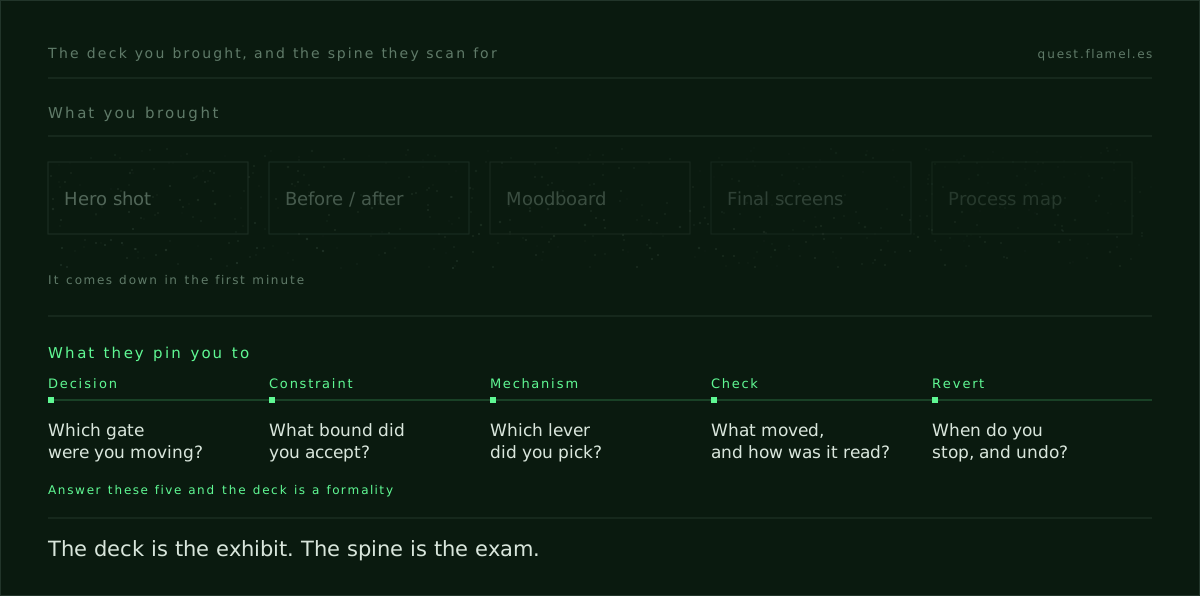
Memorizing “ux design interview questions” will not carry you in 2026; answering with a priced mechanism will. Translate prompts into bets: “Given churn on upgrade, name the gate and propose a lever under our policy and latency budgets; set success, MDC, stop‑loss, and a read window we can power.” Then own the revert and the receipts, not just the rationale. Map your answer to a skeleton the panel can trust: decision, constraint, mechanism, check, and revert.
Use verbs that bind behavior and nouns that bind risk, not adjectives that soothe anxieties. Keep local what you can measure, and reversible what you cannot afford to miss on. Tie each UI move to the lever you claim and pre‑declare the stop‑loss you will honor. If you need a scaffold to keep the shape under pressure, rehearse until the cadence lands in two minutes without slides and the mechanism survives cross‑exam.
Practice under a clock; your next step this week
You will not learn to price exposure by polishing Figma; you learn it by making small, reversible bets you can ship, read, and rescind. Timebox to a 60‑minute design challenge, name your gate, and write the two‑sentence bet before you touch layout. Bind the blast radius to the lever you chose and prewrite the revert you will honor. Then you have a case, not a concept.
Replace one gallery slot with a live, priced brief and defend it out loud. Pick a gate, draft a two‑sentence reversible bet with constraints, MDC, stop‑loss, read window, and revert, and ship it with stitched receipts: inherited baseline, exact events and IDs, isolation tactic, indexed deltas, and a power note. Treat the publish as your interview and keep your claims local, observable, and reversible so they travel across roles and survive redaction.
If you have never articulated your level in this language, compare your cadence to the signals in the new design seniority ladder. You will see the same spine: local decisions with receipts, not global claims with vibes. That is how you will read as ready in 2026—through owned judgment under constraint, not tool virtuosity.
You are a senior product design interviewer in 2026. Ask me clarifying questions, then produce a priced, local, reversible bet I can defend live. My context: [describe the product and audience], [name the gate], [business goal], [traffic volume], [inherited constraints: latency/policy], [baseline], [available telemetry], [risk budget]. Output: 1) A two‑sentence bet naming mechanism, bound, metric with bite, MDC sized to my traffic, read window, stop‑loss, and revert. 2) A tight memo with sections: decision, constraints, mechanism, check, revert. 3) An instrumentation plan with exact event names/IDs, parameters, and a routing/holdout/tight‑gate isolation tactic. 4) MDC and read‑window math notes using my traffic, plus a power note. 5) A two‑minute oral defense script and six cross‑exam Q&As that cite receipts, not taste. Constraints: keep the lever local, the blast radius bounded, claims indexed to baseline vs holdout, and language concrete. Use verbs that bind behavior and nouns that bind risk. No mood boards. No adjectives without a check.
Frequently asked questions
How do I pick the right gate and lever for my product?
Map the funnel and choose the smallest measurable decision point tied to the goal (signup, paywall, upgrade, first run). Pick a lever that directly changes behavior at that gate: ordering, default, route, friction, or copy. Confirm isolation is possible, state latency and policy bounds, and bind blast radius with scope or a toggle. Prewrite stop‑loss and revert. For scaffolds that travel, see https://quest.flamel.es/blog/ux-case-study-examples.
What if my traffic is low—how do I size MDC and the read window?
Localize further to a tighter gate, or pick a lever with a bigger expected effect so MDC is reachable. Extend the read window to accumulate power, and use a clean holdout or deterministic routing to reduce noise. State MDC as the smallest change worth staffing, not a vanity win. If still underpowered, keep the bet reversible and report a power note with limits and next step.
How do I show receipts under NDA without sharing absolute numbers?
Index deltas and redact absolutes: “+8% plan selections vs holdout” beats raw counts. List exact event IDs and parameters, describe the isolation tactic, include the baseline definition, variance, MDC, and the read window. Attach the revert condition, timestamps, and the constraint budget you honored. For a shareable pattern, adapt a https://quest.flamel.es/sample-brief.
What does a strong two‑sentence bet look like for a product design interview?
Use this spine: “Ship [mechanism] at [gate] under [latency/policy bounds] within a [layout/scroll] envelope. Success is [metric with bite] +X% with MDC Y% in [N‑day] read window; stop‑loss −Z% vs holdout; revert to [prior] if miss or variance spikes.” Keep it local and reversible.
How do I rehearse the oral defense so I don’t slip into taste talk?
Script two minutes that land in this order: decision, constraints, mechanism, check, revert. Speak to gate, lever, events, isolation, MDC, and stop‑loss. Record, cut adjectives, and replace with receipts. Ask a small panel to interrupt with “inherited constraints,” “what did you instrument,” and “how did you isolate.” Drill tone and cadence with https://quest.flamel.es/blog/how-to-defend-a-design-decision and https://quest.flamel.es/skills/authority.





