
Key takeaways
- An NDA hides logos and data, not your judgment; publish the decision, the constraint, the lever, the check, and the revert without brand surfaces.
- Lead a one-page case with the choice, stop-loss, success metric, and window, then mechanism and moment, receipts beside claims, and any sanitized or practice surfaces last.
- Redact by tokenizing entities, indexing sensitive numbers, swapping screenshots for wireframes, stripping copy to roles, and removing unit-economic hints while preserving mechanism and bounds.
- If you cannot share past work, build practice cases with real constraints, MDC and read window, variant bake-off, minimal instrumentation, priced risk, and a prewritten revert.
- Ship one public case this week: write the opener, stitch in receipts, append sanitized or synthetic surfaces, or skip the gallery and publish.
If you typed “ux portfolio nda” this week, you were not hunting for a loophole; you were trying to make judgment legible without breaching trust. You can still show the chain of choices you made under constraint, the lever you pulled, the bound you priced, and the revert you named. If you did not document the decision then, reconstruct the decision now or make a practice case you own end to end.
You are not selling the secret finish; you are selling defensible selection under limit. What survives a hiring loop is your ability to price a bet, name a revert, and show how you cut alternatives. That is showable without leaking a logo or a dashboard.
NDA blocks pixels, not judgment
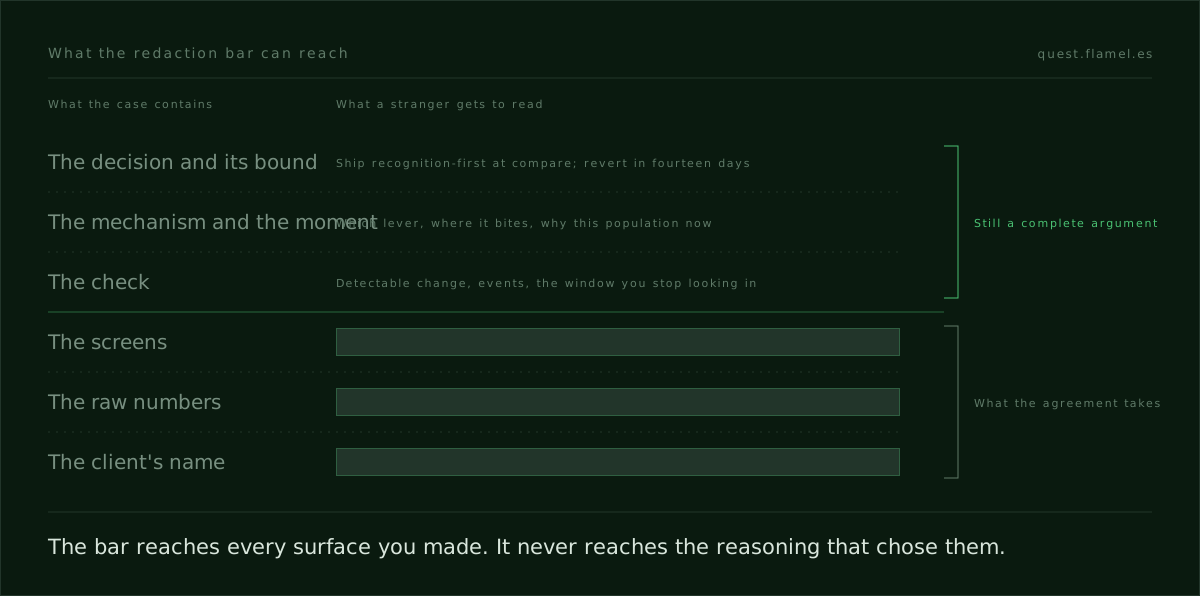
An NDA stops you from publishing brand assets, private data, and internal screenshots; it does not stop you from publishing decisions, constraints, mechanisms, checks, and reverts. The finish is protected; the fingerprint is not. Your job in public is to make causality visible and risk bounded.
Lead with the decision and its stop‑loss, then show the mechanism and the moment, then the receipts, then any sanitized surfaces. “Ship recognition‑first at compare for first‑time visitors under a fourteen‑day stop‑loss; success is +10% plan selections on mobile, else revert.” That opener prices risk without exposing secrets and makes your authorship reconstructible even if the gallery is generic.
Do not confuse “story” with proof. The market buys decisions that survive constraint. Say what the limit was, what lever you chose, why it should have worked for this population at this moment, and what would have made you undo it.
Publish decisions you can own end to end
If you cannot show the original surfaces, publish the one‑page decision that chose them. Open with the choice, the bound, the success metric, and the window; follow with mechanism and moment; place receipts beside claims; append any redacted or practice surfaces last. This is the same spine as the argument for proving the judgment was yours, and it travels furthest in loops.
If you lack pristine artifacts, declare assumptions, cite ranges, and show how you would stress the same decision today. Credit teammates for exploration and execution while claiming the frame, the lever, the bound, and the revert you owned. Senior reads as unadorned causality under constraint.
If you need reference shapes to strip ornament and keep machinery, browse a few curated UX case study examples and mirror the sequence, not the sheen. The structures that carry in rooms are short, falsifiable, and reversible.
Redact surfaces; preserve mechanism and bounds
Redaction is not vagueness; it is targeted anonymization that preserves mechanism, behavior, and price while removing brand entropy. Replace concrete nouns with role nouns, convert prices and metrics to indexed deltas, and draw system diagrams that show flow and decision gates without proprietary labels. Your reviewer should be able to price the risk even if they cannot see the logo or the pixel.
Use a redaction checklist you can defend in a room and in legal. Remove branded images, private identifiers, and any values that imply unit economics; keep the lever, the read window, and the MDC intact. Annotate any surface you show with why this shape exercises the lever, not with brand‑flavored copy. If you cannot preserve behavior truthfully, skip the gallery and strengthen your receipts.
- Tokenize entities: “Plan A/B/C” instead of named tiers; “Segment 1/2” instead of markets. Show relative differences, not brand identity.
- Index sensitive numbers: “+12% vs baseline” and “p≈0.85 in fourteen days,” not revenue or raw counts. Preserve direction, effect size, and read window.
- Replace screenshots with line‑level wireframes that show groupings, contrast, and affordances by role. Keep interaction logic; drop imagery and copy.
- Strip copy to semantic roles: “Benefit chunk,” “Price anchor,” “Error pattern,” and “Decision hint.” Explain why each element carries the lever.
- Remove any data that reveals volumes, cohorts, or campaign timing; keep the check and the window.

Build practice cases that mimic real constraints
If you cannot make a past decision publishable, build one you can own. Pick a public domain, impose a real constraint, and run a small bake‑off with a bound and a revert. Practice cases are not fan art; they are labs for showing mechanism and discipline under a priced limit.
- Choose a common flow with public baselines: plan compare, subscription upgrade, address entry, or password reset. Start where behavior is well studied; stop where behavior is proprietary.
- Impose a constraint that prices your choice set: mobile latency budget, single‑scroll limit, or a marketing calendar. Make the limit explicit and testable.
- State your MDC and read window; compute plausible power with public traffic proxies; declare assumptions. Show how you would know and when you would stop.
- Generate two to three variants with AI under a rubric; choose by mechanism and moment, not surface vibe. Tie each variant to behavior, not taste.
- Instrument a minimal event set in a prototype or analytic sketch; run a micro‑read or sequential heuristic check. Price the risk and prewrite the revert.
Document the fork, the rule that killed losers, and the revert you would run in a live system. Practice cases read as honest when they admit limits. State what is simulated, what is observed, and which claims you would refuse to make without production traffic.
Show AI as instrument, not alibi
AI can flood you with plausible surfaces; it cannot decide which lever is right for this population, at this moment, under this constraint. Make that split explicit so you protect attribution and avoid secrecy theater. “We used AI to explore surface options; the decision here is recognition over novelty at compare under a fourteen‑day stop‑loss.” That line resets scarcity on the decision, not the drawing.
Publish the constraints, acceptance criteria, evaluation rubric, and disqualifiers you used before generation. “Reject anything that adds a new concept above first scroll; favor pre‑attentive contrast on plan differentials; minimize recall burden; mobile‑first.” Then show how you read outputs against behavior. “Variant B improved contrast but taught a new affordance at the gate; C preserved recognition and reduced extraneous load; we chose C.”
List the trench work you handed to AI and the judgment you kept. AI: variant expansion, copy optioning, harmonization, and alt‑text. You: framing the decision, choosing the lever, pricing the bound, and naming the revert. Keep provenance. Note what was generated, what was edited, and what was yours.
Structure, receipts, and attribution survive redaction
Receipts do not require private dashboards; they require baselines, bounds, and checks that rhyme with your mechanism and moment. Publish the baseline behavior you inherited, your MDC, expected power in your read window, the analytics events you instrumented, and the isolation tactic that kept the read clean. Stack sources: prior experiments that rhyme, external benchmarks, and canonical research that defends your lever. Skipping that stack reads as unverifiable, and it is one of six case study red flags reviewers notice in the first minute.
Your read can be sequential and local when samples are thin. Price a small bake‑off with tight triggers and a prewritten revert, and say out loud that the goal is to settle a fork, not to write an academic paper. If you want to sharpen this posture, work through the insight skill and practice short, falsifiable claims.
Legal, ethics, and how to avoid leakage
If your employer’s agreements are strict, treat compliance as a design constraint, not a permission slip to publish nothing. Sanitize any artifact you plan to show, request a quick legal review with a clear diff from the original, and maintain a log of what you removed. Your objective is verifiable mechanism and bounds with zero brand or unit‑economic exposure. When in doubt, delete the pixel and strengthen the memo.
Do not publish raw data, screenshots, user quotes, or timelines that reveal campaign cadence. Do publish tokens, indexed changes, event names you would use anywhere, and reversible checks. Replace brand nouns with roles and flows; replace absolute values with relative deltas; replace UI with neutral schematics. If legal blocks everything, pivot to practice cases and overdeliver on receipts and revert discipline.
Your ethics are part of your signal. A candidate who protects past partners under stress is a safer bet than one who chases glamour. That posture says you can be trusted to move a roadmap in reality, not only to decorate a deck.
Close the loop: ship one public case this week
You do not need permission to publish a decision memo; you need discipline to make it legible and safe. Pick one past project you can sanitize or one practice problem you can own, write a one‑page opener with the decision, the bound, the success metric, and the read window, and stitch in receipts that price the bet. Append sanitized or synthetic surfaces last, or skip the gallery if it would leak.
Ship where hiring managers already read for attribution, not for sheen. Then publish the piece to the Showcase and let your authorship travel without ornament. Recognition is the lever there, and the pride skill explains why being seen at your best moment of judgment beats being seen at your best pixel. In a market where execution is cheap, the designer who can price a lever and undo it fast is rare.
You are a UX hiring-loop coach. Your job: turn my NDA-constrained work into a one-page, falsifiable decision memo plus receipts and a redaction plan. Ask me for: [describe the decision], [state the constraint], [baseline behavior], [MDC], [read window], [traffic proxy], [candidate variants], [revert trigger], [legal posture], [confidential elements], [AI tasks used]. Then produce:
1) Opener (one paragraph): the choice, the lever, the stop-loss, the success metric, the read window, and the revert.
2) Receipts: 3-5 claim–check–window lines, plus baseline, expected power, events, and isolation tactic.
3) Redaction plan: tokens to replace brand nouns, indexed deltas for numbers, wireframe substitutions, and what to omit.
4) AI attribution: what AI generated, what I edited, what judgment I owned.
5) Publish checklist: where to append sanitized or synthetic surfaces, and when to skip the gallery.
Use tokens, indexed deltas, and reversible bets. Price risk. Keep causality visible. No logos. No raw data.
Frequently asked questions
How do I write a portfolio case if I never saved screenshots or metrics?
Reconstruct the decision, not the pixel. State the choice, the constraint, the lever, the success check, the read window, and the revert. Declare assumptions and ranges from public baselines, compute plausible power, and name events and isolation. Use indexed deltas, role nouns, and wireframes. Run a small sequential read or heuristic bake-off now and add those receipts. For structure guidance, see proving the judgment was yours.
What does a reversible bet look like in a case study?
Make the stop-loss explicit and local. Example: “Ship recognition-first at compare for first-time visitors under a 14-day stop-loss; success is +10% plan selections on mobile; else revert to control.” Include MDC, read window, and a revert trigger you would honor in production. Price the bound from the constraint that matters, not vanity targets. Keep the mechanism tied to behavior, not taste.
How do I show results without exposing sensitive numbers?
Drop absolutes; keep direction, effect size, and timing. Use indexed deltas (“+12% vs baseline”), confidence or power cues within a declared read window, and scannable claim–check–window lines. Tokenize tiers and segments, replace screenshots with wireframes, and remove any hints of unit economics or campaign cadence. Preserve mechanism, behaviors, and bounds so a reviewer can still price the risk. If samples are thin, run a sequential read; see the insight skill.
My company bans public artifacts; do practice projects actually convince hiring managers?
Yes, if they mimic real constraints and preserve receipts. Pick a public flow, impose a concrete limit, state MDC and read window, generate variants under a rubric, and write the revert before you “ship.” Instrument a minimal read and publish the memo with indexed deltas and wireframes. This shows priced, reversible judgment. Share it where attribution is read, like the Showcase, and keep the gallery sanitized or omitted.
How do I keep authorship clear when I used AI on the visuals?
Split trench work from judgment. List AI tasks (variant expansion, copy options, harmonization, alt-text) and mark provenance. Claim the frame, the lever, the bound, the success check, and the revert as yours. Explain why chosen variants map to behavior, not vibe, and note what you edited. This makes attribution legible and aligns with the posture in proving the judgment was yours.





